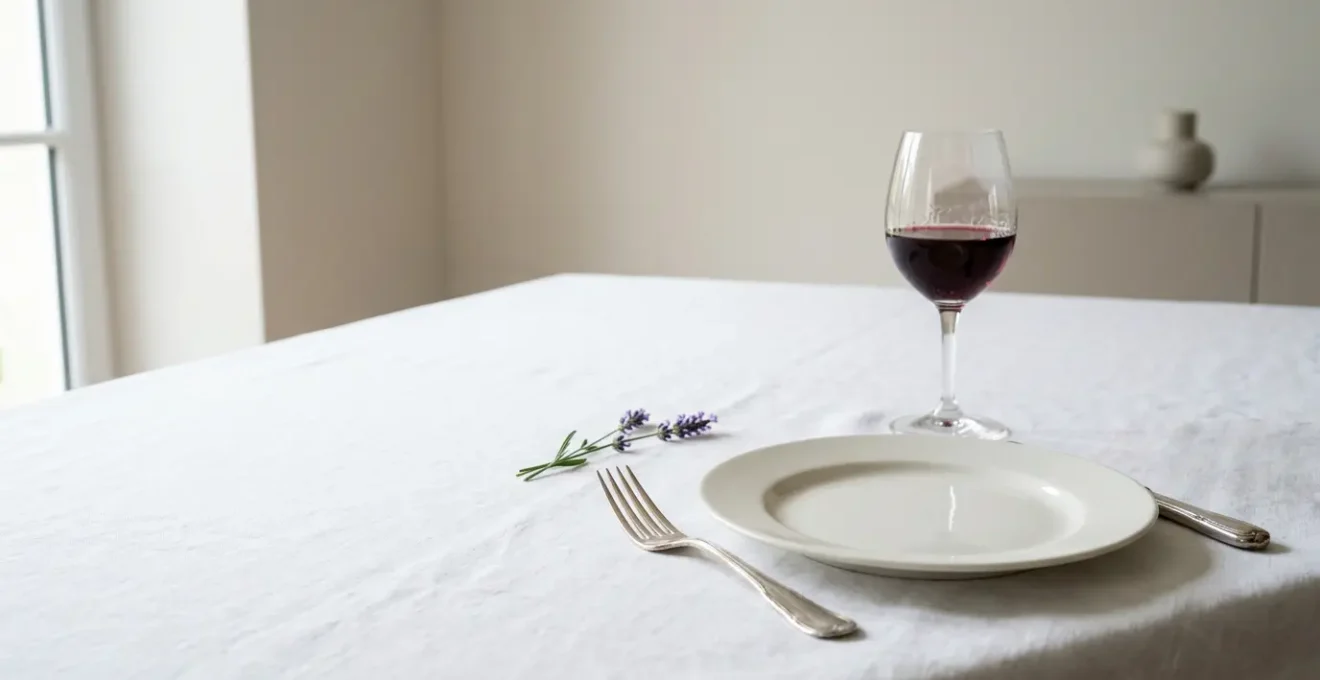
True French table elegance comes not from what you add, but from mastering the invisible principles of space and social context.
- Key differences in cutlery and bread placement are not arbitrary rules, but deeply ingrained cultural signals that communicate respect and tradition.
- Minimalism in this context is not about stark emptiness, but about creating intentional “negative space” that allows each beautiful object to breathe and be appreciated.
Recommendation: Shift your focus from accumulating objects to orchestrating a harmonious “dialogue” between pieces and a comfortable “social choreography” for your guests.
You’ve done everything by the book. You’ve invested in the crisp linen tablecloth, sourced beautiful porcelain, and polished the silver. Yet, as you step back to admire your work, a familiar sense of disappointment sets in. Instead of the effortless elegance you see in French magazines, your table looks… cluttered. Crowded. It feels like a collection of beautiful objects, not a cohesive, inviting scene. This frustration is common for many UK hosts who admire French style but find the execution falls short. The common advice to “use matching plates” or simply “less is more” feels hollow, as it doesn’t address the fundamental disconnect.
The issue isn’t a lack of quality items or a failure to follow a checklist. The problem is that French table setting is less a set of rules and more a philosophy. It’s a language of proportion, space, and social intention. Where British tradition often focuses on a contained, formal presentation on the plate, the French approach treats the entire table surface as a canvas. The secret isn’t in what you place on the table, but in *how* you orchestrate the space between things, and how that arrangement silently guides the social flow of the evening. It’s about creating a visual and emotional harmony that turns a meal into a shared experience.
This guide moves beyond the platitudes to reveal the underlying principles. We will explore the French concept of negative space, decode the cultural signals hidden in a simple fork placement, and understand the social choreography that dictates the rhythm of a true French dinner party. By the end, you will not just have a list of instructions, but a new framework for thinking about your table, transforming it from a cluttered display into a stage for genuine elegance and connection.
To help you master this art, this article breaks down the core concepts into distinct, manageable parts. The following guide will walk you through everything from the philosophy of minimalism to the subtle etiquette mistakes that can instantly break the spell of a perfectly set table.
Summary: Mastering the Art of French Table Presentation
- Why Do French Tables Look More Elegant With Less on Them?
- How to Mix Vintage and Modern French Tableware Without Creating a Jumble?
- Limoges or Haviland: Which French Porcelain Tradition Suits Your Entertaining Style?
- The Place Setting Mistake That Immediately Reveals Your Table as British Rather Than French
- When Should You Visit Drouot or French Brocantes for Best Antique Tableware Selection?
- How to Reference French Romanticism in Your Home Without Looking Like a Period Drama Set?
- The Dinner Party Mistake That Brands British Guests as Impolite in French Homes
- Why Do French People Seem Reserved When You’re Just Being Friendly?
Why Do French Tables Look More Elegant With Less on Them?
The core of French table elegance lies in a principle that is often misunderstood: the mastery of negative space. It’s not about having less for the sake of it; it’s about using emptiness as a deliberate design element to create visual calm and highlight the beauty of each individual object. While a traditional British setting might aim to fill the space neatly, the French approach treats the tablecloth as a wide, open canvas where the arrangement of plates, glasses, and cutlery creates a sense of breathability. This philosophy allows the eye to rest and appreciate the quality of the porcelain or the glint of the crystal without being overwhelmed by information.
This aesthetic is part of a wider cultural shift towards minimalism in interior design. The global market for minimalist furniture, for instance, is projected to grow significantly, indicating a collective desire for uncluttered, intentional living spaces that extends to how we dine. As design experts advise, the key is to embrace negative space and avoid clutter to maintain that clean, uncluttered look. A French table achieves this by ensuring there is ample room around each place setting and that the centerpiece, if any, is proportional and doesn’t compete for attention.
This concept is illustrated perfectly in the image below, where a vast expanse of linen is punctuated by a single, perfectly placed setting. The emptiness is not a void; it is an active component of the design, creating a feeling of luxury and serenity.
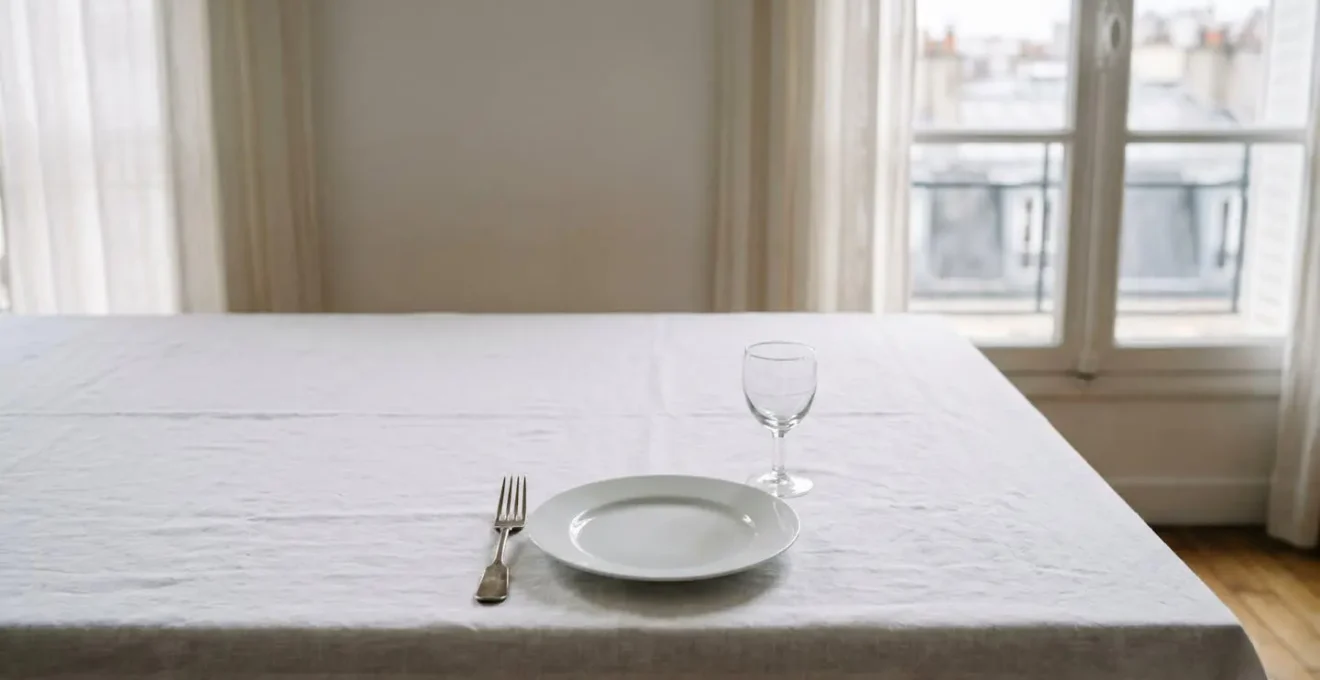
By allowing for this “breathing room,” you elevate the perceived value of what is present. A single, beautiful plate on an open field of white linen makes a more powerful statement than a dozen items crowded together. It’s a declaration of confidence in the quality of your choices and a silent invitation for your guests to slow down and savour the experience. This is the fundamental difference between a table that is merely decorated and one that is truly elegant.
How to Mix Vintage and Modern French Tableware Without Creating a Jumble?
One of the most intimidating yet rewarding aspects of French table styling is the artful mix of old and new. The fear is creating a chaotic, mismatched mess. The reality, when done correctly, is a “material dialogue” that tells a story and adds profound character to your table. The secret isn’t randomness; it’s creating a unifying thread that ties disparate elements together into a harmonious whole. This prevents the table from looking like a jumble from a charity shop and instead gives it a curated, personal feel that is the hallmark of a confident host.
To achieve this balance, focus on establishing a clear visual anchor. This can be achieved through several strategic techniques that create coherence without demanding uniformity. The goal is to make the combination feel intentional, not accidental. Here are the core principles for a successful mix:
- Establish a Unifying Colour Palette: Use a dominant neutral tone like white, cream, or a soft pastel as your base. This allows a modern white plate to sit comfortably alongside a vintage patterned one, as they share a common colour foundation.
- Apply the Material Harmony Rule: Create consistency by repeating materials. If you have vintage silver cutlery, consider modern silver-rimmed glasses or a metal charger plate. Combining wood, metal, or specific ceramic textures across different eras creates a subtle but powerful sense of unity.
- Layer Plates Strategically: Stacking is your best friend. Place a small, ornate vintage dessert plate on top of a larger, minimalist modern dinner plate. This layering creates visual depth and allows each piece to be showcased without competing.
- Maintain Proportional Balance: Be mindful of scale. A very large, heavy vintage tureen can easily overwhelm delicate modern bowls. Ensure that the sizes of your pieces are compatible and that one era doesn’t visually shout over the other.
- Use Vintage Accessories as Accents: If you’re hesitant to mix plates, start small. Introduce a set of antique cutlery, unique napkin rings, or a stunning vintage serving platter. These pieces act as focal points, infusing character into a modern setting without disrupting its core aesthetic.
By following these guidelines, you move from simply placing items on a table to composing a picture. Each piece, whether a flea-market find or a contemporary design piece, contributes to a larger narrative. This thoughtful combination is what elevates a table setting from merely functional to a genuine expression of personal style and hospitality.
Limoges or Haviland: Which French Porcelain Tradition Suits Your Entertaining Style?
Choosing French porcelain can be bewildering, with “Limoges” and “Haviland” often used interchangeably. Understanding their distinction is key to defining your entertaining style. “Limoges” is not a brand; it is a protected designation of origin for hard-paste porcelain produced in or around the city of Limoges, a region renowned for its pure white kaolin clay. For centuries, this exceptional clay has served as a pristine canvas for countless factories and independent artists, resulting in a vast and diverse range of styles, from unadorned white to elaborately decorated pieces.
Choosing “Limoges” means embracing variety and the potential for a curated, eclectic collection. It suits the host who enjoys the thrill of the hunt, mixing and matching pieces from different eras and makers to create a unique tablescape. It is the path of the collector who sees each plate as an individual work of art. The unifying factor is the quality of the porcelain itself, not a specific pattern.
Case Study: Haviland’s Revolution in Complete Services
In 1842, American trader David Haviland transformed the Limoges porcelain industry. He was the first to establish a facility that combined both manufacturing and decorating under one roof, a revolutionary concept at the time. His true innovation was producing complete, harmonious dinner services with cohesive patterns designed specifically for the discerning American market. By introducing chromolithography—a high-quality printing method that replaced laborious hand-painting while maintaining artistic quality—Haviland made elegant, matching dinner sets accessible. This approach established the Haviland brand as synonymous with systematic elegance and tradition, a stark contrast to the broader, more fragmented artistic tradition of the Limoges region. A detailed history from French porcelain historians confirms Haviland’s role in perfecting the decorated dinner service as a complete, harmonious set.
In contrast, choosing “Haviland” means opting for systematic elegance and tradition. Haviland, a specific manufacturer from Limoges, pioneered the concept of the complete, matching dinner service. This is the ideal choice for the host who values harmony, consistency, and the grandeur of a fully coordinated table. A Haviland service communicates a sense of formal tradition and established taste. It removes the guesswork from mixing and matching, offering a turnkey solution for sophisticated entertaining. Your choice, therefore, reflects your personality as a host: are you an eclectic artist (Limoges) or a traditional symphonist (Haviland)?
The Place Setting Mistake That Immediately Reveals Your Table as British Rather Than French
Beyond the grand principles of space and style, it is the small, almost imperceptible details that broadcast the cultural DNA of your table setting. For a British host aiming for French authenticity, there is one area rife with giveaways: the place setting itself. These are not arbitrary stylistic quirks but are rooted in centuries of tradition and social hierarchy. Getting them right is the quickest way to signal that you understand the deeper language of French table arts.
The most immediate and telling difference lies in the orientation of the cutlery. As cultural experts from Voilah Singapore note, this is not a matter of aesthetics but of history. The French tradition stems from a time when aristocratic families had their crests engraved on the back of the cutlery handles.
The reason for French and British operating differently here is due to ancient traditions, the French having their family crests engraved on the back of the cutlery while the British used to engrave them on the opposite side.
– Voilah Singapore Cultural Experts, The French Way of Table Setting
This single detail is part of a larger set of cultural signals. Mastering them is essential for creating a truly French atmosphere. Here are the key distinctions to be aware of:
- Fork Tines Orientation: In a French setting, fork tines always face down towards the tablecloth. This was to showcase the family crest on the back of the handle. In the British style, tines face up, a practice that arose to prevent the prongs from soiling the valuable tablecloth.
- Dessert Cutlery Placement: A major giveaway. The British convention is to place the dessert spoon and fork horizontally above the dinner plate from the start. The French find this cluttered. In France, dessert cutlery is brought out with the dessert course itself; it is never pre-set on the table.
- Bread Placement Protocol: The British typically use a dedicated side plate for bread. In an authentic French setting, bread is placed directly on the tablecloth to the upper left of the plate. This signals a more relaxed and intimate relationship with the table itself.
- Napkin Positioning: While British settings often feature the napkin folded decoratively on the plate, the French standard is more practical. The napkin is folded simply and placed to the left of the forks. Napkin rings are strictly for family meals to identify reused napkins; they are never used for guests.
These are not just trivial rules. They are the subtle grammar of table etiquette. Adhering to them demonstrates a respect for and understanding of the culture, instantly elevating your dinner party from a well-intentioned imitation to an authentic homage.
When Should You Visit Drouot or French Brocantes for Best Antique Tableware Selection?
Building a collection of beautiful French tableware is a journey, and knowing where to hunt is half the battle. Your two primary hunting grounds are the formal auction house, like the famous Drouot in Paris, and the ubiquitous local *brocantes* (flea markets) or *vide-greniers* (community yard sales). They offer vastly different experiences and cater to different goals. Drouot is for the serious investor seeking authenticated, high-value, and often rare pieces. It’s a world of catalogues, provenance, and bidding paddles. It requires research, a significant budget, and a clear mission. You go to Drouot to acquire a specific, important piece.
The *brocante*, on the other hand, is for the romantic adventurer. It’s about the thrill of discovery, the joy of unearthing a charming, affordable set of oyster forks or a stack of rustic ‘Terre de Fer’ plates. This is where you find pieces with a personal story, not a documented provenance. It’s less about investment and more about building a collection that reflects your personal taste. To succeed in this environment, you need a different strategy—one that combines timing, tactical negotiation, and a keen eye.
Sourcing from these markets is an art form in itself, requiring specific knowledge and tools to ensure you find treasures, not tourist traps. Here is a practical checklist for your next antique-hunting trip in France.
Your Action Plan for Hunting French Antiques
- Define Your Mission: Go to Drouot for authenticated, high-value investment pieces. Visit *brocantes* and *vide-greniers* for the thrill of discovery and to find charming, personal, and affordable items.
- Target Optimal Seasons: The best selections at outdoor markets are found in late spring (May-June) and early autumn (September). Avoid August, as most of France is on holiday and markets are sparse.
- Employ Dealer-Level Tactics: For the best selection, arrive at dawn with the professional dealers. For the best price, arrive at the end of the day and ask for “le prix pour remballer” (the price to pack up).
- Bring Essential Tools: Always carry cash, as it is king for negotiation. A *loupe* (magnifying glass) is crucial for inspecting items for small chips, cracks, and hallmarks.
- Learn to Read the Object: Familiarise yourself with key markings. Look for ‘Terre de Fer’ stamps for rustic ironstone, learn the different eras of Limoges stamps to date pieces, and identify the ‘poinçon Minerve’ hallmark for sterling silver versus silver plate.
By distinguishing your mission and equipping yourself with these tactics, you transform from a casual browser into a strategic collector, ready to build a tableware collection that is both beautiful and deeply personal.
How to Reference French Romanticism in Your Home Without Looking Like a Period Drama Set?
The allure of French Romanticism—with its passion, drama, and appreciation for nature—can be a powerful inspiration for a table setting. The danger, however, is over-execution. A table laden with heavy velvet, overflowing florals, and ornate everything can quickly tip from evocative to a theatrical, period-drama cliché. The modern, elegant approach is not replication, but evocation. It’s about capturing the *spirit* of Romanticism—its emotional depth and intellectual fervour—and translating it into a contemporary language. This is achieved through suggestion, contrast, and atmosphere, rather than literal interpretation.
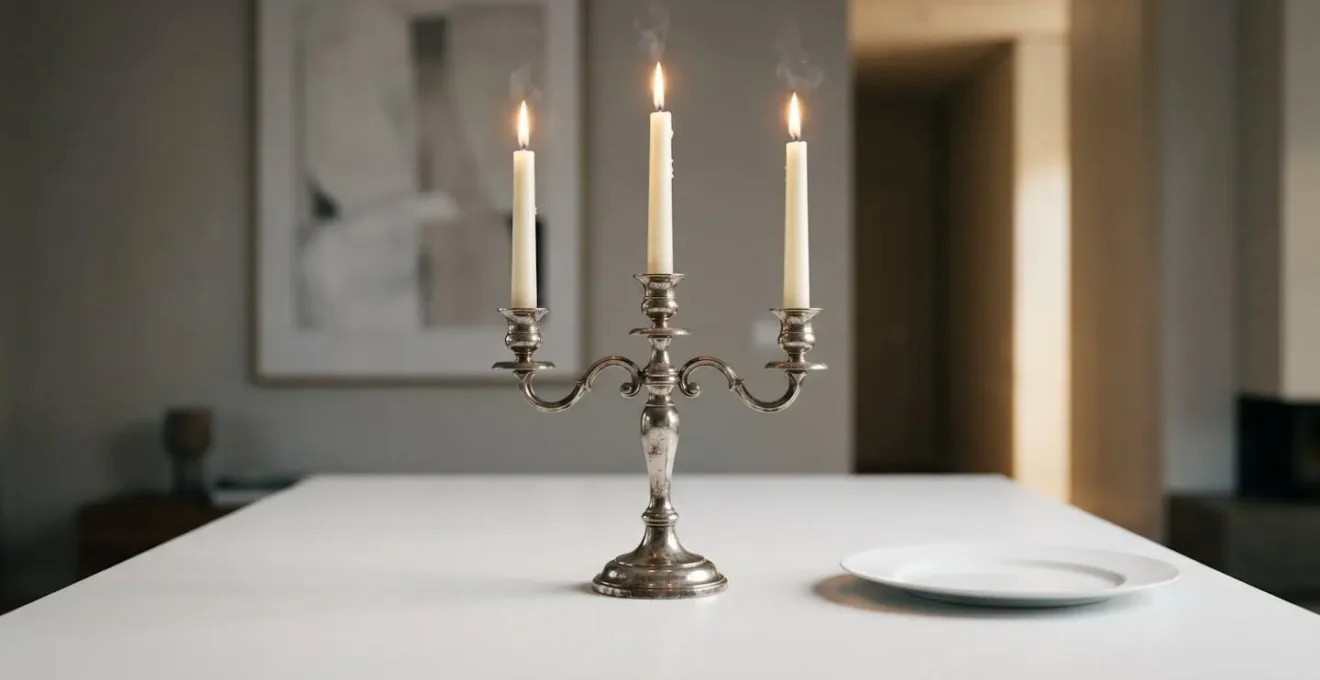
The key is to create tension between the historical and the modern. Place a single, grand, ornate element in an otherwise minimalist setting. This contrast creates a powerful focal point and makes the historical piece feel deliberate and curated, not dusty. For example, the dramatic silver candelabra shown below commands attention precisely because it is surrounded by clean lines and negative space. It feels like a piece of sculpture, a statement of intent. The lighting it casts—warm, flickering, and moody—does more to create a Romantic atmosphere than a dozen other decorative objects could.
To infuse your table with this spirit without it becoming a costume party, focus on these modern strategies:
- Practice Evocation, Not Replication: Instead of a full Toile de Jouy tablecloth, use a single runner of the fabric on a bare, rustic wood table. Or, tie simple, solid-coloured linen napkins with a thin strip of Toile de Jouy ribbon. It’s a nod, not a full reconstruction.
- Translate Principles Through Atmosphere: Romanticism was about emotion and nature. Create this with dramatic, moody candlelight instead of bright overhead lights. Arrange a “foraged” floral centerpiece that feels wild, asymmetrical, and alive, rather than a perfect, manicured bouquet.
- Deploy the ‘Single Statement Piece’ Strategy: As illustrated, place one grand, ornate, Romantic-era silver candelabra or a magnificent soup tureen in the center of an otherwise stark, modern tablescape. The tension is what creates the drama.
- Incorporate Literary References: French Romanticism was a literary and intellectual movement first. Pay homage to this by naming courses or signature cocktails after characters from Victor Hugo or Alexandre Dumas, or by using beautiful, sweeping calligraphy for place cards and menus.
This approach allows you to borrow the soul of an era, its passion and intellectual depth, while remaining firmly rooted in a contemporary aesthetic. It is a dialogue with history, not a surrender to it.
The Dinner Party Mistake That Brands British Guests as Impolite in French Homes
For a British guest, navigating a French dinner party can feel like traversing a social minefield. Many actions considered polite and helpful in the UK can be perceived as intrusive or even rude in France. This is because a French dinner is not just a meal; it is a carefully orchestrated performance, a “social choreography,” with the host as the director. Unsolicited “help” can be seen as a disruption to this flow and an implicit criticism of the host’s ability to manage. Understanding these unwritten rules is crucial for being a gracious guest.
The most common faux pas stems from the British desire to be helpful and proactive. In France, the guest’s primary role is to be a delightful and engaging conversationalist, not a kitchen assistant. Your contribution is your presence, your wit, and your appreciation. Breaching the invisible barrier between the dining room and the kitchen is a significant error. As a deep dive into etiquette by Belle de Soirée highlights, this and other well-intentioned gestures can be easily misinterpreted.
To ensure you are remembered as a charming guest rather than a clumsy one, be mindful of these critical differences in dinner party etiquette:
- Never Insist on ‘Helping’ in the Kitchen: This is the cardinal sin. While offering to clear plates or help with washing up is a sign of good manners in Britain, in France it can imply the host is overwhelmed and disrupt their carefully planned rhythm. Do not enter the kitchen unless you are explicitly and genuinely invited to do so.
- Respect the ‘Quart d’Heure de Politesse’: Punctuality is not always a virtue. Arriving exactly on time is considered slightly impolite as it can make the host feel rushed. The norm is to arrive 10-15 minutes late. Arriving early is a major social blunder.
- Choose Your Gift Wisely: Bringing a dessert can be seen as an insult to the host, implying their own dessert is not adequate. Bringing a bouquet of flowers that isn’t already in a vase is also a faux pas, as it forces the host to stop everything to find one. Better choices are a bottle of high-quality wine (which the host will likely save for a later occasion), excellent chocolates, or a small, thoughtful gift for the home.
- Match the Slow Pace of the Meal: A French dinner is a marathon, not a sprint. It is meant to last for hours. Eating your food quickly and then waiting awkwardly for others is impolite. The pace is deliberately slow, with conversation interwoven into the act of eating. Aim to finish each course at roughly the same time as everyone else.
By respecting this social choreography, you show deference to your host’s efforts and an understanding of the cultural context. Your role is to relax, engage, and enjoy the performance they have so carefully prepared for you.
Key takeaways
- True elegance is achieved not by adding more items, but by mastering “negative space” to let each object breathe.
- Small details like fork placement and the absence of a bread plate are not just rules, but powerful cultural signals of authenticity.
- A French dinner party is a form of social choreography; a guest’s role is to be an engaging conversationalist, not a kitchen helper.
Why Do French People Seem Reserved When You’re Just Being Friendly?
A common experience for many Anglo-Saxons in France is a feeling of being kept at arm’s length. Your open, friendly gestures—a wide smile to a stranger, a casual inquiry about their family—are met with a polite but distinctly cool reserve. This isn’t unfriendliness; it is the manifestation of a fundamentally different social structure. As cultural anthropologists often point out, French social life is built in concentric circles. The outer circle is governed by a formal, almost ritualistic politeness (*bonjour Madame/Monsieur*), while the inner circles of friendship and intimacy are small, tight-knit, and earned over time. Effusive Anglo-Saxon “friendliness” is often perceived as an attempt to bypass these layers too quickly, which can come across as invasive or insincere.
The primary gateway from an outer circle to an inner one is the dinner party. It functions as a kind of informal “social audition,” where a host is not being cold, but observant. They are evaluating a guest’s character and compatibility through the quality of their engagement.
French social life has layers. The outer circle is governed by formal politeness. The inner circles are warm and intimate. Anglo-Saxon ‘friendliness’ often tries to breach these circles too quickly, which is perceived as invasive or insincere.
– French Cultural Anthropologists, Understanding French Social Structures
This “audition” is not about passing a test, but about demonstrating a capacity for the kind of connection the French value. It’s a system that prioritizes depth over breadth in relationships.
The Dinner Party as a Social Audition
In French culture, connection is often built through passionate, intellectual engagement rather than effusive small talk, which can be viewed as superficial. As detailed in a cultural guide to French etiquette, your conversation quality, table manners, and ability to engage in substantive debate (often about politics, art, or philosophy) are all part of this implicit evaluation for a deeper connection. A spirited but respectful disagreement is not a sign of conflict; it is a sign of engagement and respect for the other’s intellect. The formal politeness of the outer circle only gives way to genuine warmth after this foundation of shared time and intellectual respect has been firmly established. Friendship is a serious affair, and the dinner party is where the foundations are laid.
Therefore, the perceived “reserve” is actually a form of respect—for privacy, for social boundaries, and for the value of genuine connection. The path to French friendship is not through instant familiarity, but through shared meals, spirited conversations, and the slow, deliberate building of mutual esteem. The elegant table you set is the very stage upon which this important social drama unfolds.
Begin transforming your own gatherings by applying these principles of proportion, space, and social grace to your next table setting. This is the first step toward not just mimicking French style, but truly embodying its spirit of elegance and connection.