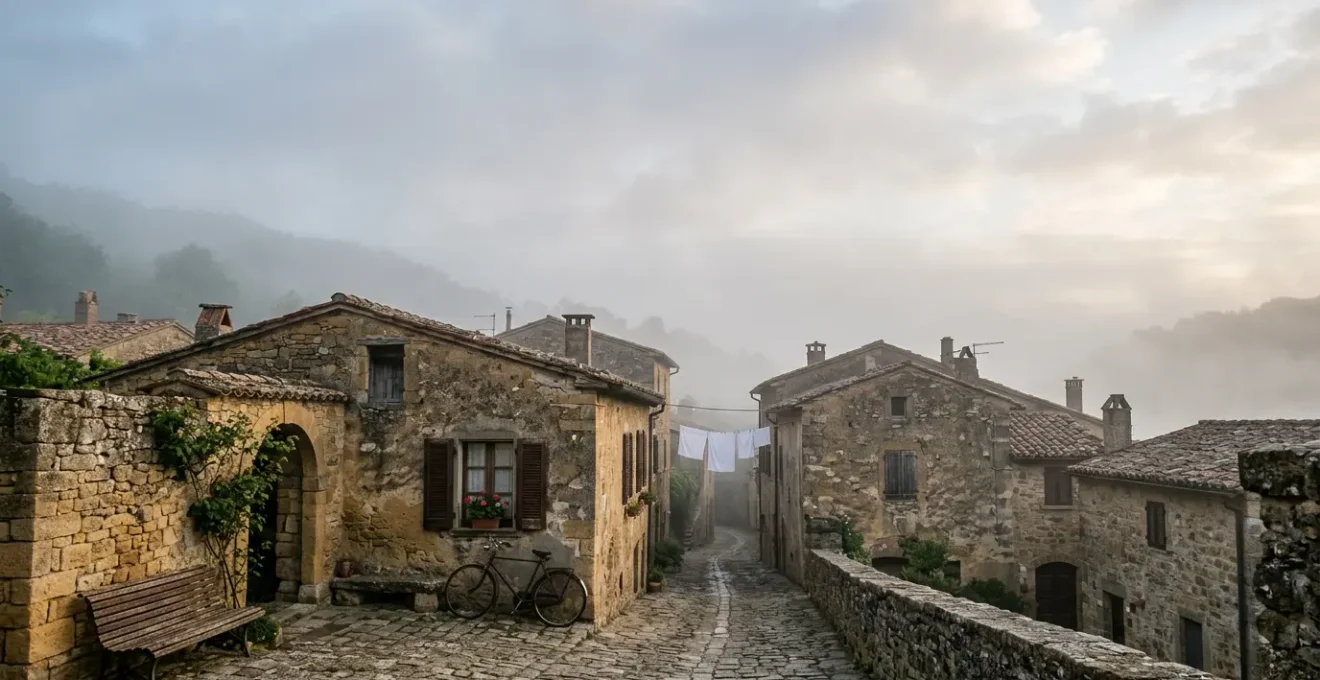
The quest for an authentic medieval experience in France is often misguided; the most perfectly preserved villages are rarely the most evocative.
- True historic atmosphere comes from “temporal texture”—the visible wear and age—not from pristine, restored facades that erase the passage of time.
- Official labels and over-tourism create “commercial friction,” turning living history into a theme park experience filled with crowds and souvenir shops.
Recommendation: Seek out the “eloquence of imperfection” in smaller, slower places where history is still being lived, not just sold.
There is a peculiar form of disappointment familiar to any history enthusiast travelling through France. You arrive, full of anticipation, at a village lauded as a “medieval gem.” The architecture is flawless, the half-timbered houses immaculate, the castle walls perfectly pointed. Yet, something feels profoundly wrong. The air hums not with history, but with the murmur of tour groups. Every other doorway leads to a shop selling identical lavender sachets and plastic knight helmets. It looks medieval, but it feels like a meticulously crafted film set, a historical shell emptied of its soul.
Conventional wisdom tells us to seek out villages on the famous “Les Plus Beaux Villages de France” list or to look for classic visual cues like cobblestone streets and ancient churches. But this approach often leads directly to the sanitised, crowded experiences we hope to avoid. The feeling of authenticity is more elusive than a simple checklist of architectural features. It’s a fragile atmosphere, easily shattered by the very mechanisms designed to promote it.
But what if the very perfection we seek is the problem? This guide challenges the conventional tourist narrative. It argues that true medieval authenticity is not found in static preservation, but in what can be called “temporal texture”—the visible, ongoing conversation between a place, its people, and the relentless passage of time. It’s an authenticity found in weathered stone, in the rhythm of daily life, and in the quiet eloquence of imperfection. We will deconstruct why one village feels alive while another feels like a museum, providing you with a new framework to find the genuine heart of medieval France.
This exploration will provide practical strategies for locating these living historic places. We’ll examine how official labels can paradoxically destroy charm, why a crumbling tower can feel more historic than a national monument, and when to visit to capture that elusive, genuine atmosphere.
Summary: Why a Souvenir Shop Shatters the Medieval Illusion
- Why Does One Medieval Village Feel Alive While Another Feels Like a Museum Set?
- How to Find Medieval Villages Where People Still Live Rather Than Sell Souvenirs?
- Périgord or Alsace Medieval Villages: Which Region Offers More Authentic Medieval Character?
- The Official “Beautiful Village” Label That Guarantees Crowds Rather Than Charm
- When Should You Visit French Medieval Villages to Experience Fog, Quiet and Genuine Atmosphere?
- Why Does UNESCO Listing Sometimes Accelerate a Tradition’s Commercialisation?
- Why Does a Small Town Castle Feel More Historic Than a Restored National Monument?
- Why Do Small French Towns Sometimes Have More Fascinating History Than Famous Sites?
Why Does One Medieval Village Feel Alive While Another Feels Like a Museum Set?
The difference between a living village and a museum set lies in the distinction between “inhabited history” and curated spectacle. A place with inhabited history has a pulse. Its ancient buildings are not just preserved artifacts but are functional parts of a contemporary community—a home, a baker’s shop, a town hall. The historic fabric serves a present-day purpose, creating a sense of continuity. Conversely, a museum set is a space where history is performed for an audience. Its purpose has shifted from living to display, creating what travellers intuitively feel is a lack of authenticity. This quest for the real is not a niche desire; consumer research shows that 77% of travelers seek authentic experiences representative of local culture.
This feeling of inauthenticity is what we can term “commercial friction.” It’s the jarring sensation when an immersive historical environment is constantly interrupted by transactional demands. Every ticket booth, every multi-language menu, every shopkeeper hawking mass-produced trinkets reminds you that you are a consumer in a marketplace, not a visitor in a historic place. This commercial optimisation fundamentally alters the character of a settlement.
As Skift Research notes in a report on the experience economy, the end result is disillusionment. For many visitors, the experience falls flat because they see these attractions for what they have become. As one analysis puts it:
some consumers see these attractions as lacking authenticity, falsely promoting themselves as unique and exclusive, and typically characterized by inflated prices, long lines, and large crowds
– Skift Research, How Authentic Experiences Shape the New Tourism Economy
A living village, by contrast, operates on its own terms. The rhythms of daily life—the postman on his rounds, the clatter from a local workshop, the chatter of residents at a café—are not staged. These organic sounds and activities create a rich, layered experience that no curated exhibit can replicate. This is the inhabited history that discerning travellers seek.
How to Find Medieval Villages Where People Still Live Rather Than Sell Souvenirs?
Finding villages that prioritise life over commerce requires a strategic shift in how one travels. Instead of chasing a checklist of famous sites, the goal is to become an observer of subtleties, looking for signs of genuine, ongoing community life. It means favouring slowness over speed and observation over consumption. A village where people truly live has a different texture and rhythm, one that can be detected if you know what to look for. The key is to trade the mindset of a tourist for that of an ethnographer.
This means paying attention to the small details that reveal a functioning community. Look for a school, a post office, or a Mairie (town hall) with posted public notices. These are the engines of a living town, not attractions. Notice the sounds: does the air carry the ring of a blacksmith’s hammer or the distant drone of a workshop, or is it dominated by the chatter of tour groups and the beep of credit card machines? This is what can be described as acoustic authenticity, a powerful and often overlooked indicator.
To move from theory to practice, here is a concrete framework for identifying and appreciating these places. It’s less a set of rules and more a methodology for seeing differently.
Your Action Plan for Finding Living History
- Observe the local economy: Look for small-scale workshops, artisans, and events advertised on village noticeboards or local websites, rather than big-ticket attractions.
- Embrace a walking pace: Choose villages designed for slowness, where short distances conceal deep layers of history, rather than places that encourage driving through.
- Practise deep immersion: Avoid trying to visit three or four villages in a single day. This “photo-driven” approach leads to only superficial impressions.
- Analyse traffic patterns: Seek villages with policies restricting vehicle access to residents and deliveries at specific hours, a sure sign that pedestrian life is prioritised.
- Listen to the soundscape: Identify places where the sound shifts from engines and tourist noise to footsteps, church bells, and the quiet hum of daily life once inside the historic core.
By applying these filters, you begin to identify villages where history is a foundation for current life, not a backdrop for commerce. These are the places that reward the curious traveller with a sense of genuine discovery.
Périgord or Alsace Medieval Villages: Which Region Offers More Authentic Medieval Character?
The question of which French region offers a more “authentic” medieval experience is a false dichotomy. Both the Périgord (part of the Dordogne) and Alsace are rich in history, but they offer fundamentally different expressions of authenticity. The choice between them depends on what kind of historical narrative you want to experience. It’s a contrast between the raw, mineral history of the southwest and the meticulously crafted, storybook history of the east.
The villages of the Périgord, like Beynac-et-Cazenac or La Roque-Gageac, are carved from the landscape itself. Their authenticity is one of rugged, stony endurance. The character is defined by the honey-gold limestone, showing centuries of weathering, moss, and repair. This is where the concept of temporal texture is most apparent. The stone tells a story of sieges, floods, and the slow, patient work of generations. The feel is elemental and deeply connected to the earth. The history feels ancient and formidable, a story of survival against the odds.
This is what temporal texture looks like up close—not a sanitised, uniform surface, but a canvas of history, with every mark and patch of lichen telling a story. It is the physical evidence of a place’s long life.
Alsace, in contrast, offers an authenticity of cultural continuity and detailed craftsmanship. Villages like Riquewihr or Eguisheim, with their brightly painted, half-timbered houses, feel less like fortresses and more like living illustrations from a book of fairy tales. The authenticity here lies in the preservation of a very specific building tradition and a vibrant, almost theatrical, aesthetic. While some can be heavily touristed, their inhabited history is strong; people live and work in these fantastically ornate 16th- and 17th-century buildings. The character is one of civic pride, prosperity, and a resilient Franco-Germanic culture.
Ultimately, neither is “more” authentic. The Périgord offers a raw, geological authenticity, the story of stone and time. Alsace presents a cultural authenticity, the story of human craft and enduring community. The discerning traveller appreciates both for the different tales they tell.
The Official “Beautiful Village” Label That Guarantees Crowds Rather Than Charm
For decades, the “Les Plus Beaux Villages de France” (The Most Beautiful Villages of France) association has been the go-to guide for tourists. Created in 1982, its mission is noble: to protect and promote the heritage of small, remarkable French villages and prevent them from falling into ruin or obscurity. The intention, as stated by the association, was to “help villages promoting their touristic potentials,” particularly those neglected by broader tourism strategies. However, for the traveller seeking genuine atmosphere, this label has become a double-edged sword, often acting as a beacon for the very mass tourism that erodes authenticity.
The success of the label is its own undoing. Gaining entry is a rigorous process; the association’s official criteria require a population under 2,000 and at least two national heritage sites, among other qualifications. Once a village is anointed, it is placed firmly on the global tourist map. The result is predictable: a dramatic increase in visitor numbers, which in turn creates a powerful economic incentive to cater to them. Local bakeries become souvenir shops, quiet squares fill with café terraces, and the commercial friction intensifies.
The label essentially creates a “best-of” list that concentrates tourist flows, transforming a living community into a high-traffic attraction. As the association itself confirms, its purpose is promotion:
The association was set up to help villages promoting their touristic potentials. It specifically targets villages that are sometimes neglected by wider regional or national touristic strategies.
– Les Plus Beaux Villages de France Association, Les Plus Beaux Villages de France – Wikipedia
This promotional success means that while the architecture remains beautiful, the soul of the place—the quiet, the sense of local life, the feeling of personal discovery—is often suffocated. The label guarantees beauty, but it also, almost inevitably, guarantees crowds. The truly “authentic” villages are often those that *failed* to get the label, or never applied for it, leaving them to slumber peacefully just a few kilometres off the well-trodden path.
When Should You Visit French Medieval Villages to Experience Fog, Quiet and Genuine Atmosphere?
The common advice to “travel in the off-season” is correct but lacks nuance. To truly capture the elusive atmosphere of a medieval village, one must think not just about the season, but about the specific time of day and quality of light. The goal is to experience the village when it has reverted to its natural state, free from the peak-hour pressures of tourism. This is when its temporal texture is most pronounced and its acoustic authenticity is restored.
Early morning is a magical time. Arriving before 10 a.m., especially in a well-known village, means you experience the streets as the residents do. The air is cool, the light is soft, and the only sounds are the delivery van for the boulangerie, the clang of a shop’s metal shutter, and the tolling of church bells. In autumn and winter, you might be rewarded with a layer of mist, which softens the edges of the modern world and enhances the feeling of stepping back in time. The village belongs to itself again, and you are a privileged, temporary guest.
Late afternoon and early evening offer a similar advantage. As the tour buses depart and day-trippers head home, the village exhales. The “golden hour” light rakes across the stone walls, highlighting centuries of wear and texture. The atmosphere shifts from transactional to residential. Choosing the right moment is as important as choosing the right place. To maximize your chances of an authentic experience, consider these timing strategies:
- The Early Bird Strategy: Arrive before 10 a.m. in the most popular villages to avoid crowds and find parking. You’ll witness the village waking up.
- The Shoulder Season Sweet Spot: Visit during spring (April-May) and early autumn (September-October) when the weather is pleasant, the light is beautiful, and the villages are far less crowded than in summer.
- The Peak-Hour Avoidance: If you must travel in summer, avoid the core weekend hours of 11 a.m. to 4 p.m. at all costs. This is when mass tourism turns a visit into a queuing experience.
- The Golden Hour Gaze: Plan your visits for the early morning or late afternoon, when tourist flow is minimal and the low, angled light is optimal for photography and atmosphere.
- The Winter Pilgrim: For the ultimate experience of quiet, consider a winter visit. The atmosphere is suspended and almost empty, though you must accept that many shops and restaurants may have reduced hours or be closed.
By being strategic with your timing, you are not just avoiding crowds; you are actively choosing to experience the village in its most honest and atmospheric state.
Why Does UNESCO Listing Sometimes Accelerate a Tradition’s Commercialisation?
The paradox seen with the “Plus Beaux Villages” label is magnified on a global scale with UNESCO’s World Heritage program. While the intention behind designating a site or a tradition as part of the “Intangible Cultural Heritage of Humanity” is to safeguard it, the act of labelling can trigger a process that alters its very nature. By codifying a living tradition, UNESCO frames it as a global asset, which inevitably attracts a global audience and market forces.
This is because heritage, in the modern tourism economy, is a product. Once a tradition—be it a craft, a festival, or the unique social fabric of a historic town—is officially recognised, it gains immense cultural capital. This capital is quickly monetized. The “living” aspect of the heritage, which is often messy, evolving, and not easily packaged, becomes secondary to the need to present a consistent, consumable “experience” for tourists. The tradition risks being frozen in time, performed rather than lived, to meet visitor expectations.
Scholar Chiara Bortolotto highlights this fundamental conflict. UNESCO’s model, unlike simple conservation, defines this heritage as dynamic and part of contemporary society. This creates a direct and often problematic link to the market.
UNESCO defines intangible cultural heritage (ICH), in contrast to conservation-oriented models, as ‘living’ and as playing a dynamic role in contemporary society, thus bringing to the fore a controversial entanglement with the market
– Chiara Bortolotto, The Embarrassment of Heritage Alienability – Current Anthropology
This “entanglement with the market” is the core of the issue. A UNESCO-listed medieval town, for example, may see its real estate prices soar, pushing out the very local families who were the bearers of its inhabited history. They are replaced by holiday lets and businesses catering exclusively to tourists. The official protection, meant to preserve, inadvertently accelerates the transformation of the town into a high-end tourism product, drained of its original, organic life.
Why Does a Small Town Castle Feel More Historic Than a Restored National Monument?
The answer lies in the concept of the “eloquence of imperfection.” A flawlessly restored national monument, like the fortress of Carcassonne or a grand Loire château, is often a victim of its own perfection. In the 19th century, restorers like Eugène Viollet-le-Duc approached monuments with an idealised vision, often rebuilding them not as they were, but as they “should have been.” This process, while saving many structures from ruin, frequently erased centuries of authentic aging, wear, and modification. It scrubbed away the temporal texture—the very evidence of the passage of time.
The result is a structure that feels historically sterile. It represents a single, idealized moment in history, hermetically sealed from the centuries that followed. It is impressive, but it is a finished statement. Its story has been concluded by the restorer. You are invited to admire it, but not to connect with its ongoing journey through time.
A small, partially ruined castle in a forgotten town tells a different, more compelling story. The ivy growing over a crumbling wall, the way a defensive tower has been integrated into a later farmhouse, the visible patches and repairs from different eras—these are not flaws. They are historical documents written in stone. This imperfection is eloquent; it speaks of resilience, decay, adaptation, and continuity.
This humble ruin has a story that is still unfolding. It is in an active, visible dialogue with nature and with the surrounding community. Its history has not been sanitised or finalised. It invites curiosity and imagination. It doesn’t present you with a complete narrative; it gives you the clues to piece one together for yourself. This is why it can feel more profoundly “historic” than a magnificent but lifeless national monument. It possesses an authenticity rooted in its visible, undeniable journey through time, not in a curator’s ideal of perfection.
Key takeaways
- True medieval authenticity is found in “temporal texture”—the visible signs of age and wear—not in perfectly preserved or over-restored facades.
- Official labels like “Les Plus Beaux Villages” and UNESCO listings, while well-intentioned, often create “commercial friction” that attracts crowds and dilutes the genuine atmosphere.
- The most rewarding experiences are found by seeking “inhabited history” and the “eloquence of imperfection” in smaller, slower places that have not been fully optimized for tourism.
Why Do Small French Towns Sometimes Have More Fascinating History Than Famous Sites?
Famous historical sites operate under immense pressure. They are required to manage huge flows of people, leading to an experience defined by queues, designated pathways, and information delivered in standardised formats. Their history, while significant, is pre-digested and presented for mass consumption. In these places, the visitor is a passive recipient. The sheer volume of tourism can dilute the very essence of the place, a phenomenon seen across Europe where data from European tourism intensity metrics shows certain destinations suffer from a tourist-to-inhabitant ratio that fundamentally alters their character.
Smaller, lesser-known French towns offer the opposite. Their history is not a performance; it is a quiet, ambient presence. Because they are not “attractions,” their stories are not curated or simplified. They are discoverable. The history is found in a faded coat of arms above a doorway, in the strange layout of a street that follows an ancient wall, or in a local church’s unassuming but remarkable 15th-century fresco. This is a history you must actively seek and piece together, making the reward of discovery infinitely more satisfying.
These places reward a different kind of travel—one based on slowness and curiosity. They are not designed for a fleeting, photo-op visit. As one observer of these places notes, their very design encourages a more profound engagement.
Medieval villages reward slowness. These are places designed for walking speed, where distances are short but layers of history are deep.
– All About Vacation, Why medieval villages offer a different way to discover Europe
This slowness allows you to notice the details that contain the town’s true character. You are not just seeing a site; you are engaging with a place. The absence of commercial friction means your immersion is deeper. The quiet allows you to think and feel. In the end, a small town’s “fascinating” history comes not from the grandeur of its monuments, but from the intimate, personal sense of discovery it offers the traveller willing to slow down and look closer.
Armed with this new perspective, your next journey into France’s past can be one of genuine discovery. The goal is no longer to find the most “beautiful” village, but the most alive one. Look beyond the official signposts and start reading the rich, complex stories written in the stones themselves.