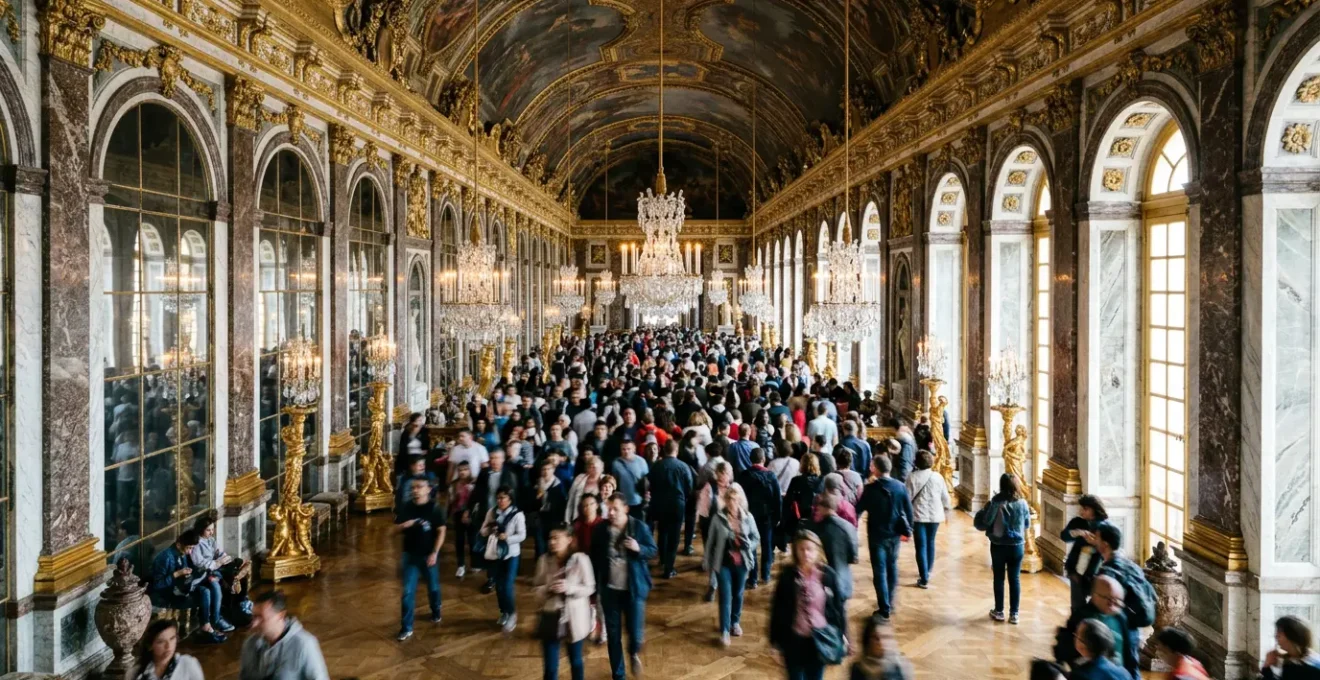
The crushing ‘theme park’ feeling at Versailles stems from experiencing it as a spectacle, not a story. The solution is to reverse the conventional tourist path.
- Instead of joining the main palace queue, start your visit at the tranquil, human-scale Trianons and Queen’s Hamlet.
- This ‘narrative reversal’ allows you to understand the royal desire to escape the suffocating grandeur *before* you experience the grandeur itself.
Recommendation: Trade the checklist-driven tour for a curated, in-depth experience of one or two areas. This defeats the ‘museum fatigue’ that plagues large-scale sites and unlocks a genuine connection to the history.
You’ve done everything right. You booked your timed-entry ticket months in advance. You arrive, full of anticipation, only to be swept into a relentless human river, channelled from one gilded room to the next. You crane your neck to see a sliver of the Hall of Mirrors between a forest of selfie sticks, feeling more like a passenger on a conveyor belt than a guest in a royal palace. By the time you emerge, blinking, into the vast gardens, you’re not enlightened; you’re exhausted and vaguely disappointed. The grandeur was immense, but the connection was absent.
This experience is profoundly common among thoughtful visitors. The standard advice—go early, book ahead—misses the fundamental problem. The issue isn’t just the number of people; it’s the very structure of the visit that encourages a theme-park-like consumption of splendor. It prioritises spectacle over substance, leading to a sense of cognitive and emotional overload.
But what if the key wasn’t to manage the crowds, but to sidestep the spectacle altogether? The secret to a truly rewarding visit to Versailles lies in a radical re-framing of your journey. It involves a strategic ‘narrative reversal’: starting not with the overwhelming power of the main palace, but with the intimate, human-scale escapes the royals built for themselves. This guide isn’t about seeing more of Versailles; it’s about experiencing it more deeply.
By understanding the ‘why’ behind the exhaustion and adopting a historian’s approach to place, you can transform a visit from a frantic tour into a meaningful pilgrimage. We will explore the mechanics of crowd flow, the art of strategic timing, and the psychological phenomena that turn wonder into weariness, providing you with a framework to unlock the soul of Versailles that hides just beyond the velvet ropes.
Table of Contents: Unlocking the Real Versailles Experience
- Why Does Versailles Channel You Through Rooms Without Time to Absorb Anything?
- How to Experience Versailles’s Lesser-Known Trianons and Hamlet Without Crowds?
- Palace Interiors or Gardens: Which Versailles Experience Rewards a Half-Day Visit Most?
- The Arrival Time That Puts You in Competition With 50 Coaches at Versailles
- Why Are You Exhausted After 90 Minutes at the Louvre Despite Loving Art?
- How to Find Castles and Monuments That Actually Let You Explore Secret Areas?
- Why Does Visiting 5 Loire Châteaux in 3 Days Leave You Unable to Remember Which Was Which?
- When Should You Return to Versailles to See What You Missed on Your First Visit?
Why Does Versailles Channel You Through Rooms Without Time to Absorb Anything?
The feeling of being herded through Versailles isn’t your imagination; it’s a direct consequence of managing a monumental site that welcomed nearly 8.4 million people in 2023. The palace operates on a principle of mandatory visitor flow. To prevent gridlock in a building designed for 17th-century courtly processions, not 21st-century mass tourism, visitors are funnelled along a pre-determined, one-way path through the most famous areas like the King’s State Apartments and the Hall of Mirrors.
This system, while logistically necessary, is the primary source of the “theme park” sensation. It transforms the experience from one of exploration and discovery into one of passive transit. You are not exploring a space; you are being moved through it. The pace is dictated not by your own curiosity, but by the density of the crowd in front of you. There is little time for contemplation, to absorb the symbolism of a ceiling fresco, or to simply imagine the room as it once was.
The very design of the tour prioritises the ‘greatest hits’, concentrating the vast majority of visitors into a very small percentage of the estate’s total area. As one expert analysis notes, this creates intense choke points. This mandatory, linear path strips visitors of their agency, forcing a uniform experience that guarantees seeing the highlights but prevents a personal, reflective connection with the space. You are, in effect, on a historical ride, and the next car is right behind you.
How to Experience Versailles’s Lesser-Known Trianons and Hamlet Without Crowds?
The most effective strategy to reclaim your Versailles experience is to completely invert the standard itinerary. Instead of starting at the main palace, you begin where the royals went to end their days: the Trianons and the Queen’s Hamlet. These were not mere annexes; they were antidotes to the oppressive formality of court life. By starting here, you understand the *need* for escape before you’ve even faced the gilded cage itself.
The Trianon estate is a world away from the main palace’s rigid symmetry. The Grand Trianon, Louis XIV’s ‘palace of pink marble and porphyry’, offers a glimpse of royalty seeking relative intimacy. But the true magic lies further on. The Petit Trianon, given to Marie Antoinette, is a masterpiece of human-scale neoclassical architecture. It feels like a home, not a statement of power. Surrounding it are the English Gardens, a deliberate rebellion against the rigid geometry of the main gardens, full of winding paths and romantic follies.
The culmination of this escape is the Queen’s Hamlet, a fantasy farm village where the Queen could play at being a shepherdess. It is here, among the thatched roofs and the gentle bleating of sheep, that the suffocating weight of the main palace becomes truly apparent. Experiencing this first provides the crucial context for everything else. You will approach the main palace later in the day not as a weary tourist, but as a historian who understands the profound psychological burden it represented.
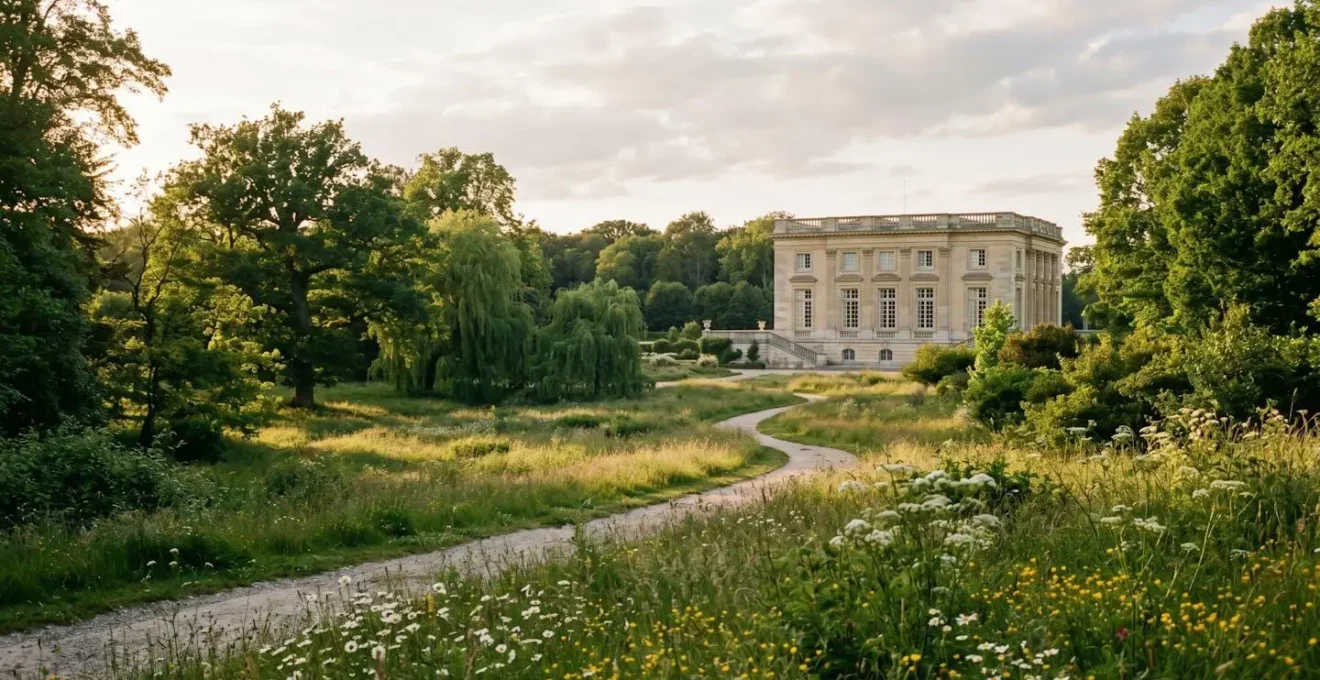
This pastoral scene at the Petit Trianon stands in stark contrast to the overwhelming scale of the main palace. It represents a search for privacy and a connection to nature, a world away from the constant public performance required at court. It is the beginning of understanding Versailles as a human story, not just an architectural one.
Action Plan: The Queen’s Escape Itinerary
- Start at the Queen’s Hamlet: Immerse yourself in the most rustic and intimate part first, Marie Antoinette’s fantasy farm village, to establish the ‘escape’ narrative.
- Move to the Petit Trianon: Explore her private palace and personal living spaces, noting the shift to neoclassical intimacy.
- Wander the English Gardens: Experience the deliberate contrast to the main palace’s rigid French formal gardens, a key element of the escape.
- Visit the Grand Trianon: Observe Louis XIV’s marble retreat, understanding it as an earlier attempt to move from formality to residential comfort.
- End at the Main Palace: Arrive at the main building in the late afternoon, now fully appreciating the suffocating grandeur the royals sought to escape.
Palace Interiors or Gardens: Which Versailles Experience Rewards a Half-Day Visit Most?
If your time is limited, attempting to ‘see it all’ is a recipe for exhaustion and disappointment. The most strategic decision you can make is to choose one core experience and commit to it fully: either the Palace Interiors or the Gardens and Estate. Trying to do both in a few hours reduces them to a checklist, robbing you of the depth that makes either one so rewarding. This choice is not about which is ‘better’, but which best suits your interests and energy on the day.
A half-day dedicated to the Palace interiors is an intellectually intensive dive into art, power, and architecture. It’s ideal for the history enthusiast who wants to decode the political messaging in every fresco and piece of furniture. However, it demands high concentration and the mental fortitude to navigate crowds and sensory overload. Conversely, a half-day in the Gardens is physically demanding but psychologically restorative. It’s a chance to appreciate André Le Nôtre’s landscape masterpiece, find pockets of solitude, and experience the changing light on the Grand Canal. It’s for the visitor seeking contemplation and natural beauty on a monumental scale.
Making a conscious choice allows you to set a realistic goal and savour the experience. Instead of rushing from the Hall of Mirrors to the Grand Canal, you can spend three hours truly absorbing the State Apartments or walking the full loop of the Grand Canal to the base of the Orangery. This focus transforms a frantic tour into a fulfilling, memorable immersion.
The following framework, based on an analysis of visitor decision patterns, can help you make the most of a limited timeframe.
| Criteria | Palace Interiors (3 hours) | Gardens Only (3-4 hours) |
|---|---|---|
| Best For | History enthusiasts, art lovers, architecture students | Nature lovers, photographers, contemplative visitors |
| Physical Demand | Constant standing, sensory overload, crowd navigation | Extensive walking but mentally restorative |
| Recommended Focus | King’s State Apartments + Hall of Mirrors only | Latona Fountain + Grand Canal + Orangery loop |
| Energy Type | Intellectually intensive, requires high concentration | Physically demanding but psychologically calming |
| Ideal Time Slot | 9:00 AM entry (before peak crowds) | Mid-afternoon (2:00-5:30 PM for best light) |
| Season Consideration | Year-round viable (climate-controlled) | April-October optimal (gardens in full bloom) |
The Arrival Time That Puts You in Competition With 50 Coaches at Versailles
The common wisdom to “arrive early” at major tourist sites is, in the case of Versailles, dangerously misleading. The absolute worst time to arrive at the palace gates is between 9:30 AM and 11:00 AM. This window puts you in direct competition with the logistical peak of mass tourism: the arrival of dozens of large tour coaches from Paris.
Case Study: Tour Bus Logistics and Peak Visitor Pattern
An analysis of Versailles visitor patterns reveals a crucial insight. Large coach tours operate on a standardised schedule. They aim to arrive between 9:30-11:00 AM, funnel their groups through the State Apartments and Hall of Mirrors, and depart for a scheduled lunch around 1:00-2:00 PM. This creates a massive, predictable human traffic jam inside the palace, with peak congestion occurring precisely between 10:00 AM and 1:00 PM. The ‘early’ arrival of the independent tourist at 9:30 AM means they enter the palace at the exact same moment as this overwhelming wave.
This logistical reality means that visitor flow analysis shows the most intense crowding happens between 9:30 AM and 3:00 PM. The strategic visitor, therefore, has two far superior options. The first is to be a true early bird, arriving well before 9:00 AM to be among the very first inside, granting you a precious 30-60 minutes before the tour bus wave hits. The second, more counter-intuitive option, is to be a late arrival. By entering the palace after 3:00 PM, you arrive just as the coach tours are departing. You will have less total time before closing, but the quality of that time is exponentially higher. You might experience the Hall of Mirrors in beautiful late-afternoon light, shared with a fraction of the mid-morning crowd.
Choosing your arrival time is not about convenience; it is the most critical tactical decision you will make. By understanding the operational rhythms of mass tourism, you can position yourself in the lulls, rather than being swept away by the tide.
Why Are You Exhausted After 90 Minutes at the Louvre Despite Loving Art?
The feeling of being utterly drained after a short time in a vast museum, even one you are excited to visit, is a universal and well-documented phenomenon. It’s not a personal failing or a lack of appreciation for art; it is a specific condition known as “museum fatigue.” This concept gives a name to the mental and physical exhaustion that sets in when we are confronted with an overwhelming amount of information and stimuli in a cultural setting.
The term was first coined over a century ago to describe this state of sensory and cognitive overload. As researcher Benjamin Ives Gilman noted in a 1916 publication:
Museum fatigue is a state of physical or mental fatigue caused by the experience of exhibits in museums and similar cultural institutions.
– Benjamin Ives Gilman, The Scientific Monthly, January 1916
This fatigue is not just about walking. It’s about the constant, subconscious decision-making: “Should I look at this painting? What does that label say? Should I move on to the next room?” Each decision depletes our finite cognitive resources. Research confirms this effect, with studies finding that visitor interest peaks around 30 minutes and can decline into apathy shortly after. Versailles, like the Louvre, is an extreme case. The sheer density of art, architectural detail, and historical significance, combined with the physical presence of crowds, accelerates this process dramatically.
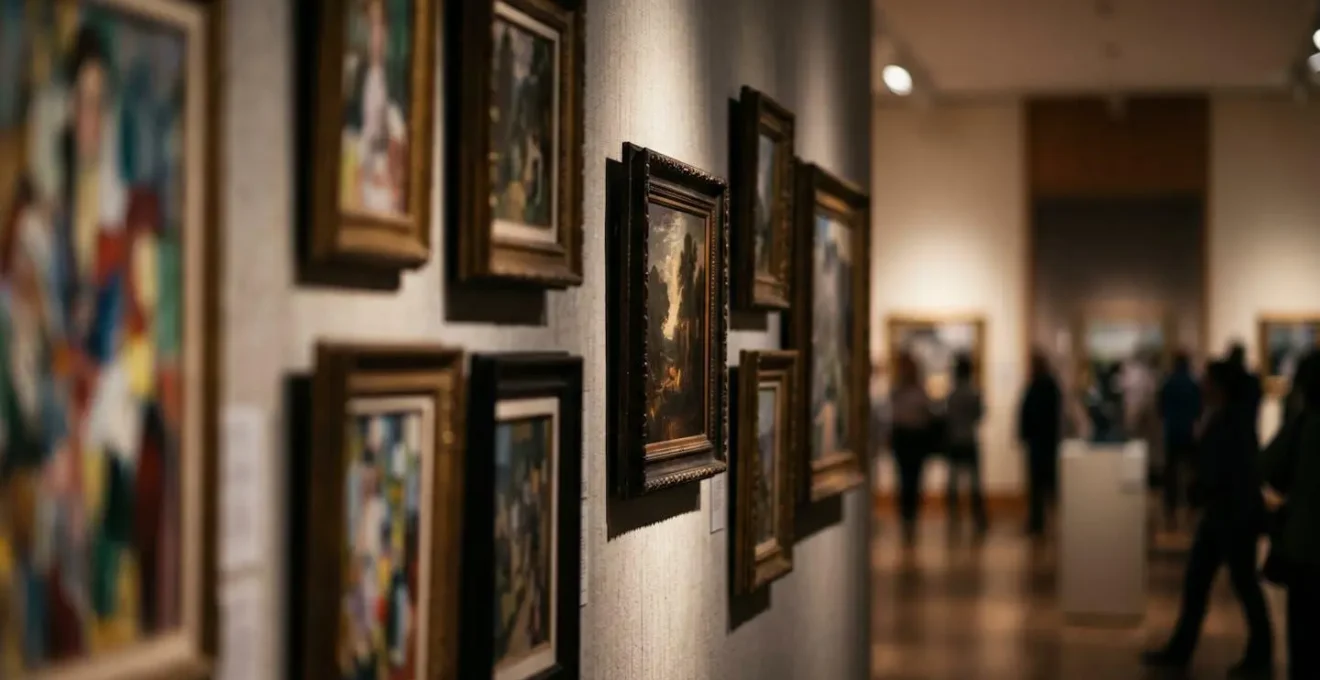
Recognising that museum fatigue is a real physiological and psychological response is the first step toward combating it. It validates the feeling of being overwhelmed and shifts the goal from “seeing everything” to “meaningfully experiencing a few things.” It’s a call to curate your own visit with surgical precision, prioritising depth over breadth to preserve your energy and attention for what truly matters to you.
How to Find Castles and Monuments That Actually Let You Explore Secret Areas?
The desire for a deeper, more authentic connection with historical sites often leads to a search for what lies “behind the scenes.” While many major monuments feel like hermetically sealed displays, a surprising number offer pathways into their hidden corners. The key is knowing the specific language and strategies to unlock these experiences, turning you from a passive spectator into an active explorer.
Official websites are the primary resource, but you need to search for more than just “tickets.” The most fruitful search terms are those used by the institutions themselves to designate special access. Look for phrases like “behind-the-scenes tours,” “curator-led tours,” or “conservation tours.” In French-speaking countries, the term “visite insolite” (unusual visit) is often a code for tours that access rooftops, cellars, or private apartments not on the standard circuit. At Versailles itself, booking the “Private Apartments” tour is the single best way to see the ‘real’ Versailles where Louis XV and Louis XVI actually lived, away from the performative state rooms.
Another powerful strategy is to time your visit with special events. The annual European Heritage Days (Journées du Patrimoine in France) is a weekend where countless normally-closed doors are thrown open to the public. Furthermore, joining a “Friends of the Museum/Monument” membership program often grants exclusive access to restricted areas, private viewings, and expert lectures as a perk. Finally, don’t underestimate the power of looking beyond the A-list sites. Smaller, privately-owned châteaux often provide much greater freedom of exploration, with fewer visitors and less stringent restrictions, offering a more intimate and memorable encounter with history.
Why Does Visiting 5 Loire Châteaux in 3 Days Leave You Unable to Remember Which Was Which?
The confusion that sets in after a rapid-fire tour of similar sites—be they Loire châteaux, Roman ruins, or English cathedrals—is a common travel ailment. It’s not a failure of memory, but a failure of narrative. When historical sites are presented as a series of interchangeable rooms, tapestries, and architectural features, our brains struggle to create distinct, lasting memories. This phenomenon can be termed “narrative collapse.”
Without a unique story to anchor the experience, the details blur into a generic “château” or “cathedral” template. You remember seeing beautiful things, but you can’t place them. You saw a famous staircase, but was it at Chambord or Chenonceau? This is the core problem of checklist tourism: it prioritises quantity of sights over quality of experience, leading to a diminished return on memory for each additional site visited.
Case Study: The Narrative Collapse Problem in Loire Valley Tourism
Travel expert Rick Steves’ analysis of visiting the Loire Valley châteaux highlights this exact issue. He observes that tourists suffer from this ‘narrative collapse’ because they are not given a strong, unique story for each castle. To combat this, his strategy is to assign each château a powerful, one-sentence identity. Chambord becomes “François I’s massive ego trip of a hunting lodge.” Chenonceau is “the ladies’ château, shaped by the rivalry of a wife and mistress.” Cheverny is “the living, breathing aristocratic estate, complete with its hunting hounds.” This simple act of narrative framing transforms an overwhelming list into a series of distinct, memorable stories.
This principle is directly applicable to Versailles. Instead of trying to “do” the palace, the Trianons, and the gardens in one go, the strategic visitor assigns a narrative to their chosen experience. A visit focused on the gardens becomes a story about “Man’s dominion over nature.” A visit focused on the Petit Trianon and Hamlet is the story of “A queen’s search for privacy.” By creating a narrative theme for your visit, you provide your brain with the hook it needs to retain the experience, transforming a fleeting spectacle into a lasting memory.
Key Takeaways
- The ‘theme park’ feeling is caused by mandatory visitor flow; the solution is to reverse the narrative and start with the Trianons.
- Combat ‘museum fatigue’ by choosing depth over breadth. Dedicate your visit to one area (Palace or Gardens) for a more meaningful experience.
- Strategic timing is crucial. Avoid the 9:30-11:00 AM tour bus rush by arriving either very early or, counter-intuitively, late in the afternoon.
When Should You Return to Versailles to See What You Missed on Your First Visit?
A first visit to Versailles, if done strategically, should leave you not exhausted, but intrigued. It lays the groundwork for a second visit that can be a truly profound historical immersion. Having grasped the estate’s scale and core narratives, your return is an opportunity to move from a general understanding to a specialist’s deep dive. This is where you truly leave the theme park behind and enter the world of the historian.
Your return can be shaped by season or by theme. An off-season visit (November-February) offers a completely different atmosphere. The gardens have a stark, melancholic beauty, and the palace corridors are far emptier, allowing for quiet contemplation. A return in summer, however, could be timed for a Fountains Night Show, where the gardens are transformed into a magical baroque wonderland of light and music. This is seeing the space perform as it was intended to.
The most rewarding return, however, might be a thematic visit. Instead of following a geographical path, you follow an idea. You could trace the theme of “Water’s Journey,” from the reservoirs to the Grand Canal, to understand the engineering genius behind the fountains. Or you could pursue a “Science of Power” theme, analysing how every piece of art and architecture was propaganda for the Sun King. Preparing for such a visit by reading a biography of Marie Antoinette or Louis XIV beforehand will enrich your experience exponentially, as every room and pathway will be layered with context you previously lacked. A second visit isn’t about seeing what you missed; it’s about seeing the same things with new eyes.
By adopting this mindset—prioritising narrative over checklists, depth over breadth, and strategic solitude over passive participation—you transform not just your experience of Versailles, but your entire approach to cultural travel. The goal is no longer to conquer a site, but to enter into a dialogue with it.