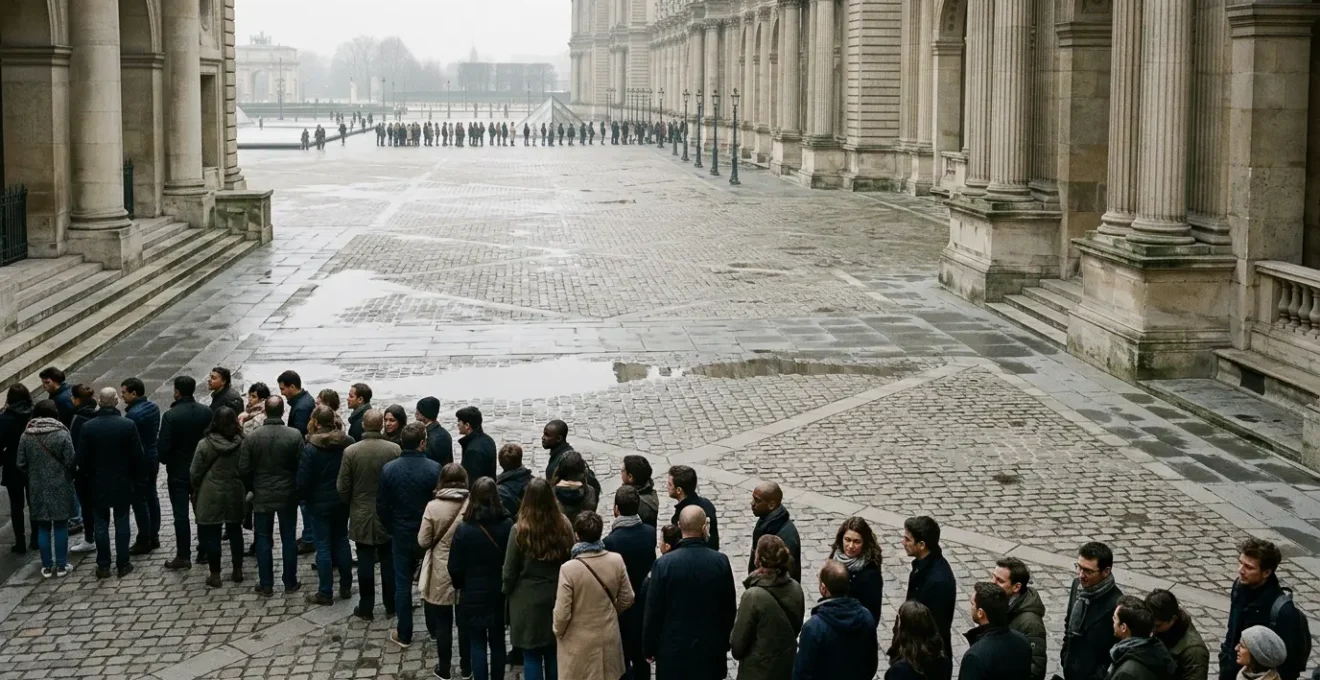
The key to a better cultural trip in Paris isn’t just booking tickets in advance or visiting on a Tuesday; it’s fundamentally rejecting the ‘checklist’ mindset that leads to crowd-induced burnout.
- Major attractions like the Louvre and Versailles operate on a ‘conveyor belt’ model, processing visitors at volumes that actively prevent meaningful engagement.
- Genuine cultural understanding is found in ‘human-scale’ experiences, where context, place, and unhurried observation are prioritized over seeing famous objects.
Recommendation: Audit your next itinerary not for how much you can see, but for how much empty space you’ve left for genuine discovery.
You’ve done everything right. You booked your Eurostar months ago, secured a charming flat in the Marais, and even pre-booked your timed-entry ticket for the Louvre. Yet, standing in the Salle des États, you find yourself viewing the Mona Lisa not through your own eyes, but through the glowing screens of a hundred smartphones held aloft. The experience feels less like a moment of cultural communion and more like navigating the-turnstiles at a football match. You leave feeling strangely empty, wondering if you’ve just participated in a highly efficient queuing exercise rather than a journey of enlightenment.
The common advice to « go off-season » or « visit on a weekday » misses the point. These are tactical plasters on a systemic wound. The truth is, for a certain tier of world-famous French cultural sites, the experience has been fundamentally re-engineered from one of personal discovery into a process of industrial-scale crowd management. This transformation has profound consequences not just for our enjoyment, but for our ability to absorb, understand, and remember what we came to see.
But what if the solution wasn’t about finding a cleverer time to visit the Louvre, but about questioning why the Louvre is the default goal in the first place? This guide takes a different approach. We will deconstruct the ‘conveyor belt’ model of cultural tourism that leaves so many travellers feeling exhausted and unfulfilled. We’ll explore the cognitive science behind « museum fatigue » and reveal why a week-long trip can paradoxically leave you knowing less than you’d hoped.
More importantly, we will provide a new framework for planning. We will show you how to find world-class masterpieces without the queues, how to choose experiences that foster deep understanding, and how to embrace a travel philosophy that prioritizes genuine connection over a ticked-off checklist. It’s time to trade the marathon for meaning.
This article provides a complete framework for rethinking your approach to cultural travel in France. Explore the sections below to deconstruct the problem of overcrowding and discover a more rewarding way to engage with French culture.
Summary: A Strategist’s Guide to Escaping the Cultural Conveyor Belt in Paris
- Why Do Major French Museums Feel More Like Crowd Management Than Cultural Experience?
- How to Find Museums With Masterpieces but No Queues in Paris?
- Art Museums or Historic Sites: Which Cultural Focus Creates Deeper French Understanding?
- The Cultural Overload That Means You Remember Nothing From Your Paris Art Weekend
- When Should You Visit the Louvre to Actually See Paintings Rather Than Other Tourists?
- The Booking Habit That Keeps 90% of Visitors From Genuine French Encounters
- Why Does Versailles Channel You Through Rooms Without Time to Absorb Anything?
- Why Do Week-Long French Holidays Leave You Knowing Less Than Expected?
Why Do Major French Museums Feel More Like Crowd Management Than Cultural Experience?
The feeling of being processed rather than inspired at a major museum isn’t just in your head; it’s a mathematical reality. These institutions are grappling with a fundamental conflict between their mission of cultural preservation and the demands of global mass tourism. The result is an experience dictated by logistics, not by art. This is the essence of « Conveyor Belt Culture »: a system designed to move the maximum number of bodies past a series of designated points, with personal contemplation becoming an inconvenient side-effect.
The Louvre is the prime example. It was simply not built for the crowds it now receives. Recent data confirms the museum welcomed 8.7 million visitors in 2024, more than twice its original design capacity of four million. This isn’t just a queue at the door; it’s a constant, internal pressure that transforms galleries into corridors and viewing art into a competitive sport. The experience is no longer about a quiet, personal encounter with history; it is about navigating a human river that flows in a predetermined direction.
This reality is not lost on the museum’s own leadership. In a moment of striking candour, Louvre Director Laurence des Cars acknowledged the challenges faced by visitors. She described a standard visit as a potential:
physical ordeal’ due to overcrowding, leaks, poor catering, and inadequate facilities.
– Laurence des Cars, Louvre Museum Director, World Attractions Pro
When the director herself calls the experience a « physical ordeal, » it signals that the model is broken. The institution’s primary function has shifted from enabling cultural appreciation to managing the sheer volume of its own popularity. The art is still there, but the conditions required to truly see it have been engineered away for the sake of capacity.
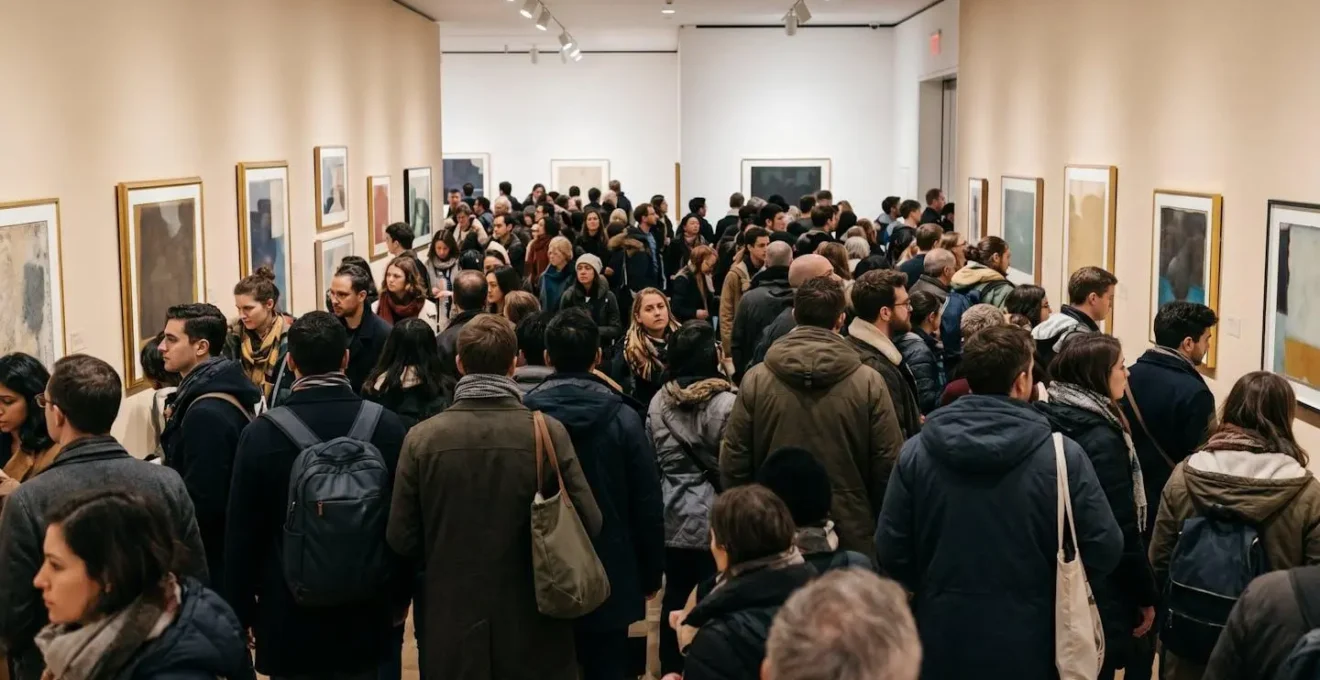
This photograph captures the essence of the problem. The architecture is grand, the art is on the walls, but the dominant feature is the dense, undifferentiated mass of people. It’s a visual representation of how individual experience is subsumed by the logic of the crowd. Understanding this systemic issue is the first step toward consciously choosing a different path.
How to Find Museums With Masterpieces but No Queues in Paris?
Escaping the conveyor belt doesn’t mean sacrificing quality. The great secret of Paris is that its cultural riches are distributed far more widely than the typical tourist itinerary suggests. The city boasts over 130 museums, yet a staggering majority of visitors concentrate on just four or five. The strategic choice is not to abandon the idea of seeing great art, but to seek it out in places designed for human-scale appreciation, where the environment itself encourages contemplation rather than competition.
These alternative museums are not « second-rate. » Many house world-class collections, masterpieces of decorative arts, or entire oeuvres of major artists. Their relative calm is a feature, not a bug. It is a direct result of their specialized focus and their location slightly off the main tourist superhighways. Choosing them is an act of curatorial intelligence for your own trip. As the editors of one guide note, « Sticking to the most popular museums means you’ll miss unusual (and quieter) institutions, filled with stories that may be hiding in plain sight. »
Instead of joining the throng at d’Orsay, consider the quiet halls of the Petit Palais, with its free collection spanning centuries. Instead of just seeing medieval sculpture at the Louvre, immerse yourself in the period at the Musée de Cluny. Here are five exceptional Paris museums where the art, not the crowd, takes centre stage:
Five Havens of Art Without the Crowds
- Musée de Cluny (National Museum of the Middle Ages): Home to the mesmerising ‘The Lady and the Unicorn’ tapestries, this museum is a total immersion in the medieval world, housed within a 15th-century abbey built atop an ancient Roman bathhouse.
- Musée Carnavalet: The definitive museum of Paris history. You don’t just see artefacts from the French Revolution; you experience them within the stunning Renaissance mansions where Parisian history unfolded, from Roman Lutetia to the student protests of May 1968.
- Musée Gustave Moreau: A journey into the mind of a single, visionary artist. This was the Symbolist painter’s home and studio, and it remains filled with over 1,300 paintings and 5,000 drawings, all crowned by its iconic, soaring spiral staircase.
- Musée Nissim de Camondo: An immaculately preserved mansion offering a glimpse into the opulent world of 18th-century French decorative arts. It’s a house-museum with a world-class collection and a deeply poignant family story tied to WWII.
- Petit Palais: Directly opposite the ticketed, often-crowded Grand Palais, this architectural gem offers a superb permanent collection—entirely for free. Journey from the medieval period to the 19th century, encountering works by Rembrandt, Delacroix, Cézanne, and Monet in Belle-Époque splendour.
Selecting one of these institutions is more than a practical choice to avoid a queue. It is a strategic decision to trade the spectacle of mass tourism for the profound and personal experience of art. It’s about choosing an environment where you have the time and space to look, think, and feel.
Art Museums or Historic Sites: Which Cultural Focus Creates Deeper French Understanding?
The quest for a deeper cultural understanding often leads us to a crucial choice: do we prioritise collections of objects (art museums) or immersive environments (historic sites)? While a gallery like the Louvre offers an unparalleled breadth of artefacts, a historic site like a specific château or a preserved house-museum provides a powerful, contextualised experience that our brains are uniquely wired to appreciate. The distinction is key to escaping the feeling of a cultural checklist.
An art museum often presents masterpieces in a decontextualized « white cube » space. A Titian that was painted for a Venetian church altar now hangs next to a Dutch portrait painted for a merchant’s home. While this allows for aesthetic comparison, it strips the objects of their original function and meaning. In contrast, a historic site offers a place-based narrative, where the building itself is a primary exhibit. The furniture, the art, the very layout of the rooms work together to tell a single, coherent story. This integrated experience can be far more memorable and impactful.
Case Study: The Integrated Narrative of the Musée Carnavalet
The Carnavalet Museum, dedicated to the history of Paris, exemplifies the power of a place-based narrative. Housed in two adjoining Renaissance mansions, the museum doesn’t just display history; it embeds you within it. You see artefacts from the French Revolution not in a sterile glass case, but in the grand rooms and staircases of a building that stood through the period. You experience the decorative arts of the Belle Époque in recreated period salons. This creates an immersive understanding of how Parisians lived, a depth that viewing decontextualized objects in a sprawling gallery struggles to achieve.
This difference in impact is supported by science. We have a finite capacity for absorbing disconnected information. Studies on « museum fatigue » are revealing in this regard; research on museum visitor attention spans reveals that a visitor’s interest peaks and then falls sharply, often within the first 20-30 minutes. A massive, object-rich environment like a major art museum can quickly lead to cognitive burnout. A focused, narrative-rich historic site, however, provides a story that guides our attention and makes the information feel more cohesive and less overwhelming.
Choosing a historic site is not about rejecting art; it is about choosing to experience art and objects within the context that gave them meaning. It’s the difference between reading an encyclopaedia of French history and reading a gripping historical novel set in a specific time and place. Both are valuable, but only one truly transports you.
The Cultural Overload That Means You Remember Nothing From Your Paris Art Weekend
You return from a packed weekend in Paris, your camera roll filled with hundreds of photos of paintings, sculptures, and palace interiors. Yet, when a friend asks what you saw, you struggle to recall specific details beyond a vague impression of « lots of gold » or « a famous painting that was quite small. » This experience is not a personal failing; it’s a well-documented phenomenon known as museum fatigue. It’s the cognitive wall we hit when our brains are pushed beyond their capacity for processing aesthetic and historical information.
This isn’t the same as physical tiredness from walking. As visitor studies expert Stephen Bitgood explains, museum fatigue is a complex syndrome of « exhaustion, satiation from repeated exposure to similar exhibits, stress, information overload, [and] object competition. » Your brain is being asked to perform a high-energy task: constantly shifting focus, making aesthetic judgments, reading labels, and attempting to place it all in a historical context. It’s mentally exhausting.
The core of the problem, as neuroscience research explains, is directed attention fatigue. Unlike the restorative, involuntary attention we use when walking in nature, navigating a museum requires constant, conscious « directed attention. » This is a finite mental resource. Each time you decide to look at a new painting instead of the one next to it, or switch from looking at the art to reading the label and back again, you deplete this resource. After a couple of hours of this intense task-switching, your « attention battery » is flat. You might still be walking, but you are no longer truly seeing or learning.
The conventional « more is more » approach to travel planning is the primary cause of this burnout. Packing three museums into a single day doesn’t triple your cultural enrichment; it guarantees you’ll be running on cognitive fumes by lunchtime, rendering the afternoon’s visits largely ineffective. The solution is counter-intuitive: to see more, you must plan to see less. By consciously limiting the number of stimuli, you preserve your directed attention for the few things you have chosen to focus on, allowing for deeper processing and stronger memory formation.
Your Action Plan: Auditing Your Itinerary for Meaningful Engagement
- Points of contact: List all the museums, sites, and attractions on your current itinerary. Be honest about how many you’ve crammed in.
- Collecte: For each item, ask: « Why am I going? Is it to see one specific thing, or just because it’s ‘famous’? » Inventory your motivations.
- Coherence: Confront this list with your core travel values. If you want a « relaxing, immersive trip, » does a schedule with three timed-entry tickets in one day align with that?
- Mémorability/émotion: For each location, identify the one thing you hope to feel or remember. If you can’t name one, question its place on the list. Differentiate unique personal goals from generic « must-sees. »
- Plan d’intégration: Drastically cut the list. Replace « filler » attractions with empty blocks of time labelled « wander » or « café. » Prioritise one ‘main event’ per day and treat everything else as an optional bonus.
This audit forces a shift from a quantity-based itinerary to a quality-based one. It is the most effective strategy to combat cultural overload and ensure your memories are rich and specific, not a blurry, exhausting montage.
When Should You Visit the Louvre to Actually See Paintings Rather Than Other Tourists?
Let’s be pragmatic. Despite the compelling reasons to explore other venues, for many, a trip to Paris feels incomplete without visiting the Louvre. The challenge, then, is not to avoid it entirely but to fundamentally alter your approach. The goal is to carve out moments of human-scale appreciation within the belly of the beast. This requires abandoning the typical visitor’s path and adopting a contrarian strategy.
First, understand the scale of the problem you’re up against. The epicenter of the Louvre’s crowding is the Mona Lisa. According to visitor flow analysis, roughly 20,000 people per day funnel into the Salle des États, many for a fleeting selfie. This single painting creates a gravitational pull that distorts the flow of people throughout the entire Denon wing. The first rule of a better Louvre visit is simple: go anywhere else.
Instead of joining the herd, think like a cultural strategist. The Louvre is not a single entity; it is a collection of several museums under one roof. Your mission is to find the quiet ones. This means consciously ignoring the « masterpiece trail » (Mona Lisa, Venus de Milo, Winged Victory) during peak hours and applying a set of deliberate tactics.
The following strategies are designed to help you find the quiet, contemplative experience represented above, even on a busy day. They are about using the museum’s own layout and schedule to your advantage:
Strategic Louvre Tactics for the Crowd-Averse Visitor
- Use alternative entrances: The main Pyramid entrance is iconic but often has the longest security queue. The Porte des Lions entrance (check if open) or the underground Galerie du Carrousel entrance often allow you to get inside faster and start your visit in less-trafficked areas.
- Target permanently quiet wings: The crowds are overwhelmingly concentrated in the Denon wing (Italian Painting) and near the Greek antiquities. Head instead to the Richelieu wing to explore the magnificent covered courtyards of the Cour Marly and Cour Puget, or delve into the Near Eastern Antiquities or the lavish apartments of Napoleon III.
- Attend Wednesday/Friday evening nocturnes: The museum’s late-night openings are a game-changer. The crowds are thinner, the demographic shifts to a more local, adult audience, and the art is seen under artificial light, creating a completely different, more intimate atmosphere.
- Reverse the typical circuit: Most visitors arrive in the morning and make a beeline for the Mona Lisa. Do the opposite. Start your visit in one of the quieter, overlooked wings. By late afternoon, as tour groups and day-trippers begin to leave, you can then make your way to the major galleries, which will be significantly calmer than they were at 10 a.m.
By applying these tactics, you are not just avoiding people; you are taking control of your experience. You are choosing to engage with the museum on your own terms, seeking out the quiet corners and forgotten masterpieces that the « conveyor belt » leaves behind.
The Booking Habit That Keeps 90% of Visitors From Genuine French Encounters
In our quest to maximise efficiency and avoid disappointment, we have embraced a new travel dogma: pre-booking everything. We book flights, trains, hotels, and, increasingly, every single museum and attraction with a timed-entry slot. While logical on the surface, this practice has a significant, insidious side-effect. It creates what one analysis calls the « tyranny of the optimized itinerary »—a rigid, non-negotiable schedule that is the mortal enemy of genuine discovery.
The tyranny of the optimized itinerary creates a rigid, non-negotiable schedule that kills the single most important ingredient for genuine discovery: serendipity.
– Cultural tourism analysis, Paris visitor behavior study
A perfectly optimised schedule leaves no room for the unexpected. There is no time to linger in a café because a charming street caught your eye, no flexibility to duck into an interesting-looking gallery you happen to pass, no opportunity to follow a local recommendation. Every hour is accounted for. This approach transforms a journey of discovery into a series of logistical appointments. You are not exploring a city; you are executing a project plan.
This behaviour is actively encouraged, and even mandated, by the institutions themselves. In a bid to manage overwhelming crowds, major sites have made pre-booked, timed-entry tickets all but compulsory. The Louvre, for instance, has implemented a daily availability cap of 30,000 tickets to guarantee an ‘optimal’ experience. This policy, while well-intentioned, effectively eliminates the possibility of a spontaneous visit. The decision to visit must be made weeks or even months in advance, locking you into a commitment and reinforcing the « tyranny of the itinerary. »
The real cost of this hyper-scheduling is the loss of serendipity—the happy accident, the unplanned encounter, the unexpected turn that often becomes the most cherished memory of a trip. A genuine encounter, whether with a person, a place, or an idea, cannot be scheduled. It arises from being present, open, and available to the moment. An over-booked itinerary makes you physically present in a city but mentally absent, your mind already on the next timed appointment. To reclaim the possibility of a genuine encounter, you must dare to leave blank spaces in your calendar. These « inefficient » empty hours are not wasted time; they are the fertile ground where real travel experiences grow.
Why Does Versailles Channel You Through Rooms Without Time to Absorb Anything?
The Palace of Versailles is perhaps the ultimate expression of « Conveyor Belt Culture. » Visitors often report a disorienting experience of being relentlessly propelled through a series of opulent rooms, unable to stop and appreciate the very details they came to see. This is not an accident of palace design; it is the inevitable consequence of forcing a historic residence to function as a mass tourist attraction operating far beyond its intended capacity.
The numbers are staggering. As visitor statistics reveal, the palace welcomes 10 million visitors annually, with upwards of 30,000 people passing through its gates on a single high-season day. The grand apartments of the King and Queen, designed for the controlled circulation of a few hundred bewigged aristocrats, are now expected to accommodate a flow rate equivalent to a major transportation hub. The result is a constant forward pressure, a human current that makes stopping a virtual impossibility. As one visitor wryly noted of the pre-COVID experience, it was « unlikely a visitor could see their reflection over the heads of the crowd » in the famed Hall of Mirrors.
The fact that this experience is a direct function of crowd density—and not an inherent flaw of the palace—was proven by a unique, unintentional experiment during the summer of 2020. A fascinating case study in visitor management emerged when Versailles reopened with strict post-pandemic capacity limits.
The Versailles Experiment: A Glimpse of a Different Experience
Upon reopening in June 2020, Versailles was forced to implement drastic changes. A maximum of just 500 visitors were allowed in the Château at any one time, with a daily cap of 4,500—a fraction of the usual 30,000+. All visits required a mandatory timed-entry ticket. Visitors during this brief period reported a completely transformed experience. The one-way routes allowed for leisurely exploration of details. It was possible to take a photo of the King’s bed without a dozen other people in the shot. Most tellingly, people could actually stop in the Hall of Mirrors and see their own individual reflection. This « experiment » proved that the typical « conveyor belt » ordeal is a deliberate choice of over-capacity management, not a necessity of the palace’s layout.
This case study is a powerful illustration of the trade-off at the heart of modern tourism. By prioritising volume, these institutions sacrifice the very quality of experience they are supposed to provide. They have the power to create a sublime, reflective experience, as the 2020 reopening showed. But day in and day out, they choose not to. For the visitor, this understanding is liberating. The frustration you feel at Versailles is not your fault; it’s a built-in feature of the business model. The only winning move is not to play the game—either by visiting at times of radically low demand or by choosing other, more human-scale châteaux that haven’t yet sacrificed soul for scale.
Key Takeaways
- Reject the « Conveyor Belt »: Actively identify and question visits to sites that prioritize crowd volume over visitor experience.
- Embrace « Human-Scale »: Prioritize smaller museums, historic sites, or specific wings of larger museums where you have the time and space to think and feel.
- Cultivate Serendipity: Intentionally leave large, unstructured blocks of time in your itinerary. True discovery happens in the unplanned moments, not in the timed-entry queues.
Why Do Week-Long French Holidays Leave You Knowing Less Than Expected?
The paradox of a modern, week-long holiday is that you can return more exhausted than when you left, with a collection of photos but a surprisingly shallow understanding of the place you visited. This is the natural endpoint of a trip built on the principles of the « conveyor belt » and the « tyranny of the optimised itinerary. » By relentlessly pursuing a checklist of sights, we cover immense ground but fail to establish any real connection. We accumulate place names but not experiences.
The alternative is a profound shift in mindset: from breadth of coverage to depth of experience. It means understanding that one hour spent truly present in a single place is more valuable than ten minutes spent in six different places. This philosophy is deeply embedded in French culture itself, though it is often invisible to the hurried tourist. It’s about savouring, not sampling. As one expert on French travel astutely observes, the goal is not to accomplish, but to experience.
Slowing down is the whole point. You’re not judged by how much you’ve accomplished in a day by any means in this country. You’re judged by whom you’ve talked to, how much are you savoring life.
– Steve Smith, Co-author of Rick Steves’ France guidebook, Rick Steves Europe
This principle of « savouring life » can be put into practice through the establishment of simple, daily rituals. This is how you move from being an observer of a culture to a temporary participant in it. The most accessible model for this is the Parisian café.
Case Study: The Parisian Café as a Model for Cultural Immersion
Since the 17th century, the café has been a cornerstone of Parisian life—a « third place » between home and work. For the traveller, it offers a powerful lesson. Instead of trying a different café for breakfast every morning, try returning to the same one. Learn the server’s name. Let them see your face more than once. This simple act of repetition transforms you from an anonymous tourist into a temporary regular. You begin to notice the rhythm of the neighbourhood, the other regulars, the way the light hits the street at a certain time of day. This micro-immersion, this familiarity built over a few days, can provide a more genuine sense of connection to Paris than a frantic tour of a dozen monuments.
This model can be extended. Visit the same boulangerie each morning. Buy your newspaper from the same kiosk. Sit on the same park bench each afternoon. These small acts of repetition create a sense of place and belonging that a constantly changing itinerary can never provide. They are the building blocks of a trip that you will not just remember, but feel.
Ultimately, a more rewarding trip to France requires a conscious rebellion against the pressures of the « must-see » list. It demands that you have the confidence to choose a quiet hour in a beautiful garden over a stressful hour in a famous queue. Reframe your next journey not around a checklist of places, but around a series of desired experiences: a leisurely meal, an unplanned conversation, a moment of quiet reflection in a place that speaks only to you. This is the path from tourism to true travel.