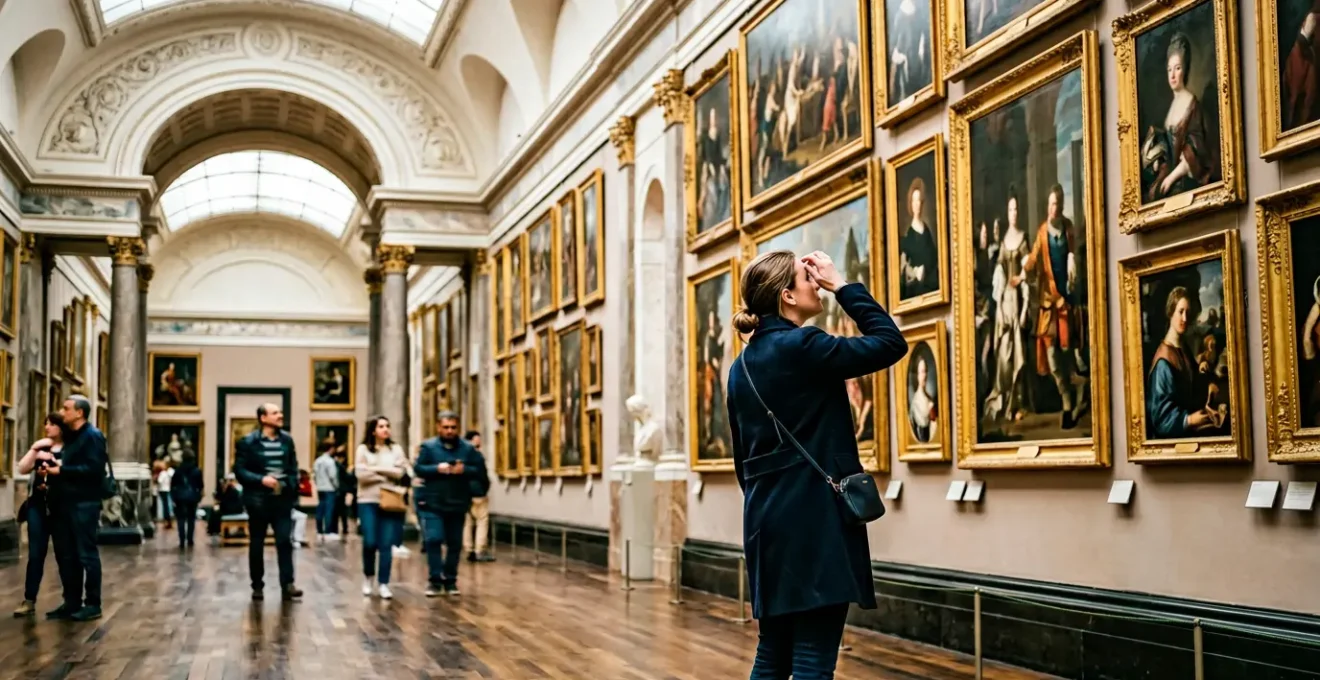
Your museum fatigue isn’t a lack of stamina; it’s a predictable result of a design conflict between historic palaces and the demands of mass tourism.
- Cognitive load, caused by navigational confusion and decision-making, is the true source of exhaustion—not just the physical act of walking.
- A strategic, pre-planned « mission, » such as following a specific theme, is far more effective for a satisfying visit than simply trying to avoid crowds.
Recommendation: Stop trying to « see » a museum and start designing a specific, personal experience *within* it. This guide shows you how.
You arrive at the Louvre, heart full of anticipation. You are an art lover, ready for a day of inspiration. Yet, 90 minutes later, you find yourself utterly drained, navigating seas of people, and feeling more frustration than wonder. The common advice— »go early, » « buy tickets online, » « don’t try to see it all »—feels hollow because you did all that, and it still fell flat. You leave feeling a strange sense of personal failure, questioning your own capacity to appreciate one of the world’s greatest cultural treasures.
But what if the problem isn’t your stamina or your planning? What if the overwhelming feeling is a built-in feature, an unavoidable consequence of placing a 21st-century tourist attraction into an 18th-century royal palace? The exhaustion you feel is not a personal failing but a design problem. The key to a fulfilling visit isn’t about finding clever tricks to « beat the system, » but about understanding the system’s inherent flaws—its architectural conflicts, its psychological traps—and designing a personal experience that artfully sidesteps them.
This guide deconstructs why these magnificent institutions so often feel like exercises in crowd management rather than cultural immersion. We will explore the cognitive science behind « museum fatigue, » analyze the strategic blunders most visitors make before they even step inside, and provide a concrete framework for reclaiming your visit. It’s time to move beyond the checklist and transform your next museum trip from an overwhelming ordeal into a deeply personal and rewarding engagement with art.
Summary: From Museum Fatigue to Masterful Visit: A Strategic Guide
- Why Are You Exhausted After 90 Minutes at the Louvre Despite Loving Art?
- How to See the Louvre’s Best Without Walking 5 Miles or Waiting in Lines?
- Musée d’Orsay or Centre Pompidou: Which Paris Museum Offers More Satisfying Single Visit?
- The Ticket Mistake That Costs You 90 Minutes of Queue Time at French Museums
- When Are French National Museums Most Rewarding for Serious Art Engagement?
- Why Do Major French Museums Feel More Like Crowd Management Than Cultural Experience?
- Why Does Versailles Channel You Through Rooms Without Time to Absorb Anything?
- Why Do People Leave the Louvre Having Only Seen the Mona Lisa They Couldn’t Get Near?
Why Are You Exhausted After 90 Minutes at the Louvre Despite Loving Art?
That profound sense of exhaustion you feel in a large museum isn’t primarily physical; it’s cognitive. Known as « museum fatigue, » this phenomenon is the result of your brain working overtime. Long before your feet give out, your mind is drained by the constant, low-level effort of navigating, making choices, and processing an overwhelming amount of visual information. In fact, research shows that museum visitors’ interest begins to decline after just 30 minutes, not because of boredom, but because of intense mental exertion.
The root cause is cognitive load. Unlike a purpose-built modern gallery, a former palace like the Louvre forces you to simultaneously interpret complex art, navigate a confusing layout not designed for public flow, and actively inhibit natural impulses like wanting to get closer or touch. This mental juggling act is incredibly taxing. Factors like crowd density, the pressure to « see the right things, » and even the subconscious effort of following « do not touch » signs all contribute to hijacking your attention and depleting your mental energy reserves.
This isn’t a new problem. Studies dating back to 1916 have documented how the very environment of a museum contributes to mental fatigue. Every decision— »Do I turn left or right? », « Should I read this label? », « Is that a masterpiece I should know? »—adds to your cognitive load. You’re not just looking at art; you’re performing a continuous series of micro-tasks that, when combined, are more mentally draining than a mountain hike. The feeling of being overwhelmed is a perfectly normal response to an environment that demands an unsustainable level of mental processing.
How to See the Louvre’s Best Without Walking 5 Miles or Waiting in Lines?
The solution to Louvre-induced exhaustion is not to walk faster or develop more stamina, but to abandon the idea of « seeing the Louvre » altogether. Instead, you must adopt a strategic mindset and design a targeted « mission. » This transforms you from a passive wanderer into an active curator of your own experience, dramatically reducing cognitive load and physical strain. The goal is to impose a clear narrative onto a chaotic environment.
Here are three powerful strategies to achieve this:
- The Thematic Thread Strategy: Before you go, pick a niche theme that interests you personally—such as « Depictions of Power, » « The Evolution of the Portrait, » or « Mythological Creatures. » Use the museum map to chart a course that connects only the artworks related to your theme. This gives your visit a purpose and a story, allowing you to ignore 99% of the museum guilt-free and move with intention.
- The Hub-and-Spoke Model: Choose a central, less-crowded gallery in your chosen wing to serve as your « base camp. » From this hub, make short, targeted excursions to one or two adjacent rooms to see specific works. Then, return to your base to rest, reorient, and absorb what you’ve seen before venturing out again. This method breaks the visit into manageable chunks and prevents the long, disorienting treks that cause fatigue.
- The One Masterpiece Deep Dive: Instead of spending 30 seconds with 60 famous works, commit to spending 30 minutes with a single, less-famous masterpiece. Before your visit, choose a piece that intrigues you. Once there, study its composition, the use of light, its historical context, and the artist’s story. This approach delivers a far more profound and memorable connection than a superficial sprint through the highlights.
To execute these strategies, preparation is key. Use the lesser-known Carrousel du Louvre or Porte des Lions entrances to bypass the main Pyramid security lines. More importantly, download the museum map in advance or use the free on-site Wi-Fi (‘Louvre_Wifi_Gratuit’) to access digital maps and the « My Visit to the Louvre » app. This allows you to plan your mission before you even step inside.
Musée d’Orsay or Centre Pompidou: Which Paris Museum Offers More Satisfying Single Visit?
For the visitor seeking a single, highly satisfying art experience without the risk of « Louvre syndrome, » the choice between the Musée d’Orsay and the Centre Pompidou is critical. Both are world-class institutions, but they offer fundamentally different experiences in terms of layout, atmosphere, and cognitive demand. The key to satisfaction lies in aligning the museum’s design with your personal expectations.
The Musée d’Orsay, housed in a former train station, offers a more linear and intuitive journey. Its chronological layout guides you through the progression of 19th and early 20th-century art, telling a coherent story. The Centre Pompidou, in contrast, features vast, open-plan floors that encourage self-directed exploration, which can feel liberating for some but disorienting and overwhelming for others without a strict plan. For a visitor prioritizing a clear narrative and manageable scale, the Orsay generally provides a higher effort-to-reward ratio.
The table below breaks down the experiential differences:
| Criterion | Musée d’Orsay | Centre Pompidou |
|---|---|---|
| Layout & Navigation | Linear, intuitive (former train station), chronological story-like experience, compact and focused | Open-plan floors, self-directed exploration, sometimes disorienting, vast and diverse collection |
| Atmosphere | Serene, light-filled contemplation vibe, Belle Époque elegance, quiet galleries | Vibrant urban energy, radical modern architecture, library, cinema, street performers outside |
| Collection Focus | 1848-1914 French art (Impressionist & Post-Impressionist: Monet, Van Gogh, Degas) | Modern/Contemporary art (post-1914: Picasso, Matisse, multimedia installations) |
| Effort-to-Reward Ratio | High – more achievable satisfying single visit due to focused period and compact size | Lower – vast diversity can feel overwhelming without strict plan, similar to Louvre challenge |
| Visitor Experience | Classic Paris art-history experience, glamorous, international and passionate crowd | Creative rebellion, hands-on, playful, colorful architecture as part of experience |
| Best For | First-time visitors wanting iconic Impressionist works in manageable setting | Modern art enthusiasts, those seeking experimental/interactive experience and city views |
Ultimately, your choice should reflect your goal. If you desire a serene, focused encounter with iconic Impressionist and Post-Impressionist masterpieces in a glamorous setting, the Orsay is the more reliable choice for a satisfying single visit. If you thrive on vibrant energy, modern experimentation, and the thrill of discovery in a space where the architecture is part of the art, the Pompidou will be more rewarding, provided you go in with a clear plan of attack.
The Ticket Mistake That Costs You 90 Minutes of Queue Time at French Museums
The most common and frustrating mistake visitors make is assuming that any ticket bought online is a « skip-the-line » ticket. In major French museums, this misunderstanding can easily cost you an hour or more in a queue you thought you had avoided. The key is to understand the crucial distinction between different types of tickets and the separate lines for security and ticket purchasing.
Buying a standard ticket online might let you bypass the ticket-buying queue, but it does not exempt you from the often much longer security line. Worse, many visitors fail to secure a time-stamped ticket (‘billet horodaté’). This is a reservation for a specific entry slot (e.g., 10:00-10:30 AM). Without one, even with a pre-paid ticket, you may be forced into a slow-moving queue for those without a reserved time, or even denied entry during peak periods.
Even the popular Paris Museum Pass has a major pitfall. While it grants access and lets you skip ticket *purchase* lines, it does NOT automatically grant you entry. For high-demand sites like the Louvre, you must still go online in advance and use your pass to book a free, mandatory time slot. Showing up with just the pass during a busy period can lead to a very long wait or outright refusal. To avoid these costly errors, a pre-visit audit of your ticketing strategy is essential.
Your Pre-Visit Ticketing Audit
- Ticket Type Verification: Check your ticket confirmation. Does it explicitly state a time slot (e.g., « Entrée: 10h30 »)? If it only shows a date, it is not a time-stamped ticket and you may face queues.
- Entrance Strategy: Have you identified a secondary, less-crowded entrance? Research and locate an alternative like the Carrousel du Louvre or Porte des Lions to minimize the unavoidable security queue time.
- Museum Pass Protocol: If using a Paris Museum Pass, have you gone to the Louvre’s official website to reserve a specific, mandatory time slot? Confirm you have a separate reservation confirmation in addition to your pass.
- Time Slot Adherence: Note the strictness of your time window. Plan to arrive at the museum entrance at the beginning of your reserved slot, as arriving more than 30 minutes late can invalidate your ticket at major sites.
- Reservation Confirmation: For peak season visits, have you double-checked if a time slot reservation is now mandatory even for sites that previously didn’t require it? Policies can change, especially for popular exhibitions.
When Are French National Museums Most Rewarding for Serious Art Engagement?
For a truly rewarding visit, the goal isn’t just to find a quiet time, but to find a time conducive to serious artistic engagement. This means not only fewer people, but a different quality of light and a more contemplative atmosphere. The conventional wisdom of « go on a weekday » is often flawed, as museums are frequently packed with disruptive school groups during term time.
A more effective strategy is to target specific windows when the crowds thin and the environment changes. Late afternoons on weekdays, after 3:00 PM, are often excellent as school groups have departed. However, the most transformative experience is often found during evening hours, or « nocturnes. » The Louvre, for instance, is open until 9:45 PM on Fridays. This is a game-changer; data from the Louvre reveals that 440,000 visitors took advantage of its Friday night openings in 2023, seeking a different experience.
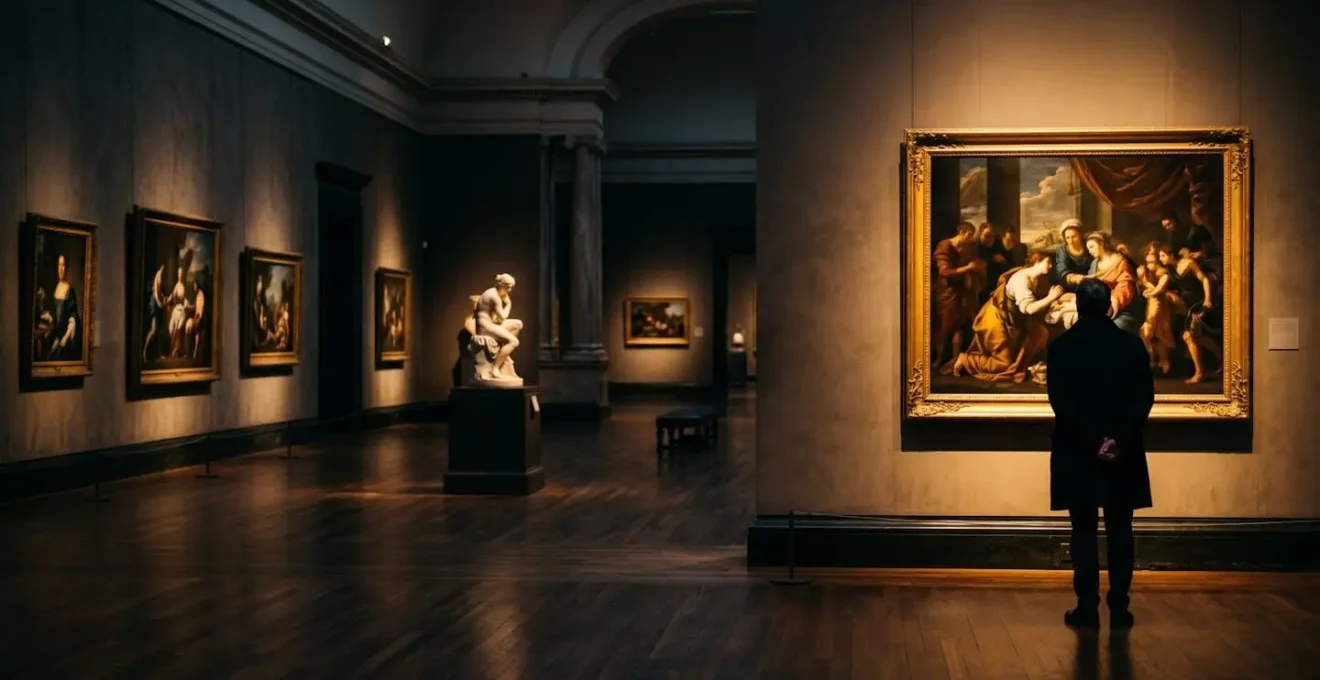
Visiting at night offers a completely different aesthetic. Artificial lighting creates dramatic shadows and highlights, transforming the perception of sculptures and paintings. The surrounding darkness fosters a more intimate, focused, and almost sacred viewing condition. Here is a strategic guide to timing your visit:
- Evening Hours (Nocturnes): Prioritize evening openings (like Fridays at the Louvre) for a dramatic and less crowded experience. The artificial light reveals different details in the artworks.
- Late Afternoon Weekdays: Aim for visits after 3 PM on weekdays during the school year to avoid the rush of school tours and enjoy relative calm before closing.
- Early Morning Precision: If you must go in the morning, be at the entrance before the 9 AM opening time. The first 60-90 minutes offer a precious window of tranquility before the midday crowds arrive.
- First Sunday (Off-Season): From November to March, the free first Sunday of the month can be surprisingly rewarding. While busy, the crowd is often composed of more locals and engaged art lovers than tourists, creating a different energy.
- Avoid Peak Times: Steer clear of weekends, public holidays, and French school vacation periods at all costs. Always check the museum’s schedule for major temporary exhibitions, as these significantly increase overall footfall.
Why Do Major French Museums Feel More Like Crowd Management Than Cultural Experience?
The feeling that you’re being managed rather than enriched stems from a fundamental, unsolvable conflict at the heart of institutions like the Louvre. They are forced to serve two opposing masters: they are sacred temples of culture, but also massive, cash-generating tourist attractions. In 2023, the Louvre, the world’s most visited museum, welcomed 8.9 million visitors. Managing this volume of people within a structure never designed for it forces a design philosophy where visitor flow and security inevitably take precedence over individual contemplation.
This is the architectural conflict: adapting a former royal palace, with its series of sequential state rooms and narrow corridors, for mass public circulation is an immense challenge. The building’s original design was meant to guide a select few through a specific procession, not to allow millions to wander freely. This inherent mismatch creates natural bottlenecks, confusing pathways, and a sense of being « herded » through predefined routes.
This architectural problem is compounded by a marketing one. To make the vast collection digestible to a global audience, museums often focus their promotion on a handful of « blockbuster » masterpieces like the Mona Lisa or the Venus de Milo. This creates what is known as the « Blockbuster Effect. » It funnels a huge percentage of visitors towards a few key locations, inevitably generating human traffic jams and turning a journey of discovery into a « checklist » to be completed. The galleries in between become mere corridors to be rushed through, rather than spaces for quiet reflection. Your feeling of being processed is not an illusion; it’s a direct consequence of the operational imperatives of managing millions within a historic, ill-suited container.
Why Does Versailles Channel You Through Rooms Without Time to Absorb Anything?
The sensation of being pushed through the rooms at the Palace of Versailles is not accidental; it is a direct consequence of both historical architecture and modern social psychology. The visitor route you follow is intentionally linear because it is designed to mimic the historical, processional nature of courtly life. You are, in effect, walking the same path a 17th-century courtier would have taken to progress through the King’s State Apartments. Understanding this can shift your perception from « being herded » to « participating in a historical reenactment. »
However, this historical layout collides with the reality of modern tourism. With historic houses like Versailles welcoming 6.9 million visitors in 2022, the narrow rooms and corridors create an intense psychological phenomenon known as « Audience Pressure. » This is more than simple overcrowding. It is the subconscious, felt presence of the crowd behind you, waiting their turn. This pressure creates a powerful, non-verbal cue to move on, inhibiting your ability to stop and truly absorb your surroundings.
Even if no one explicitly tells you to move, your brain registers the social expectation to keep the line flowing. You feel the collective impatience of those behind you, and this social signal overrides your personal desire to linger. This is why you can feel rushed even when there isn’t a stated time limit per room. The architecture designed for procession combines with the psychology of crowd pressure to create a forward momentum that is very difficult to resist. You are not just being channeled by the building, but also by the silent, collective will of the thousands of other visitors sharing the same constrained space.
Key Takeaways
- Museum fatigue is primarily cognitive, not physical, caused by decision-making and navigational stress in environments not designed for public flow.
- A successful visit requires a proactive « experience design » approach. Creating a specific mission, like a thematic tour, is more effective than aimless wandering.
- Understanding the nuances of ticketing, especially the requirement for a time-stamped ticket (‘billet horodaté’), is more critical than simply buying online.
Why Do People Leave the Louvre Having Only Seen the Mona Lisa They Couldn’t Get Near?
The magnetic pull of the Mona Lisa, which causes thousands to fight for a glimpse of a small, distant painting, has little to do with art appreciation and everything to do with psychology. With the Louvre receiving an average of 29,000 visitors daily in 2023, the phenomenon is driven by a powerful cognitive bias called Social Proof. The value is not in the personal experience of seeing the artwork, but in participating in a global cultural ritual and gaining the social currency to say, « I was there. » The act of seeing it becomes secondary to the validation of having completed the task.
This is amplified by « Goal-Oriented Tourism. » When faced with a limited timeframe and an overwhelming number of options (the Louvre has over 35,000 works on display), tourists default to a checklist of famous « goals. » The Mona Lisa is the ultimate, most recognizable goal, making it a cognitive shortcut that overrides any nascent desire for personal discovery. It feels like the « right » thing to do because everyone else is doing it.
The strategic reframe is to use the Mona Lisa not as a destination, but as a gateway. After performing the ritual and seeing Leonardo’s famous portrait, you are in the perfect position for true discovery. Instead of immediately leaving, you can walk just five minutes into the adjacent galleries of Italian masters—artists who influenced Leonardo or were his contemporaries—and find yourself in a nearly empty room with ten other people. This transforms the experience from one of checklist completion to one of genuine exploration and context. The Mona Lisa becomes the starting point of your journey, not the disappointing end.
Now that you understand the hidden forces shaping your museum experience, the next step is to apply this « experience design » mindset to your next cultural outing. By reframing your visit as a personal mission rather than a public obligation, you can curate a day that is memorable, enriching, and entirely your own.