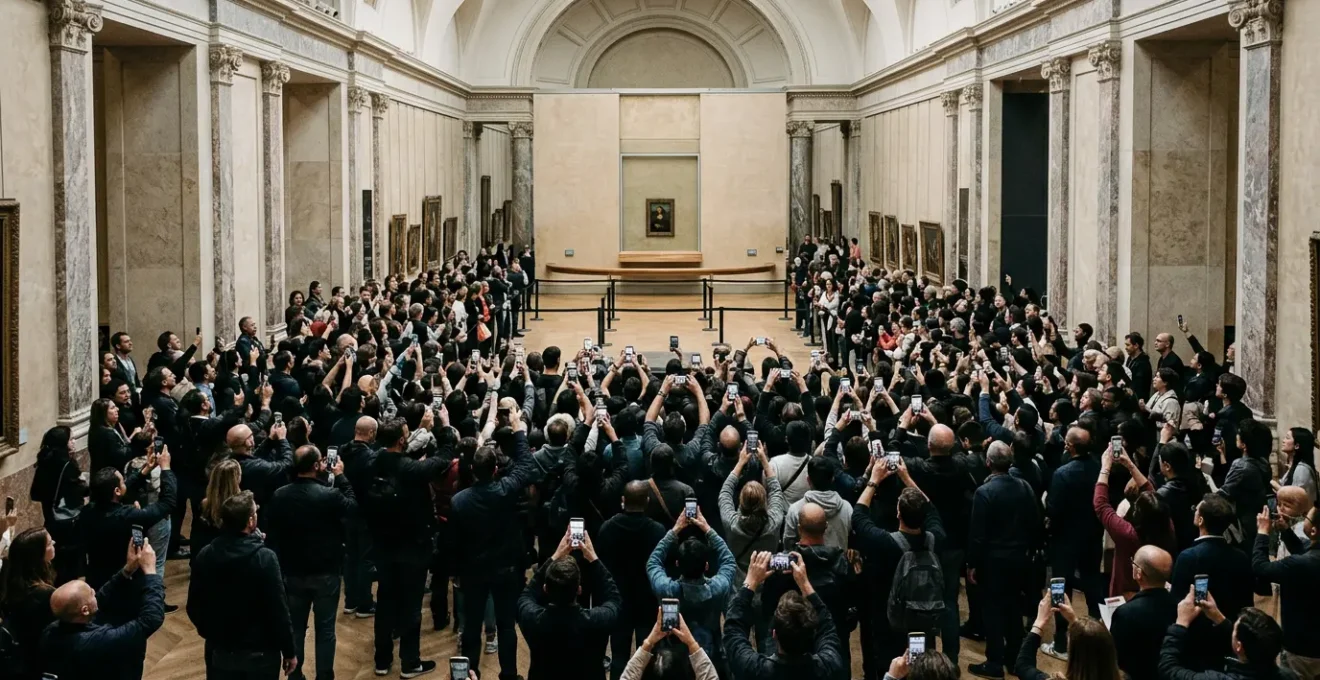
Contrary to popular belief, a successful Louvre visit has nothing to do with seeing the ‘Big Three’ and everything to do with outsmarting the museum’s design.
- The Louvre’s confusing layout isn’t a flaw; it’s a strategic tool you can use to find empty galleries.
- The crushing crowds around famous works create “experience vacuums”—entire wings filled with masterpieces, but no people.
Recommendation: Stop following the herd. Instead of a checklist, use a ‘curatorial mindset’ to design a short, deep, and personal tour that guarantees you’ll find artistic magic.
There’s a shared, slightly deflating experience among millions of Louvre visitors. You arrive, filled with anticipation for a day of cultural immersion, and you leave hours later, feet aching, head spinning, with a blurry photo of the Mona Lisa taken from 15 feet away as your primary trophy. You’ve been told the Louvre is the greatest museum in the world, yet the reality often feels like an exhausting, overwhelming battle against crowds and a labyrinthine layout.
The standard advice—”buy tickets online,” “wear comfortable shoes,” “don’t try to see it all”—is well-meaning but ultimately fails to address the core problem. It doesn’t explain *why* the museum feels so overwhelming or provide a real strategy to overcome it. The feeling of failure isn’t your fault; it’s a predictable outcome of visiting a 15-acre former palace packed with 35,000 works of art without an insider’s game plan.
But what if the very things that make the Louvre overwhelming—its scale, its confusing history, and its crowds—are actually secrets to a profoundly personal and unforgettable visit? The key isn’t to see more, but to see smarter. It’s about trading the ‘checklist’ for a ‘curator’s mindset’ and learning to read the museum’s map not as a list of obligations, but as a web of opportunities for genuine discovery.
This guide will equip you with that insider knowledge. We will deconstruct the Louvre’s challenges and turn them into your advantages, showing you how to navigate its wings, choose your battles, and find artistic intimacy in the most-visited museum on earth. You will learn not just how to visit the Louvre, but how to experience it.
To help you craft this perfect visit, we’ve broken down the essential strategies into a clear roadmap. This summary outlines the key steps to transforming your experience from overwhelming to unforgettable.
Summary: Your Insider’s Guide to a Meaningful Louvre Visit
- Why Is the Louvre’s Layout So Confusing and How Can You Use It to Your Advantage?
- How to Design a 3-Hour Louvre Route That Matches Your Specific Art Interests?
- Egyptian Antiquities or Italian Painting: Which Louvre Department Rewards First Visits Most?
- The Famous Painting Hunt That Makes You Miss Better Art in Empty Rooms Nearby
- When Should You Arrive at the Louvre to Have Galleries Nearly to Yourself?
- How to See the Louvre’s Best Without Walking 5 Miles or Waiting in Lines?
- How to Find Castles and Monuments That Actually Let You Explore Secret Areas?
- Why Does Everyone Say the Louvre Is Amazing but Your Visit Felt Overwhelming?
Why Is the Louvre’s Layout So Confusing and How Can You Use It to Your Advantage?
The first thing to understand is that the Louvre was never designed to be a museum. Its bewildering, non-linear layout is the direct result of its 800-year history as a medieval fortress, then a royal palace, before finally becoming a public institution. This architectural evolution is the source of most visitors’ navigational frustration, but for the informed visitor, it’s a strategic key.
Case Study: The Louvre’s Architectural Evolution
The museum’s current three-wing structure (Denon, Richelieu, Sully) wasn’t a master plan but a centuries-long process of additions and renovations. The wings weren’t built to guide tourists but to house royalty, which is why they don’t flow logically from one to the next. However, this history gives each wing a distinct “personality.” Sully is the historical heart, built around the medieval fortress foundations. Richelieu is known for its grand sculpture courts and royal apartments. Denon is the blockbuster wing, home to the Italian masters. Understanding these personalities allows you to choose an experience, not just a direction.
Instead of trying to conquer the whole palace, the secret is to treat it like three interconnected, smaller museums. Your goal is not to walk from one end to the other, but to master one territory. By choosing a single wing based on its personality, you immediately reduce the cognitive load and transform an impossible marathon into a manageable, enjoyable exploration. The layout stops being confusing and becomes a curatorial framework. You’re no longer lost; you’re being selective.
How to Design a 3-Hour Louvre Route That Matches Your Specific Art Interests?
Once you’ve accepted you can’t see everything, a new, liberating question emerges: “What do I truly want to see?” This is the shift from a checklist mindset to a curatorial mindset. You are now the director of your own experience. An effective 3-hour visit isn’t about rushing between highlights; it’s about creating a personal narrative thread that connects a few, carefully chosen pieces.
The “5-3-1 Rule” is a powerful framework for this. Instead of a random walk, you design a journey with purpose. Start by using the Louvre’s online database before your visit to identify five “anchor pieces” that genuinely fascinate you, regardless of their fame. These could be tied to a theme you love—say, “Depictions of Power,” “Mythological Creatures,” or “The Art of the Dutch Golden Age.” Then, identify three gallery sections that connect them and plan to walk through these at a relaxed pace. Finally, leave space for one serendipitous find. This structure provides direction without sacrificing the joy of discovery.
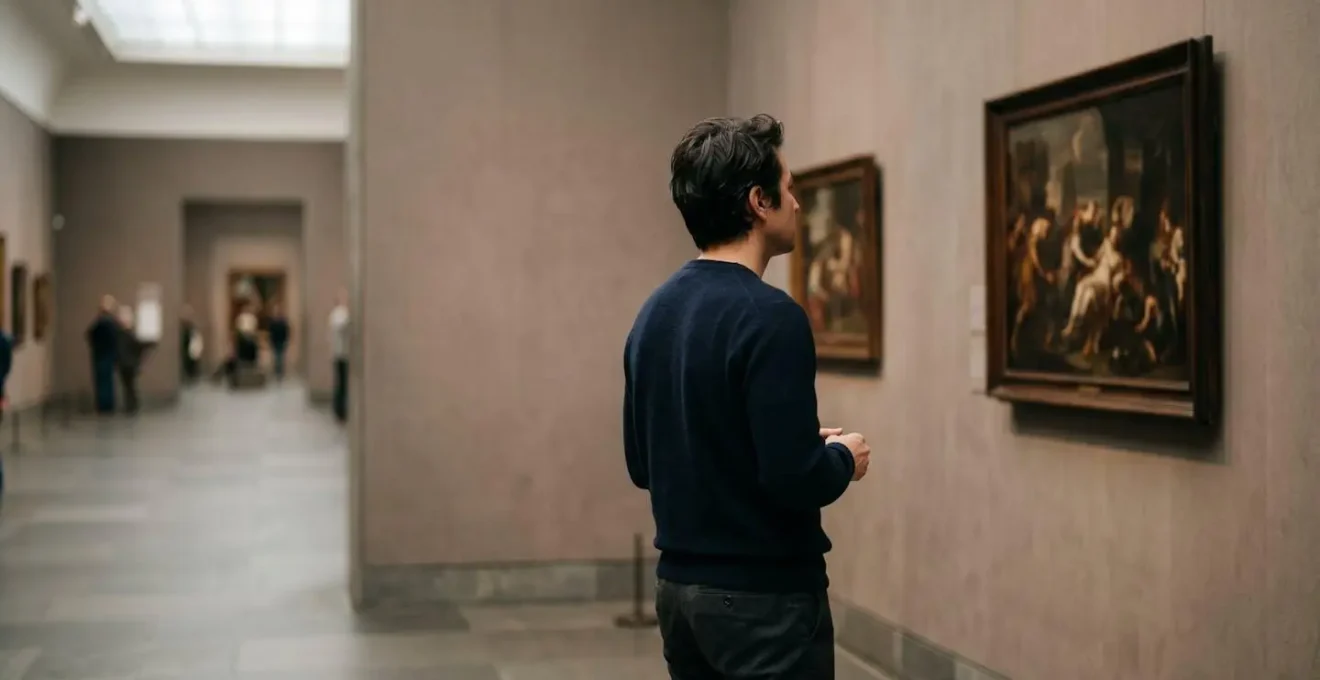
This approach transforms your visit. You’re no longer a passive consumer ticking off a list. You are an active participant, engaging in a dialogue with the art. You will spend 20 meaningful minutes with a painting you chose, understanding its story and details, rather than 20 seconds jostling for a view of one you were told to see. This is the essence of a rewarding museum visit: depth over breadth. You will leave with a handful of vivid, lasting memories instead of a blur of vaguely recalled masterpieces.
Egyptian Antiquities or Italian Painting: Which Louvre Department Rewards First Visits Most?
For a first-time visitor grappling with limited time, the choice of where to begin can be paralysing. The two most popular starting points are often the grand narrative paintings of the Denon Wing or the mysterious depths of the Egyptian Antiquities in the Sully Wing. From an ‘insider’ perspective, the choice isn’t about which art is “better,” but which department delivers a better visitor experience under the pressure of crowds and fatigue.
While the Denon wing holds the marquee names like the Mona Lisa and is the default for most, its linear “highway” design often leads to a congested, rushed experience. You are swept along by the current of the crowd, with little room for quiet contemplation. The Egyptian Antiquities, by contrast, offer a vastly different spatial dynamic. Its labyrinthine layout, spread across dozens of interconnected rooms and crypts, naturally disperses visitors. This creates more breathing room and a higher “serendipity factor,” where discovery feels personal as you turn a corner into an unexpectedly quiet chamber.
This detailed comparison, based on an analysis from museum experience experts, highlights the experiential differences between the two most popular departments.
| Aspect | Egyptian Antiquities (Sully Wing) | Italian Paintings (Denon Wing) |
|---|---|---|
| Spatial Layout | Labyrinthine, multi-room layout encouraging meandering discovery | Linear, often congested ‘highway’ through sequential galleries |
| Crowd Density | More breathing room, visitors spread across multiple chambers | Heavy concentration, especially near Mona Lisa and major Renaissance works |
| Visitor Psychology Match | Best for: fascination with ancient mysteries, grand rituals, epic scale of civilization | Best for: seeking emotional narratives, human drama, Renaissance masterpieces |
| Viewing Pace | Self-paced exploration, less pressure from crowds behind you | Often feels rushed due to crowd flow and queue for famous works |
| Serendipity Factor | High—unexpected discoveries around corners | Lower—most visitors follow same famous-works route |
For a rewarding first visit, especially if you want to avoid feeling overwhelmed, the Egyptian department often delivers a more satisfying sense of personal exploration and discovery. You trade the obligation of seeing the ‘big hits’ for the genuine thrill of unearthing treasures on your own terms.
The Famous Painting Hunt That Makes You Miss Better Art in Empty Rooms Nearby
The single biggest mistake visitors make is the “Famous Painting Hunt.” It’s a journey driven by obligation, not curiosity, and it paradoxically ensures you will have a worse experience and miss better art. The intense concentration of crowds around a few key masterpieces creates a phenomenon we can call the “Mona Lisa Gravity Well.” This gravitational pull of the crowd creates vast “experience vacuums” – entire galleries, often just metres away, that are stunningly beautiful, historically significant, and completely empty.
Case Study: The Experience Vacuum in Action
The phenomenon is starkly evident in the Salle des États. While hundreds of people jostle with their backs to the wall to get a photo of the Mona Lisa, they are literally turning their backs on Veronese’s ‘The Wedding at Cana.’ This is the largest painting in the entire Louvre, a masterpiece of Venetian painting teeming with life and detail. Because it’s not on the “must-see” checklist, it sits in the same room, viewable in perfect, quiet conditions. This demonstrates how checklist tourism creates an artificial scarcity of attention, leaving world-class art virtually ignored.
The secret is to consciously defy the gravity well. When you see a massive crowd, treat it as a signpost pointing towards a nearby opportunity for solitude and discovery. Instead of joining the throng, pivot 180 degrees and walk into the adjacent, emptier room. You are almost guaranteed to find something spectacular that you can have all to yourself.
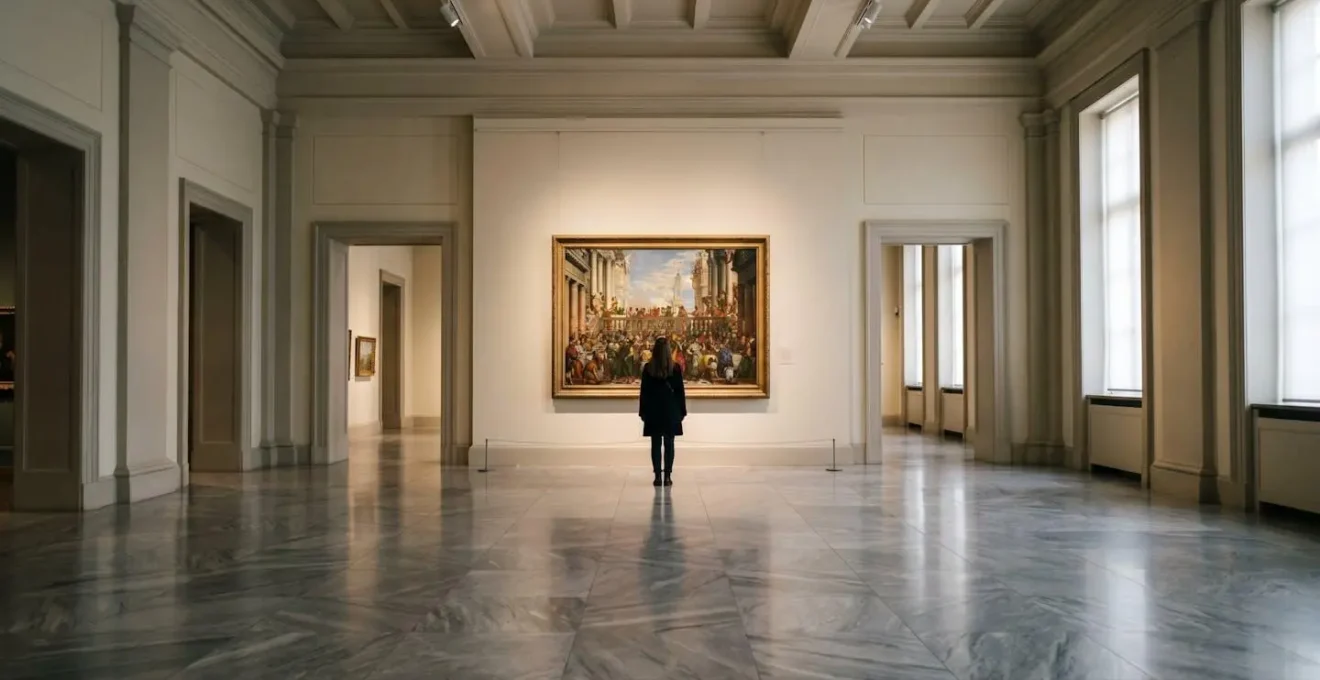
To cultivate this skill, you need to switch from passive viewing to active looking. Playing a game like the “Curator’s Eye” can transform your experience entirely.
Action Plan: The Curator’s Eye Game
- Choose a less-famous gallery: Opt for the Dutch Golden Age paintings, French decorative arts, or the stunning Islamic Art section.
- Go analog: Put away your phone and audio guide. Rely only on your eyes for this exercise.
- Ask the three key questions: For each artwork, ask yourself: (1) What detail intrigues me most? (2) What story is being told? (3) Which one would I save in a fire?
- Practice “slow looking”: Spend a full hour in this single gallery, engaging deeply with just 5-7 works instead of scanning dozens.
- Document your discoveries: Take a photo or note of your personal favourites to research later. This turns passive consumption into active curation.
By doing this, you are not just seeing art; you are building a personal connection to it, a memory far more valuable than a blurry photo of a famous painting.
When Should You Arrive at the Louvre to Have Galleries Nearly to Yourself?
“Go early or late” is the most common advice for avoiding crowds, but it lacks the nuance of a true insider strategy. With the Louvre implementing a daily cap and welcoming over 28,700 visitors per day on average in 2023, timing is everything. Understanding the museum’s daily rhythm allows you to find pockets of calm that most visitors miss.
The most powerful strategy is not just arriving early, but thinking counter-intuitively once you’re inside. At 9:00 AM, 90% of the crowd makes a beeline for the Denon wing and the Mona Lisa. The ultimate hack is to do the exact opposite. Head directly to the furthest, most remote galleries of the Richelieu or Sully wings. You will be rewarded with 30-60 minutes of near-total solitude among French sculptures or Egyptian sarcophagi before the rest of the museum’s population disperses.
Another powerful tactic is to leverage the late openings on Wednesdays and Fridays (until 9:45 PM). But again, don’t just show up late. Employ the “Reverse Flow” strategy: arrive around 6:00 PM, when the evening rush is over, and start at the far ends of the wings. You will essentially be walking against the tide of the few remaining visitors, who are making their way out. The galleries will progressively empty around you, culminating in a magical, quiet experience under the Pyramid as closing time approaches. And don’t underestimate the “lunch lull” between 12:30 PM and 2:00 PM, especially on weekdays, when large tour groups depart and create a brief but noticeable dip in crowd density in major galleries.
How to See the Louvre’s Best Without Walking 5 Miles or Waiting in Lines?
The physical exhaustion of a Louvre visit is legendary. The sheer scale of the palace means visitors can easily walk 4-5 miles. However, much of this walking, and the associated waiting in line, is entirely avoidable with a few key logistical secrets. The most impactful secret begins before you even see the famous glass pyramid.
Forget the main Pyramid entrance. The snaking queues you see are a trap for the uninformed. The ultimate insider’s entrance is via the Métro. By taking Line 1 to the Palais Royal-Musée du Louvre station, you can enter the Carrousel du Louvre underground shopping centre. From there, follow the signs directly to the museum’s entrance hall. This climate-controlled, underground route completely bypasses all exterior queues—security, ticketing, and weather. With a pre-purchased timed ticket, this method, hailed as one of the most effective ‘secrets’ shared by local guides, can save you 1-2 hours of standing in line before you’ve even started.
Once inside, the best way to reduce walking is to abandon the idea of seeing “the Louvre” and instead commit to the “Single Wing Immersion” strategy. Dedicate your entire visit to just one wing. This dramatically reduces travel time between disparate collections and replaces exhausting cross-palace treks with deep, focused exploration.
Case Study: The Richelieu Wing Deep Dive
A visit focused solely on the Richelieu wing offers a complete, satisfying museum experience in a manageable area. You can marvel at the monumental French sculptures in the Cour Marly under its glass roof, wander through the impossibly opulent Napoleon III apartments, and then explore masterpieces of Northern European painting by Rembrandt and Vermeer. This “deep dive” provides rich cultural immersion and high satisfaction, eliminating the anxiety of missing out by reframing success as depth of experience rather than breadth of coverage.
Combining the underground entrance with a single-wing focus is the definitive strategy for a visit that is both physically comfortable and mentally enriching. You save your energy for the art, not for the queues and corridors.
How to Find Castles and Monuments That Actually Let You Explore Secret Areas?
The “curator’s mindset” you’ve honed at the Louvre—the art of looking past the obvious and seeking personal discovery—is a skill that can transform how you experience all historical sites. The frustration of being herded along a roped-off path is common, but many French monuments offer hidden opportunities for those who know how to look for them. The secret lies in using the right language in your research.
Instead of generic searches, using specific French terms unlocks a world of non-standard tours. Searching for “visite insolite” (unusual tour) or “visite des coulisses” (backstage tour) on a monument’s official website can reveal tours that go into normally restricted areas, from conservation workshops to hidden chapels. These are often led by passionate curators or historians and offer a level of intimacy with the site that standard visits lack. It is important to differentiate between ‘secret’ areas (which are truly inaccessible) and ‘unseen’ areas, which are simply overlooked. Your goal is to find the latter.
This mindset shift allows you to discover gems hidden in plain sight. Instead of battling crowds at Versailles, you might find yourself exploring the vast, hauntingly empty medieval halls of the Conciergerie in Paris or wandering freely through centuries of royal rooms at the Château de Fontainebleau. You learn that the most memorable experience isn’t always at the most famous landmark. Often, it’s in the place that gives you the space and freedom to feel a direct, tactile connection with history.
The key is to apply the Louvre lesson: the greatest reward comes not from ticking a box, but from the thrill of personal discovery. By actively seeking out these less-travelled paths, you trade a passive viewing for an active exploration, ensuring your cultural encounters are always meaningful.
Key Takeaways
- Feeling overwhelmed at the Louvre is a normal cognitive response to “object saturation,” not a personal failure.
- The museum’s confusing layout is a strategic advantage; treat the three wings (Denon, Richelieu, Sully) as separate, smaller museums and explore only one.
- Adopt a “curator’s mindset” by pre-selecting a few personal “anchor pieces” and focusing on depth of experience, not breadth of coverage.
Why Does Everyone Say the Louvre Is Amazing but Your Visit Felt Overwhelming?
If your Louvre visit felt more like a chore than a wonder, you are not alone, and it is not your fault. The feeling is a well-documented phenomenon known as “museum fatigue.” It’s a specific form of mental exhaustion caused by information overload and decision fatigue. Research has shown that our ability to meaningfully engage with exhibits plummets surprisingly quickly in a museum environment.
The Louvre is an extreme case. With 35,000 objects on display, your brain is forced into a constant, subconscious process of filtering. Every doorway is a decision, every label a piece of data to process, and every artwork a competitor for your limited attention. This “object competition” is neurologically taxing. As influential researcher Stephen Bitgood noted, this isn’t just about being tired; it’s a cognitive shutdown.
Museum fatigue is not a simple phenomenon and to understand it we need to examine the impact of all the phenomena as well as how they interact with each other. At least 2 phenomena (object competition and information overload) that have been associated with ‘fatigue’ appear to have little to do with fatigue other than share the pattern of decreased attention.
– Stephen Bitgood, Visitor Studies Journal
This is compounded by the psychological pressure of the “checklist mindset.” The implicit social obligation to “see the highlights” turns what should be a journey of discovery into a stressful scavenger hunt. The result is inevitable: you feel overwhelmed because you are trying to do something your brain is not wired to do. As peer-reviewed museum studies confirm that visitor attention drops sharply in as little as 20 minutes, attempting a multi-hour, multi-wing marathon without a strategy is a recipe for burnout.
The strategies in this guide—choosing one wing, adopting a curator’s mindset, and using crowds as a navigational tool—are not just “tips.” They are cognitive management tools designed to counteract museum fatigue. By limiting your scope, you reduce decision fatigue. By having a personal plan, you eliminate the pressure of the checklist. You give your brain the space it needs to truly see and connect with the few things you choose to focus on, transforming an overwhelming space into a place of personal meaning.
By embracing this insider’s approach, you’re ready to transform your relationship with the Louvre from one of intimidation to one of intimate discovery. The next step is to put this knowledge into practice and craft the visit you’ve always wanted.