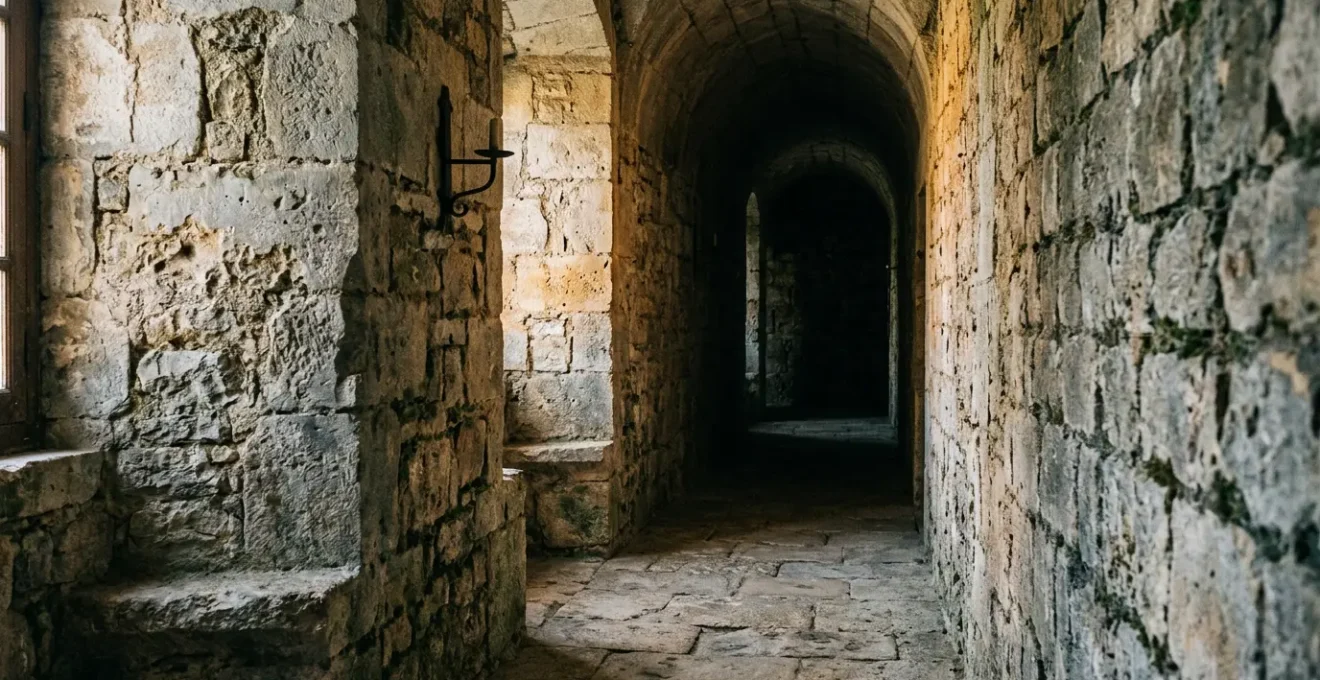
The common frustration of guidebooks teasing secret passages without granting access isn’t a dead end; it’s a misunderstanding of how French heritage operates. The solution lies not in finding a different guide, but in learning to decipher the unspoken code of preservation, safety, and economics that governs these hidden spaces. This article provides the key to transforming you from a passive tourist into a strategic explorer who knows exactly how to unlock France’s concealed history.
For any history enthusiast, the words “secret passage” are a siren call. You read them in a guidebook, your imagination ignites with visions of hidden staircases and dusty tunnels, only to arrive at the château and find… nothing. The guide might wave a hand vaguely at a wall, mention a long-sealed tunnel, and move on. This experience is so common it has become a cliché of cultural tourism, leaving you with the nagging question: are these hidden spaces just a romantic myth used to sell tickets?
The conventional wisdom is to simply accept this limitation or to pin all your hopes on the annual European Heritage Days. But the reality is far more nuanced and, for the dedicated explorer, far more rewarding. The silence surrounding these spaces isn’t usually a deliberate refusal to share history. It’s a complex system of what can be called heritage gatekeeping, driven by legitimate concerns for conservation, visitor safety, and the stark economic realities of maintaining centuries-old structures.
But what if the true secret isn’t the passage itself, but the method to gain access? The key is to shift your approach from that of a standard tourist to a focused researcher. By understanding the reasons behind the secrecy, you can learn to identify the sites that are willing and able to open their doors, recognise the marketing ploys, and use “strategic inquiry” to uncover experiences that aren’t listed in any commercial guide.
This guide will deconstruct that system. We will explore why some châteaux embrace their hidden architecture while others feign ignorance, provide a concrete plan to find the ones that grant access, and even reveal how to turn the confusing layouts of giants like the Louvre to your advantage. Prepare to move beyond the guidebook and start discovering the history that lies just behind the wall.
To help you navigate this hidden world, this article breaks down the essential strategies and insights. Here is a summary of the path we will follow to unlock France’s most guarded secrets.
Summary: A Specialist’s Guide to Uncovering French Heritage Secrets
- Why Do Some Châteaux Show Their Secret Passages While Others Pretend They Don’t Exist?
- How to Find Castles and Monuments That Actually Let You Explore Secret Areas?
- Underground Tunnels or Hidden Rooms: Which Type of French Secret Space Rewards Exploration?
- The “Secret Tour” That Shows You Nothing Actually Hidden at Premium Prices
- When Do French Heritage Sites Open Rarely-Shown Secret Areas to the Public?
- Why Is the Louvre’s Layout So Confusing and How Can You Use It to Your Advantage?
- How to Find Castles and Historical Sites That Don’t Appear in Standard Guidebooks?
- Why Do Small French Towns Sometimes Have More Fascinating History Than Famous Sites?
Why Do Some Châteaux Show Their Secret Passages While Others Pretend They Don’t Exist?
The paradox of the “mentioned-but-hidden” passage is not a conspiracy; it’s a fundamental conflict between preservation and profit. A secret passage is, by its nature, an unstable and often dangerous architectural feature. It was never designed for high-traffic tourism. For many private owners or underfunded public sites, the cost of securing, lighting, and insuring a medieval tunnel is simply prohibitive. Opening it to the public creates a massive liability. Therefore, it’s often easier and safer to keep it as a romantic anecdote rather than a physical attraction. This silence is a form of heritage gatekeeping born from practicality, not secrecy for its own sake.
On the other side of the equation is the immense pressure to attract visitors. With French heritage sites welcoming 46.8 million visitors in 2023, competition is fierce. The allure of “secrets” is a powerful marketing tool. Some châteaux have successfully navigated this conflict by turning their hidden infrastructure into their main feature. They invest heavily in making these spaces safe and accessible, using the revenue generated from this unique offering to fund the ongoing, and often monumental, conservation work required.
Case Study: The Château de Brézé Model
Château de Brézé in the Loire Valley is the ultimate example of this strategy. It is, in essence, a castle on top of another castle. The site has successfully opened kilometres of its vast underground fortress to the public, including tunnels, storerooms, and even a fully functional subterranean bakery. This was not a simple decision. It required significant investment in modern lighting, structural stabilization of moat walls, and continuous restoration projects. The genius of the Brézé model is that it created a virtuous cycle: the unique appeal of its underground network draws enough visitors whose entrance fees directly fund the very preservation that makes their visit possible. This proves that with the right management and financial model, secret passages can be a sustainable and accessible part of the visitor experience.
Ultimately, a château’s decision to reveal or conceal its secrets is an economic and logistical calculation. The sites that do it successfully, like Brézé, demonstrate that it requires a dedicated mission to balance public engagement with the immense responsibility of preservation. For the explorer, understanding this dynamic is the first step in identifying which doors are truly locked and which ones might open with the right approach.
How to Find Castles and Monuments That Actually Let You Explore Secret Areas?
Once you understand the “why” behind the secrecy, you can begin the “how” of discovery. Finding the châteaux that genuinely open their hidden areas requires moving beyond standard tourist channels and adopting a researcher’s mindset. It’s a process of strategic inquiry, where you learn to read the signals that indicate authentic access. This means looking for specific language, targeting niche events, and sometimes making direct contact with a well-researched question.
The goal is to demonstrate that you are not a casual tourist seeking a quick thrill, but a genuine enthusiast interested in the site’s history and architecture. This approach can yield surprising results, from discovering pre-announced “exceptional openings” to receiving a spontaneous invitation from a proud owner or conservator. The key is knowing where and how to look for these opportunities, which often hide in plain sight but outside the glare of mainstream tourism marketing.
The following five-step plan outlines a practical methodology for identifying these sites and maximizing your chances of stepping into a part of history that most visitors will never see.

Your Action Plan: A 5-Step Strategy to Uncover Accessible Secret Spaces
- Target Key Events: Focus on the annual Journées du Patrimoine (European Heritage Days) in September. During this weekend, many sites use the opportunity to grant access to spaces “habituellement fermés au public” (usually closed to the public), including tunnels and private chambers.
- Scan for Specific Language: When researching sites online, look past generic marketing. Search for specific French phrases like “visite insolite” (unusual tour), “les coulisses” (behind the scenes), or “ouverture exceptionnelle” (exceptional opening). These are strong indicators of genuine, restricted-access tours.
- Engage in Direct, Scholarly Contact: During the low season (November-February), contact smaller, privately-owned châteaux directly. Don’t just ask “do you have secret passages?” Instead, ask a specific question based on your research (e.g., “I read that the 15th-century tower had a defensive spiral staircase. Is any part of it still visible?”). This signals serious interest and can lead to private viewings.
- Monitor Restoration Projects: Follow heritage foundations like the Fondation du Patrimoine. When a major restoration is completed, sites often organize special openings to showcase the newly secured areas and thank donors. These are prime “access windows.”
- Join a Heritage Association: Become a member of a regional association de patrimoine. These groups of passionate local experts and volunteers often organize members-only tours to sites that are completely unknown to the general public, offering unparalleled access throughout the year.
Underground Tunnels or Hidden Rooms: Which Type of French Secret Space Rewards Exploration?
Not all secret spaces are created equal. The term “secret passage” is a romantic catch-all for a wide variety of architectural features, each with a different purpose, history, and likelihood of being accessible. Understanding this typology is crucial for the strategic explorer. It allows you to refine your search and manage your expectations. A vast network of defensive tunnels offers a very different experience from a compact, emotionally charged priest hole.
Some spaces, like walled-off rooms from previous renovations, are often discovered by accident and are rarely stable enough for public viewing. Others, such as service corridors used by servants to move discreetly through a palace, are more structurally sound and are sometimes integrated into extended “behind-the-scenes” tours. The most historically significant spaces—escape tunnels (souterrains-refuges) and hidden chambers (cachettes) for concealing people—are often the most compelling, but also the most difficult to access due to their age and original clandestine construction.
By knowing what you’re looking for, you can better interpret the information you find. A château advertising its “discreet service corridors” is likely offering an interesting logistical tour, whereas one that has secured a section of its medieval souterrain is providing a rare glimpse into defensive history. The following analysis, based on data from heritage conservation studies, breaks down the different types of spaces and their value to the modern explorer.
| Type of Secret Space | Original Function | Historical Significance | Typical Accessibility | Visitor Experience Value |
|---|---|---|---|---|
| Escape Tunnels (Souterrains-Refuges) | Emergency evacuation during sieges | High – demonstrates medieval defensive strategy | Rare – structural instability common | High when accessible – tangible connection to survival history |
| Hidden Service Corridors | Discreet staff movement between rooms | Moderate – reveals social hierarchy architecture | Moderate – often incorporated into extended tours | Moderate – interesting for understanding palace logistics |
| Priest Holes / Cachettes | Concealing religious figures or valuables | High – linked to specific historical persecution periods | Low – most sealed or too small for visitors | Very High when viewable – compact spaces with intense stories |
| Underground Fortifications | Military defense networks with storage | Very High – complete defensive ecosystems | Growing – sites like Brézé opening kilometers of passages | Very High – immersive experience of medieval military engineering |
| Walled-Off Renovation Rooms | Sealed during architectural modifications | Low to Moderate – time capsules of previous eras | Rare – discovered accidentally during restoration | High for history enthusiasts – authentic preservation of forgotten periods |
This classification serves as a critical filter. The highest reward often comes from underground fortifications and accessible escape tunnels, as they provide an immersive experience. However, the rarity of a viewable priest hole can make it the most memorable discovery of all. Tailor your research to the type of experience you value most.
The “Secret Tour” That Shows You Nothing Actually Hidden at Premium Prices
As the appetite for unique experiences grows, so does the marketing that exploits it. The word “secret” has become a powerful, and often misleading, tool in cultural tourism. Many sites now offer premium-priced “secret tours” or “hidden tours” that, in reality, offer little more than a standard tour with a slightly different route or a few extra anecdotes. This strategy capitalizes on the visitor’s desire for exclusivity, creating the *feeling* of a special experience without providing the substance.
Tourism marketing studies reveal a clear trend: visitors are increasingly willing to pay more for perceived exclusivity. According to research on dynamic pricing in attraction marketing, the number of visitors paying entrance fees over €10-15 has risen significantly. One analysis notes that between 2019 and 2023, the proportion of visitors paying these higher fees jumped from 44% to 54%. The “secret tour” is a perfect vehicle for this premium pricing, as it frames the higher cost as payment for privileged access, even when that access is minimal or illusory.
Distinguishing an authentic “behind-the-scenes” tour from a clever marketing package is therefore a crucial skill for the heritage explorer. Fortunately, there are several red flags and green flags to look for. Genuine restricted-access tours, by necessity, have characteristics that are difficult to fake, such as very small group sizes and specialist guides. Learning to spot these signals will save you both money and disappointment.
Here are the key indicators to help you identify the real deal:
- Red Flag 1: Vague Language. Be wary of descriptions that rely on fuzzy terms like “hidden gems” or “off the beaten path” without specifying *which* normally closed areas you will visit.
- Red Flag 2: Large Group Sizes. Authentic tours into fragile or cramped historic spaces require small groups, typically a maximum of 8-12 people. A “secret tour” for 25 people is almost certainly just a standard tour.
- Red Flag 3: Lack of Specialist Guide. Real access is usually granted by a site historian, curator, or conservator. If the tour is led by a general guide with a script, it’s likely not a true “behind-the-scenes” experience.
- Green Flag: Specific Justifications. Look for tours that require mandatory reservations, mention “exceptional authorization,” or are offered only on specific dates due to “conservation limits.” This language signals genuine logistical constraints, which is a hallmark of authentic access.
When Do French Heritage Sites Open Rarely-Shown Secret Areas to the Public?
Timing is everything. For 99% of the year, most of France’s secret spaces remain firmly behind locked doors for the preservation and safety reasons we’ve discussed. However, specific and predictable “access windows” appear throughout the year when these rules are relaxed. The most famous of these is the Journées Européennes du Patrimoine (European Heritage Days), held annually on the third weekend of September. This is the single best opportunity for the public to gain widespread access.
During this event, over 1,500 sites in the Paris and Île-de-France region alone open their doors for free or at reduced prices, with many offering special tours of otherwise restricted areas. Ministries, embassies, private mansions, and châteaux all participate, making it a nationwide celebration of heritage. For the secret-hunter, this is the main event on the calendar. But it is not the only one. Other access windows include national events like the Nuit des Musées (Night of Museums) or site-specific anniversaries and post-restoration celebrations.
Major monuments often use these events to test the waters for opening new areas or to reward public interest with a temporary, controlled glimpse into their hidden architecture. These are not spontaneous decisions but are planned months in advance, requiring a strategy to manage crowds and ensure safety.
Case Study: The Chambord Lantern Tower Opening
For the 2024 Heritage Days, the iconic Château de Chambord offered a textbook example of a managed access window. It provided exceptional access to its famous tour-lanterne (lantern tower), which rises 56 meters above the structure. This area is normally off-limits. To manage the opportunity, the château implemented a strict system: access was granted in timed 20-minute slots, and visitors had to register in person at the information point on the day. This model perfectly illustrates the balance: offering a breathtaking, unique perspective from the château’s rooftops during a high-interest event, while using capacity controls to maintain safety and prevent overwhelming the historic structure.
The lesson is clear: follow the calendar. By tracking these national and local heritage events, you can plan your visits to coincide with these rare but invaluable opportunities to see what lies behind the velvet rope.
Why Is the Louvre’s Layout So Confusing and How Can You Use It to Your Advantage?
The Louvre is not just a museum; it’s an architectural palimpsest, a building that has been continuously overwritten for 800 years. Its confusing layout is a direct and physical map of French history, and understanding this is the key to navigating it effectively. What feels like a frustrating labyrinth is, in fact, a series of palaces from different eras fused together, each with its own logic, corridors, and courtyards. This historical layering is the primary source of its bewildering visitor experience.
As one analysis from a French heritage study points out, this complexity is the museum’s very identity. This insight reframes the problem: the confusion isn’t a design flaw; it’s a feature.
The confusion is a direct result of the building’s layered history—from medieval fortress to royal palace to public museum. The layout is a ‘map’ of French history itself.
– Heritage Architecture Analysis, French Heritage Conservation Studies
For the strategic visitor, this confusion is an opportunity. While 90% of visitors follow the prescribed, crowded paths from the Pyramid to the Mona Lisa, the museum’s vast, rambling structure contains countless quiet galleries, overlooked masterpieces, and “official” secret spaces. By abandoning the highlight-reel mentality and embracing the labyrinth, you can curate a far more personal and profound experience. The key is to intentionally target the areas the crowds ignore and use the museum’s own historical layers to your advantage.
- Enter Strategically: Use the less-crowded Porte des Lions entrance (on the Seine side). It offers immediate, less-trafficked access to the Denon wing and collections like ancient Egyptian art.
- Target Quiet Wings: The Decorative Arts (Richelieu, 1st floor) and Near Eastern Antiquities departments historically receive a fraction of the visitors of the Italian Paintings galleries, yet they house world-class collections.
- Explore the Foundations: Descend into the Sully wing’s basement to see the excavated foundations of the original medieval fortress. This is the Louvre’s most profound “secret space,” a museum within a museum that most visitors miss entirely.
- Visit During Late Openings: On Wednesday and Friday evenings, the museum stays open late. Crowd density can drop by as much as 60%, transforming congested galleries into quiet, contemplative spaces.
- Get Intentionally Lost: The transitional galleries that connect the main wings are often deserted. These liminal spaces contain hidden courtyards, stunning architectural details, and masterpieces placed outside the main circuits.
How to Find Castles and Historical Sites That Don’t Appear in Standard Guidebooks?
The most rewarding discoveries often lie completely outside the established tourist trail. France has tens of thousands of protected historical sites, but only a tiny fraction ever make it into a Rick Steves or Michelin guide. The true secret for the dedicated explorer is learning how to access the “unlisted inventory”—the vast number of smaller châteaux, forgotten manors, and medieval ruins that are known only to locals and specialists. Finding them requires moving beyond Google Maps and using the same professional-grade tools that French historians and conservationists use.
These tools allow you to peel back the layers of the modern landscape to see what lies beneath. They include official government databases that catalogue every protected structure, historical maps that reveal forgotten estates, and the networks of passionate local heritage groups who are the true guardians of this history. This level of research is the final step in your transformation from tourist to explorer, giving you the ability to build your own unique itinerary of discovery.
Case Study: The Private Owner-Led Tour at Château de Digoine
Château de Digoine in Burgundy is a perfect example of a heritage experience that exists entirely off the guidebook grid. This magnificent private château is lovingly maintained by its owner, who offers intimate, personal tours. Visitors don’t just see architecture; they hear family stories and learn the lived history of the home from the person who knows it best. This type of access is impossible to find through standard tourism channels. It is discovered through specialist networks, direct outreach, or by building a reputation as a visitor with genuine historical interest—precisely the kind of explorer these owners are happy to welcome.
Here are the advanced research techniques to build your own map of undiscovered France:
- Use Historical Map Overlays: France’s official IGN Géoportail (geoportail.gouv.fr) allows you to overlay historical maps, like the 18th-century Carte de Cassini, onto current satellite images. This reveals ruins, earthworks, and old estate layouts invisible on modern maps.
- Search the Mérimée Database: The official Base Mérimée is a government database of all protected historical monuments. Search for properties classified as “inscrit” rather than “classé.” This lower tier of protection often includes significant but less famous sites, many privately owned and unknown to tourism.
- Connect with Local Heritage Associations: The Fédération Patrimoine-Environnement maintains a directory of regional heritage associations. The websites of these local groups are goldmines of information on minor châteaux and vernacular architecture ignored by national bodies.
- Cross-Reference with the Cadastre: Use the French land registry (cadastre.gouv.fr) to identify property boundaries of historic “domaines” (estates). This can help pinpoint historically significant properties even if they are not officially open to the public.
Key Takeaways
- Access to secret passages is governed by a code of preservation, safety, and economics, not just a desire for secrecy.
- Strategic research, targeting specific events like the Journées du Patrimoine and using precise language, is more effective than relying on guidebooks.
- Differentiating between authentic access and premium-priced marketing ploys is a crucial skill for any heritage explorer.
Why Do Small French Towns Sometimes Have More Fascinating History Than Famous Sites?
The final secret to unlocking France’s hidden history is a counter-intuitive one: sometimes, the smaller the town, the deeper the discovery. While famous sites like Versailles or Mont-Saint-Michel offer a polished, and often crowded, version of history, small towns and villages provide something far more valuable for the true explorer: unfiltered access and a human scale. Their historical significance isn’t diluted by mass tourism, and their stories are often more tangible and intimately preserved.
The most powerful advantage offered by these small communities is the accessibility of their archives. A visit to the local mairie (town hall) can yield more in a single afternoon than weeks of navigating a vast national institution. Here, history is not an abstract concept; it’s a collection of old photographs, property records, and cadastral maps often curated by a passionate local archivist who is eager to share their town’s story.
The Accessible Archive Advantage
Unlike the often-intimidating national archives, a small town’s municipal records are a treasure trove for the hands-on researcher. Within a few hours, you can trace the ownership of a local manor, identify architectural features on an old map that have since disappeared, or uncover the story of a local family connected to a nearby ruin. This direct, personal engagement with primary sources—often with the help of a knowledgeable local librarian—is an empowering experience that creates a profound connection to the past, a connection that is simply impossible to achieve on a guided tour with 50 other people.
This is where all the strategies converge. In a small town, you can use the Géoportail to spot a ruin, check the Mérimée database for its status, and then walk into the mairie to ask for the 19th-century cadastral map showing its original estate. This combination of digital research and on-the-ground human interaction is the ultimate method for discovering history that no one else has found.
Your quest for France’s hidden history begins not with a ticket, but with a question. By moving beyond the guidebooks and embracing the methods of a researcher, you transform every trip into a potential discovery. The secrets are there, waiting not for a tourist, but for an explorer. Start your own investigation today.