
Contrary to popular belief, “Haute Couture” is not a marketing term for expensive fashion; it’s a legally protected title, an appellation contrôlée, awarded by the French government to an exclusive group of Parisian ateliers.
- The term “artisanal” is largely unregulated in France, allowing mass-produced items to use it, whereas the “Haute Couture” designation is strictly enforced.
- True value in French luxury often lies in verifiable craftsmanship from specific ateliers (like Lesage embroidery), not just a brand name or logo.
Recommendation: Shift your focus from brand recognition to understanding the legal and craft-based systems behind an item. This is the key to discerning and investing in genuine French luxury.
You see it everywhere: on department store dresses, on perfume bottles, and in countless brand bios. The word “couture” has become a ubiquitous synonym for “luxury” or “high-end.” For many fashion enthusiasts, it signifies detailed craftsmanship, premium materials, and a hefty price tag. This general understanding, however, misses the fundamental truth of what constitutes the pinnacle of fashion. The common belief is that any well-made, expensive garment can claim a connection to couture.
But what if this assumption is fundamentally flawed? What if the term “Haute Couture” has a meaning as precise and legally protected as “Champagne”? The reality is that true Haute Couture is not a style but a legally defined and government-sanctioned designation. It is a closed system, an exclusive club with rules, audits, and a membership list maintained by the French Ministry for Industry. Outside this tiny circle of Parisian ateliers, the word “couture” on a label holds no legal weight and often serves as little more than a powerful marketing adjective.
This distinction is the first and most critical step to understanding French luxury beyond surface-level logo recognition. It is the key to discerning between a genuine piece of applied art and a well-marketed industrial product. This guide deconstructs the codes that separate authentic craftsmanship from brand premiums. We will explore the legal framework that protects this heritage, identify strategies for acquiring pieces of true value, and decode the subtle cultural signals that define Parisian style.
This article will guide you through the intricate world of French luxury, providing a clear framework for assessing authenticity, value, and style. The following sections break down the essential knowledge every collector and enthusiast needs to navigate this landscape with an insider’s confidence.
Summary: Decoding the Real Value of French Luxury
- Why Can Only 15 Houses Legally Call Themselves Haute Couture in Paris?
- How to Afford Your First Authentic Haute Couture-Adjacent Piece Without Spending £20,000?
- Vintage Chanel Bag or Contemporary Dior Dress: Which French Luxury Holds Value Better?
- The Authentication Detail That Exposes 30% of Online “Authentic” French Luxury as Fake
- When Should You Visit Paris for Best Access to Luxury Sales Without Compromising Selection?
- Why Can French Factories Legally Call Mass-Produced Items “Artisanal”?
- Why Do Parisians Spend Less on Clothes but Look More Expensive Than Londoners?
- Why Does Wearing Chanel, Dior and Louis Vuitton Together Look Wrong to French Eyes?
Why Can Only 15 Houses Legally Call Themselves Haute Couture in Paris?
The term Haute Couture is not a qualitative descriptor but a legally protected designation, an appellation contrôlée governed by French law. This status is overseen by the Fédération de la Haute Couture et de la Mode, which enforces a strict set of criteria. To qualify, a fashion house must have an atelier in Paris employing at least 15 full-time staff, present two collections a year with at least 25 original designs for day and evening wear, and create custom-fitted garments for private clients.
This legal framework has deep historical roots. The controlled appellation was officially created through the 1945 ministerial decision that codified the term. Established in the wake of WWII, it was designed to protect the unique ecosystem of Parisian craftsmanship and ensure its top artisans had privileged access to scarce raw materials. While material shortages have ended, the system of legal protection and cultural prestige remains firmly in place.
As the Fédération itself states, this is a matter of law, not just industry tradition. Only those houses that meet the stringent requirements and are approved by a dedicated commission at the Ministry for Industry can use the label.
The term haute couture is protected by French law and defined by the Paris Chamber of Commerce. Only those companies mentioned on the list drawn up each year by a commission domiciled at the Ministry for Industry are entitled to avail themselves of the label haute couture.
– Fédération de la Haute Couture et de la Mode, via Wikipedia
This is why the number of official members is so small and fluctuates. According to recent industry data, only 13 houses currently hold the ‘haute couture’ accreditation, alongside a rotating list of guest members. Any brand outside this circle using the term is doing so for marketing purposes only, without the legal or technical legitimacy the designation confers.
How to Afford Your First Authentic Haute Couture-Adjacent Piece Without Spending £20,000?
While a full, head-to-toe Haute Couture look remains one of the most exclusive purchases in the world, accessing its underlying craftsmanship is more attainable than most believe. The secret is to practice “craft arbitrage”—seeking out the skill and technique of couture without the price tag of the major maison name. This involves looking at the supply chain and adjacent services where the same level of artistry is applied.
One of the most effective methods is exploring demi-mesure or made-to-measure services. Unlike full bespoke, which involves creating a pattern from scratch, demi-mesure starts with a ready-made piece that is then extensively tailored to your body over multiple fittings. Parisian tailors like Smalto offer this service, providing a couture-level fit at a fraction of the cost. Another strategy is to commission or acquire a single couture component and have it integrated into a garment by a local tailor. You could acquire an exquisitely embroidered panel from an atelier like Lesage or unique, handmade buttons from Desrues, elevating a simple garment into a one-of-a-kind piece.
This close-up view reveals the soul of couture: the thousands of hours of human skill invested in a single piece. It is this tangible artistry that you are investing in.
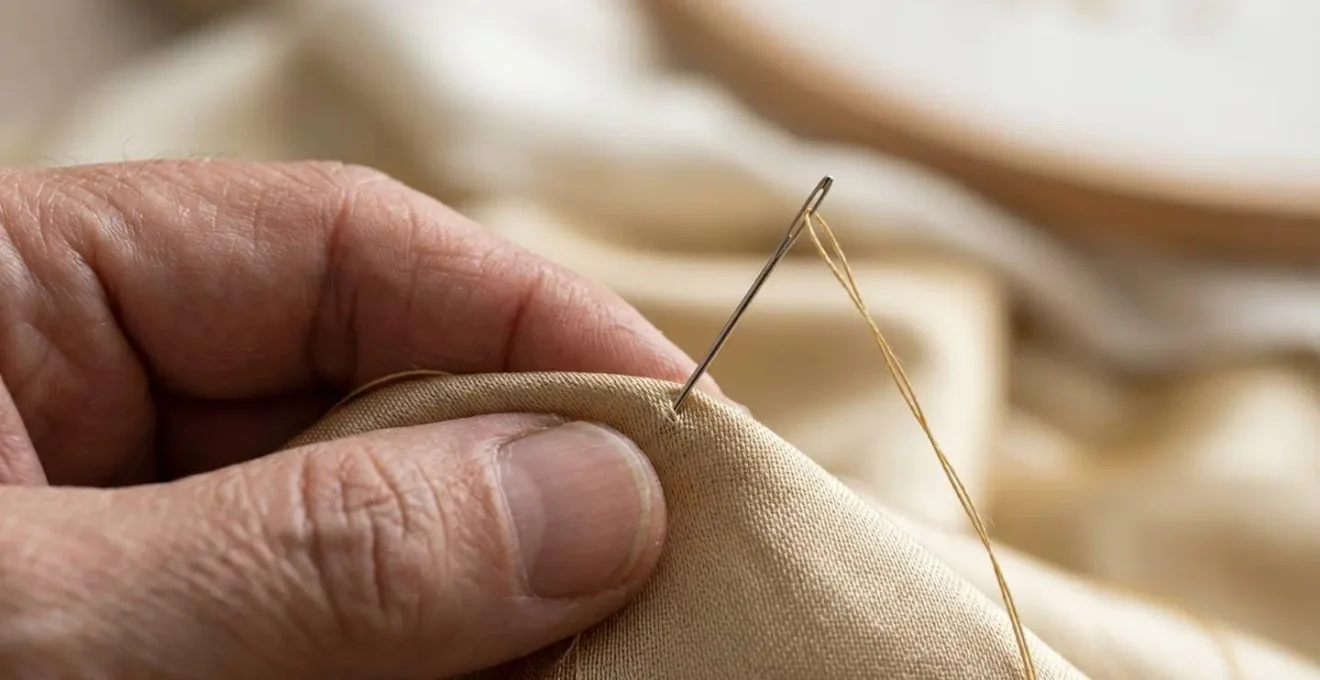
As you can see, the value is in the meticulous handwork, not the label. For those seeking suiting, independent Parisian bespoke tailors such as Camps de Luca or Cifonelli offer garments made with couture techniques for a starting price around €6,500—a significant investment, but a world away from the six-figure cost of a full couture ensemble. Finally, networking with fashion industry insiders can provide access to highly exclusive press or private atelier sales, where samples and past-season pieces are sold at a deep discount.
Vintage Chanel Bag or Contemporary Dior Dress: Which French Luxury Holds Value Better?
When considering French luxury as an investment, the debate often centres on iconic brands and item types. However, the most crucial factor for value retention and appreciation is not the brand name itself, but the level of irreplicable craftsmanship embedded within the piece. While a contemporary ready-to-wear dress from Dior may be beautiful, it is ultimately a factory-produced item made in the thousands. Its value is tied to current trends and will likely depreciate once the season ends.
In contrast, a vintage piece—whether a bag, jacket, or gown—that features significant work from a renowned métier d’art atelier like Lesage (embroidery), Lemarié (feathers and flowers), or Goossens (goldsmithing) possesses an intrinsic value that is decoupled from fashion’s fleeting cycles. This is because the handwork is a quantifiable and increasingly rare asset. A single haute couture jacket featuring Lesage embroidery, for example, can require over 700 hours of handwork to complete. This labour represents an artistic investment that collectors recognise and are willing to pay a premium for, now and in the future.
An industry analysis in Seamwork Magazine reinforces this, stating that “a piece featuring work from a renowned atelier…has an intrinsic craft value that can make it appreciate independently of the brand’s general market performance.” Therefore, a vintage Chanel bag from an era known for its 24k gold-plated hardware and superior construction will almost always be a better investment than a contemporary ready-to-wear item. The key is to look for evidence of the “hand”—the unmistakable touch of an artisan. This is the true hallmark of an investment-grade piece, far more than a current-season logo.
The Authentication Detail That Exposes 30% of Online “Authentic” French Luxury as Fake
In the world of online resellers, the market is flooded with sophisticated fakes that can mimic logos, serial numbers, and even packaging. For the untrained eye, spotting a counterfeit can feel impossible. However, there is one area where counterfeiters almost always fail: the hardware. The key authentication detail is not the shape or the engraving of a logo, but the hardware density and metallurgical quality.
Authentic French luxury houses, particularly heritage brands like Hermès and Chanel (especially vintage pieces), invest heavily in their hardware. Clasps, zippers, and chain straps are often custom-made from dense, high-quality metals like brass, which are then plated in precious materials like gold or palladium. This results in hardware that has a noticeable physical weight and a solid, cold feel. When you hold it, it feels substantial. Counterfeiters, aiming to cut costs, typically use cheaper, lighter zinc alloys or plastics coated with a metallic finish. These pieces feel light, hollow, and warm to the touch.
This macro photograph highlights the integrity of authentic hardware. The precision of the milling and the substantial nature of the metal are impossible to replicate cheaply.

Observe the finish and the engineering. Authentic hardware often shows microscopic signs of precision machining, with clean edges and flawless surfaces. Fake hardware, by contrast, may have tell-tale signs of being cast in a mould, such as slightly rounded edges, pitting, or an uneven, bubbly surface. When you operate a clasp or a zipper, an authentic mechanism will have a smooth, satisfyingly engineered click or glide. A fake one will often feel gritty, flimsy, or misaligned. Before you even look at a logo, pick up the bag and focus on the weight and feel of its metal components. This single tactile test can expose a huge percentage of fakes that otherwise look visually convincing.
When Should You Visit Paris for Best Access to Luxury Sales Without Compromising Selection?
Timing your trip to Paris for the official sales, or Soldes, is a strategic art. The state-regulated sales happen twice a year, typically starting in January (winter) and late June (summer). While the deepest discounts of up to 70% occur in the final weeks, this is a trap for the discerning buyer. By that point, the only items left are often in undesirable sizes, extreme colours, or are unwearable runway pieces. The key is to access the sales early, when selection is pristine.
The ultimate goal is to gain access to the Ventes Privées, or private sales, which are held exclusively for established clients of a maison two to three weeks before the official Soldes begin. These offer first pick of the current season’s inventory at a 20-40% discount. Gaining access requires building a relationship with a sales associate over time. For a first-time strategic shopper, the most effective approach is the “pre-sales” strategy. Visit your target boutiques about one week before the official start date. Introduce yourself to a sales associate, select the items you wish to purchase, and have them held for you. The associate will then ring up the purchase on the first official day of the sale, guaranteeing you get the pieces you want in your size.
If pre-sales are not an option, the next best strategy is to be at the boutique when its doors open on Day 1 of the official Soldes. This still provides access to the full range of marked-down inventory before it’s picked over. This tiered approach ensures you balance discount with selection.
Your Action Plan for Paris Luxury Sales
- Relationship Building: For top-tier access, become a known client at a specific boutique. This is the only path to Ventes Privées.
- Pre-Sales Reconnaissance: Visit boutiques 7-10 days before the official Soldes start date. Choose your items and build a rapport with a sales associate to have them held.
- Day 1 Assault: If pre-sales fail, be present at the boutique’s opening on the first official day of the sales for the best selection of discounted stock.
- Size & Colour Priority: Focus on securing classic pieces in neutral colours and your correct size first. These are the first to sell out.
- Avoid the Final Week: Do not be tempted by 70% discounts. The remaining inventory is almost always compromised and represents poor value, even at a steep discount.
Why Can French Factories Legally Call Mass-Produced Items “Artisanal”?
For many consumers, the word “artisanal” evokes images of a skilled craftsperson labouring over a single item in a small workshop. In France, however, this romantic notion collides with the realities of commercial law. The key lies in the distinction between the noun “Artisan” and the adjective “artisanal.” In France, “Artisan” is a protected title for a person who is professionally qualified and registered with the official Chambre de Métiers et de l’Artisanat. It signifies a verified level of skill and a small-scale operation.
The adjective “artisanal,” however, is a different matter. It is a largely unregulated marketing term. As legal analysis points out, it can be legally applied to a process or a recipe, even if that process is executed at an industrial scale. A factory making thousands of croissants a day can legally call them “artisanal” if they use a traditional recipe. Similarly, a factory producing thousands of identical leather bags can use the term if a single step in the production line, such as stitching a handle, involves a degree of handwork, no matter how minor.
This legal loophole is a key distinction in French commercial law that many brands exploit. So, how does a discerning consumer identify true, preserved craftsmanship? The answer lies in another, far more meaningful designation: the Entreprise du Patrimoine Vivant (EPV) label. This is a state-issued certification awarded by the government to French firms with excellent and rare traditional craftsmanship. An EPV-certified company—be it a weaver, a lace maker, or a goldsmith—represents the gold standard of genuine French savoir-faire. When seeking authentic craft, looking for the EPV label is a much more reliable indicator than the often-misleading adjective “artisanal.”
Why Do Parisians Spend Less on Clothes but Look More Expensive Than Londoners?
The comparison between Parisian and Londoner style often comes down to a fundamental difference in philosophy: investment and alteration versus trends and volume. While it’s a generalisation, the typical Parisian approach to building a wardrobe is not about acquiring a large number of clothes, but about investing in fewer, higher-quality pieces and then perfecting them. The secret weapon in this strategy is the ubiquitous culture of the retoucheur, or local tailor.
Rather than expecting a garment to fit perfectly off the rack, a Parisian will buy a well-made blazer from a mid-range brand and immediately take it to a trusted tailor to have the shoulders adjusted, the waist taken in, and the sleeves shortened to the perfect length. This small additional investment transforms a €150 ready-to-wear piece, giving it the silhouette and drape of a bespoke garment. An expertly tailored, well-fitting high-street piece will always look more expensive than an ill-fitting £1,500 designer item. This philosophy is about prioritising fit over brand.
This investment mindset extends to the highest echelons of menswear. At top Parisian ateliers, it’s understood that time equals value. It’s not uncommon for artisans to spend more than 60 hours on a single bespoke suit, an investment intended to last a lifetime. This cost-per-wear thinking filters down to the mainstream. Parisians spend less overall because they buy fewer items, but the items they do buy are chosen for their quality and potential for longevity, which is then unlocked through tailoring. It’s a focus on silhouette and personal fit rather than the fleeting statement of a logo or a “look of the season.”
Key Takeaways
- “Haute Couture” is a legally protected French title, not a generic term for luxury fashion. Its use is strictly controlled by the government.
- True investment value in luxury goods comes from demonstrable, rare craftsmanship (e.g., specific embroidery, hardware quality), not from brand logos or current trends.
- The Parisian “expensive look” relies on a philosophy of buying fewer, better pieces and investing in expert tailoring (retoucheurs) to perfect the fit, prioritising silhouette over logos.
Why Does Wearing Chanel, Dior and Louis Vuitton Together Look Wrong to French Eyes?
To an outside observer, combining multiple prestigious luxury brands might seem like the ultimate display of success and style. A Chanel bag with a Dior coat and Louis Vuitton shoes sounds like a powerful statement. To discerning French eyes, however, this practice of “logo-stacking” often looks unsophisticated or, as they might say, nouveau riche. This reaction is rooted in a core tenet of French style philosophy: the art of décalage.
Décalage translates literally to a “gap” or “mismatch.” In fashion, it is the practice of creating visual interest and effortless sophistication through deliberate contrast. It means pairing a precious or highly structured item with something casual, worn, or unexpected. Think of a perfectly tailored couture jacket worn with faded, vintage jeans; an exquisite silk blouse paired with simple, masculine brogues; or a classic Hermès handbag carried with a simple, unbranded white t-shirt. This intentional mismatch grounds the luxury item, making it part of a personal style rather than a costume.
This approach avoids the one-dimensional effect of being a walking advertisement for a single brand or a billboard for luxury in general. As one cultural analysis notes, true couture is a statement about values—”slowness, depth, and the dignity of making things well.” It is an element to be integrated into a life, not a uniform to be worn.
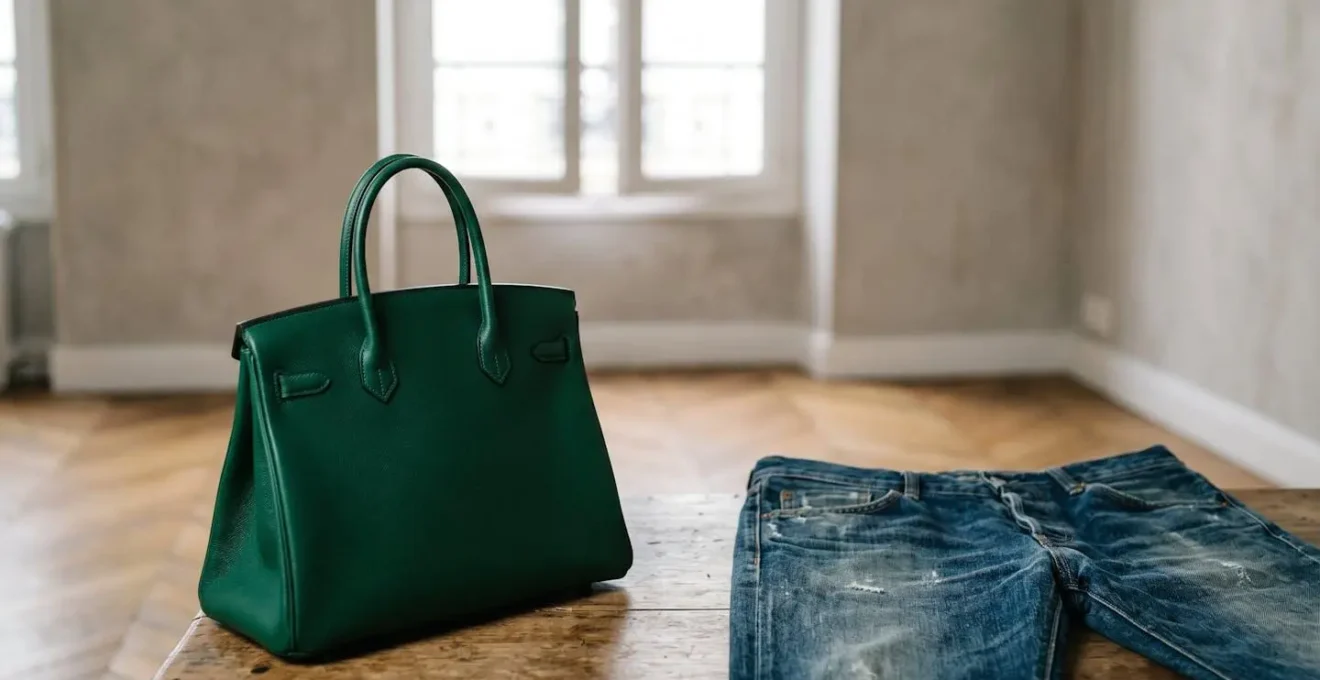
Wearing multiple, easily identifiable luxury brands at once eliminates this sophisticated tension. It creates a look that is too “literal,” too coordinated, and lacks the personal touch that comes from mixing high and low, new and old, precious and ordinary. It signals that the wearer understands brand names but not the subtle, underlying codes of style. The goal is not to show you can afford everything, but to show you have the confidence to integrate one beautiful thing into your own authentic world.
Now that you are equipped with the legal, technical, and cultural codes of French luxury, the next step is to apply this framework. Move beyond the logos and start evaluating pieces based on their true, intrinsic qualities: the legality of their designation, the verifiable craft of their construction, and their potential to integrate into a personal, sophisticated wardrobe.