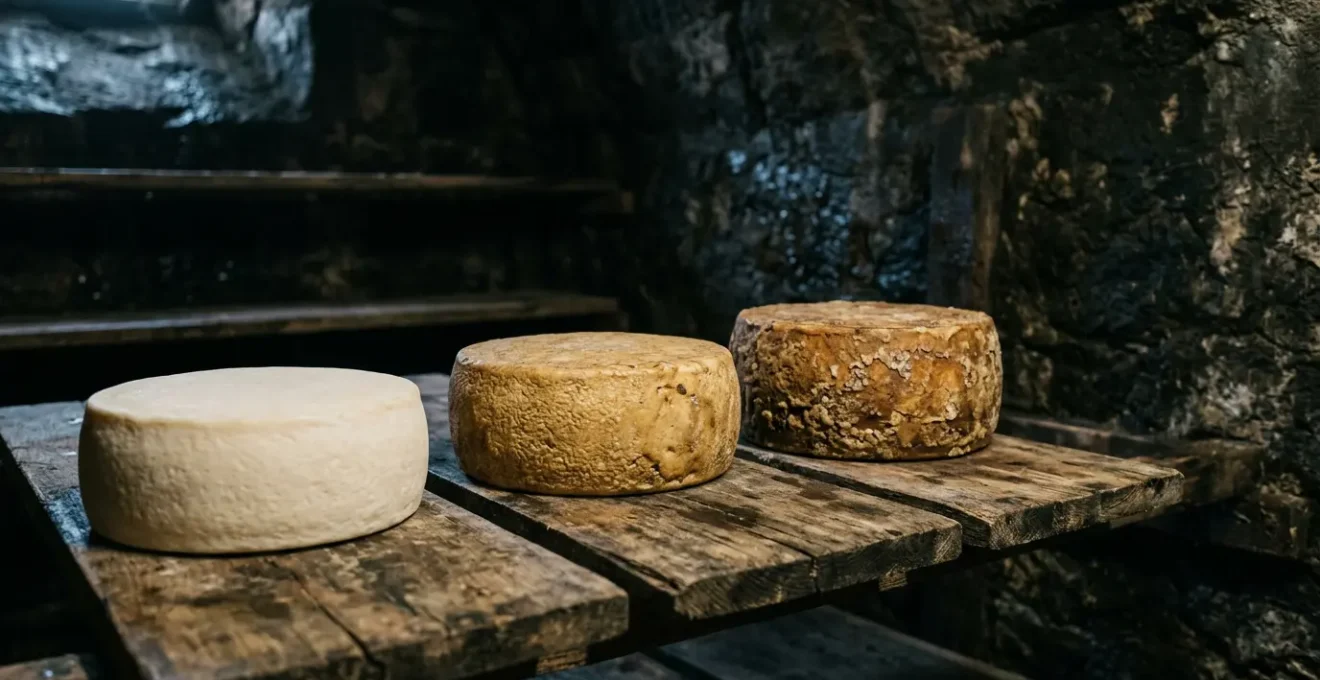
The AOP label is not a guarantee of superior taste, but a baseline of authenticity; true quality is revealed by decoding secondary signals like the producer, the affineur (ripener), and the season of production.
- A high price on an AOP cheese often reflects the reputation of the affineur or the rarity of farmhouse (fermier) production, not just the AOP status itself.
- Supermarket AOP cheeses are typically younger and mass-selected, whereas specialist shops offer wheels aged for complexity and chosen for superior flavour profiles.
Recommendation: To find the best value, learn to look beyond the AOP logo. Ask your cheesemonger about the affineur, the age, and the production style (fermier vs. laitier) to find a cheese that truly justifies its price.
You stand before the cheese counter, a familiar scene for any UK buyer with a love for French gastronomy. Two blocks of Comté sit side-by-side. Both bear the coveted red-and-yellow AOP (Appellation d’Origine Protégée) seal, a symbol of protected origin and traditional methods. Yet, one costs three times as much as the other. This frustrating paradox is common: the AOP status, which should be a beacon of quality, often creates more confusion than clarity, leading you to wonder if you’re just paying for fancy packaging or a story.
The conventional wisdom is to “just look for the AOP logo.” But this advice is incomplete. It ignores the intricate system of quality that operates *within* the AOP framework. The AOP guarantees a specific process, geography, and raw material—the *cahier des charges*—but it sets a minimum standard, not a peak of flavour. The difference between a good AOP cheese and a truly exceptional one lies in a series of secondary signals that most consumers overlook: the skill of the producer, the art of the affineur (the master ripener), the season the milk was collected, and the specific aging process.
But what if the key to navigating this landscape wasn’t about trusting the primary label, but about learning to read these secondary clues? This guide is designed to act as your designation systems analyst, clarifying value and discriminating quality. We will move beyond the logo to explore the hidden factors that create profound differences in taste and texture. By understanding the roles of farmhouse production, master affineurs, and seasonal variations, you will gain the confidence to select AOP cheese that delivers an experience worthy of its price tag.
This article will deconstruct the AOP system, providing you with the tools to identify true quality. From spotting the subtle label details that expose imitations to understanding why your supermarket Comté can’t compare to an artisanally-aged wheel, you’ll learn to make informed choices at the cheese counter.
Summary: Decoding the True Value of AOP Cheese
- Why Does AOP Status Not Guarantee the Best Example of That Cheese Type?
- How to Find the Best Comté Producer When All Are Equally AOP Certified?
- Fermier or Laitier AOP: Is the Price Premium for Farmhouse Production Worth It?
- The Label Detail That Exposes Non-AOP Cheese Sold as Genuine Protected Designation
- When Is Spring-Made Comté Ready to Eat at Its Peak After Appropriate Ageing?
- Why Does AOP Certification Matter More Than Producer Marketing Claims?
- Why Do Some Grand Cru Wines Cost 10 Times More Than Equally Rated Neighbours?
- Why Does Your Comté From the Supermarket Taste Like Plastic Compared to What You Had in Jura?
Why Does AOP Status Not Guarantee the Best Example of That Cheese Type?
The fundamental misunderstanding of the AOP system is equating its guarantee of origin with a guarantee of superior taste. The AOP label is a legal framework, not a flavour score. It ensures that a cheese like “Camembert de Normandie” is made in Normandy, with raw milk from specific cow breeds, and ladle-moulded according to tradition. It does not, however, grade the skill of the cheesemaker or the specific qualities of that day’s milk. This is why you can have two AOP cheeses, made to the same rulebook, that offer vastly different sensory experiences.
The price difference often reflects factors beyond the basic AOP requirements. One producer might be a celebrated artisan, another a large-scale cooperative. The AOP acts as a baseline, a floor for authenticity, not a ceiling for quality. As one analysis of the system notes, “AOP guarantees a process and provenance, not a superior palate.” This gap between process and palate is where price variations emerge. Consumers are often paying a premium for a brand’s reputation, extended aging, or the unique terroir expression from a single farm—all factors that exist on top of the AOP certification.
This explains the significant price gap; industry data shows that AOP cheeses command a 65% higher average price than their non-AOP counterparts. The label successfully creates a perception of premium value, but it’s up to the discerning buyer to determine if the specific cheese in their hand lives up to that premium. The AOP gets you in the door, but it doesn’t seat you at the best table. True quality lies in the details beyond the seal.
How to Find the Best Comté Producer When All Are Equally AOP Certified?
With over 160 village cooperatives (known as *fruitières*) producing Comté, all under the same AOP certification, identifying a superior wheel requires looking for secondary signals of quality. The AOP is the starting point, but the true differentiators are the affineur (the master ripener) and the specific characteristics of the wheel itself. An exceptional Comté is not just made; it is selected and matured to its peak potential by an expert hand.
The casein plaque, a green tag embedded in the rind of every wheel, is your first clue. It contains codes identifying the *fruitière* and the date of production, offering full traceability. While you may not know the reputation of every cooperative, a knowledgeable cheesemonger does. They are your most valuable resource in navigating the subtle differences. They can identify wheels from renowned affineurs like Marcel Petite or Rivoire-Jacquemin, who have their own proprietary grading systems that go far beyond the basic AOP standards, ensuring a higher level of selection and consistency.
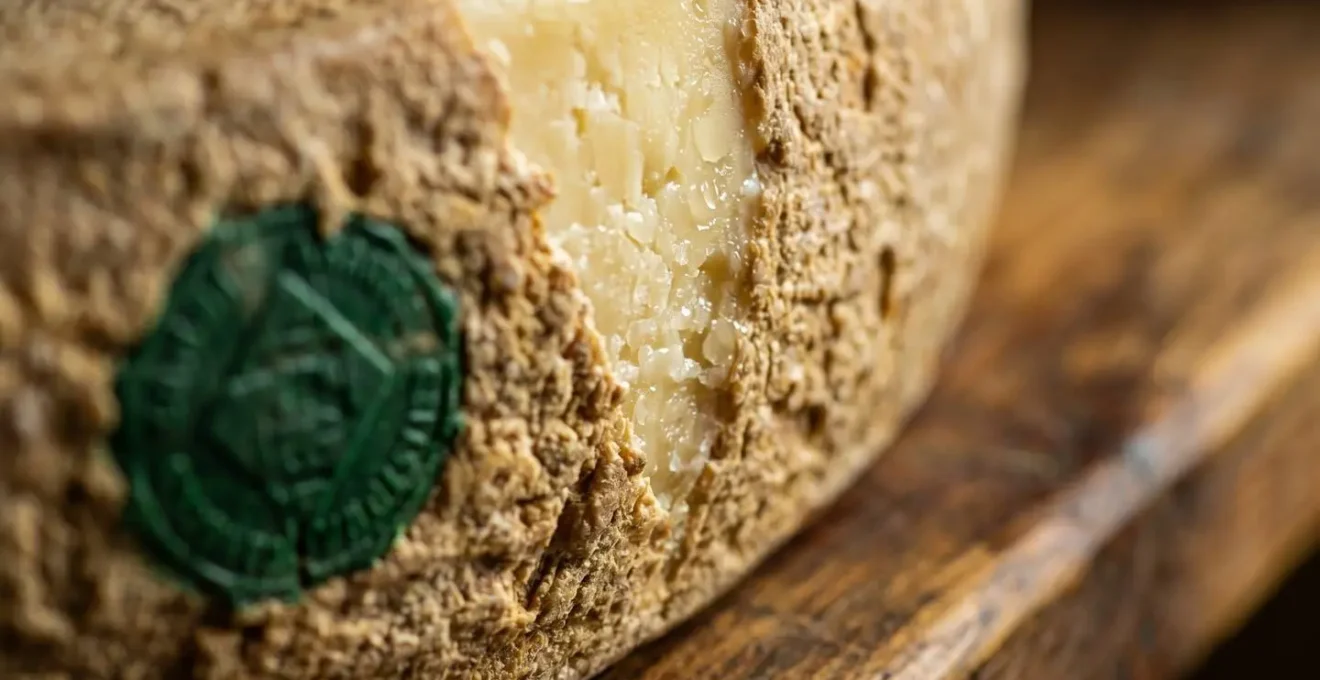
As the image above illustrates, the traceability plaque is an integral part of the cheese, a permanent record of its origin. Beyond this, a great cheesemonger can guide you through the aging profiles. A younger Comté (8-12 months) will be lactic and buttery, while a mature wheel (18-24 months) develops the sought-after tyrosine crystals (the crunchy bits) and complex notes of roasted nuts and fruit. Don’t be afraid to engage and ask specific questions to unlock a world of quality hidden behind the uniform AOP label.
Your Checklist for Selecting Superior Comté
- Ask: ‘Who is the affineur?’ Renowned affineurs like Marcel Petite have proprietary grading systems (e.g., bells) that signal superior selection beyond basic AOP standards.
- Inquire: ‘Which fruitière (cooperative) does it come from?’ Ask for the workshop number from the casein plaque to identify village-specific terroir characteristics.
- Compare: ‘Do you have a summer-milk and a winter-milk Comté?’ Compare the fruity, yellow summer cheese with the nutty, pale winter version to understand seasonal impact.
- Clarify: ‘What is the aging profile of this wheel?’ Request tasting notes for different ages to find your preference, from young and buttery (8-12 months) to mature and crystalline (18-24 months).
- Check: ‘Can I see the green or brown band grading?’ The official Comté grading (green for 14+ points, brown for 12-14) helps identify superior wheels within the AOP.
Fermier or Laitier AOP: Is the Price Premium for Farmhouse Production Worth It?
Within the AOP system, a crucial distinction exists between “fermier” (farmhouse) and “laitier” (dairy/cooperative) production. A fermier cheese is made on a single farm using only milk from that farm’s herd. A laitier cheese is made in a central dairy or cooperative (*fruitière* in the Jura) using milk pooled from multiple farms. This difference is fundamental to a cheese’s character and price. The “fermier” designation often commands a premium because it represents the ultimate expression of a single, unique terroir—one herd, one pasture, one cheesemaker.
Case Study: The Reblochon Distinction
Reblochon AOP offers a perfect illustration. Reblochon Fermier, identified by a green casein stamp, is made on-farm and is known for richer, funkier, and more complex flavours reflecting its unique microbial signature. The farmer bears the entire cost and risk, from milking to making. In contrast, Reblochon Laitier (red stamp) pools milk, creating stability and consistency. While less individualistic, it benefits from the precision equipment and specialist expertise of a dedicated dairy, sometimes resulting in a more reliably excellent cheese than a poorly made fermier example.
The price premium for fermier cheese is a direct reflection of its rarity and the undiluted expression of its origin. However, “laitier” does not mean inferior. For long-aged hard cheeses like Comté, the role of the *affineur* (the ripener) at the cooperative is often more decisive for the final quality than the milk’s origin. Laitier production benefits from economies of scale and professional cheesemakers who can ensure consistency and technical perfection. The choice is not about good versus bad, but about what you value: the wild, variable character of a single farm or the refined consistency of a professional cooperative.
This table breaks down the key differences, helping you decide where the premium is justified for your palate. This information is based on an in-depth analysis of production models.
| Characteristic | Fermier (Farmhouse) | Laitier/Fruitier (Cooperative) |
|---|---|---|
| Milk Source | Single farm, single herd | Multiple farms, pooled milk |
| Production Scale | Small batches, artisanal | Larger batches, professional facilities |
| Terroir Expression | Unique microbial signature of one farm | Blended regional terroir |
| Flavor Profile | Variable, distinct, reflects single pasture | Consistent, refined, reflects entire valley |
| Quality Control | Farmer’s intuition and skill | Precision equipment, specialist expertise |
| Price Point | Higher (reflects rarity and direct link) | Lower (economies of scale) |
| Risk Factor | Can be excellent or poor depending on maker | Consistently good with less variation |
| Best For | Soft cheeses, short aging (Saint-Nectaire, Reblochon) | Long-aged hard cheeses where affineur role is decisive (Comté) |
The Label Detail That Exposes Non-AOP Cheese Sold as Genuine Protected Designation
The prestige and high consumer trust in the AOP system inevitably attract imitators. Unscrupulous producers use clever but legal wording to imply AOP status without adhering to its strict rules. For a confused buyer, this is where costly mistakes are made. The most critical skill is learning to distinguish between a legally binding certification and unregulated marketing fluff. The only non-negotiable proof is the official red-and-yellow AOP/PDO logo. If that logo is missing, it is not an AOP cheese, regardless of how authentic the packaging looks.
The most famous example is the “Camembert” trap. A package labelled “Camembert de Normandie AOP” guarantees a raw-milk, ladle-moulded cheese from Normandy. However, a product labelled “Camembert fabriqué en Normandie” (Camembert made in Normandy) is a legally distinct, often pasteurised and industrially produced cheese with no AOP protection. The phrasing is deliberately similar to confuse consumers. Other “weasel words” to watch for include “style,” “façon,” “traditional recipe,” or simply using the region’s name without the cheese’s official AOP name.
This distinction is vital because the AOP label represents a significant pact of trust with consumers. According to figures from France’s national institute for origin and quality (INAO), this trust is well-placed, showing that 80% of French consumers trust the AOP label. This high level of confidence is precisely what imitators seek to exploit. Training your eye to ignore all the romantic text and search immediately for the official logo is the single most effective way to avoid being misled.
- Red Flag #1: Weasel Words. Terms like ‘style’, ‘façon’ (method), or ‘traditional recipe’ borrow AOP prestige without certification.
- Red Flag #2: Misleading Geography. “Camembert fabriqué en Normandie” is not the same as “Camembert de Normandie AOP.” Only the latter is the real, raw-milk deal.
- Red Flag #3: The Missing Logo. The official red-and-yellow AOP/PDO (or PDO in English) emblem is the only absolute proof. No logo, no AOP. Period.
- Red Flag #4: Vague Descriptors. Unaudited marketing terms like ‘artisanal’ or ‘authentic taste’ are opinions, not legally binding quality standards like AOP.
When Is Spring-Made Comté Ready to Eat at Its Peak After Appropriate Ageing?
The flavour of Comté is profoundly influenced by the season in which the milk was produced. This is a direct expression of terroir: the taste of the pasture is transmitted through the milk into the cheese. Summer Comté, made from the milk of cows grazing on lush, diverse mountain pastures from April to September, is richer in beta-carotene. This gives the cheese a distinctly yellower, golden hue and develops fruity, floral, and even tropical fruit notes after aging.
Conversely, Winter Comté is made when cows are kept indoors and fed hay. The resulting milk is lower in carotene, producing a paler, ivory-coloured cheese. Its flavour profile is different but no less complex, tending towards nutty, brothy notes with hints of celery or leek. Because of these intrinsic differences, summer and winter wheels have different optimal aging trajectories. The richer summer milk cheeses can support longer aging, developing deeper complexity over 18 to 24 months. Winter cheeses often reach their peak sooner, around 12 to 15 months.
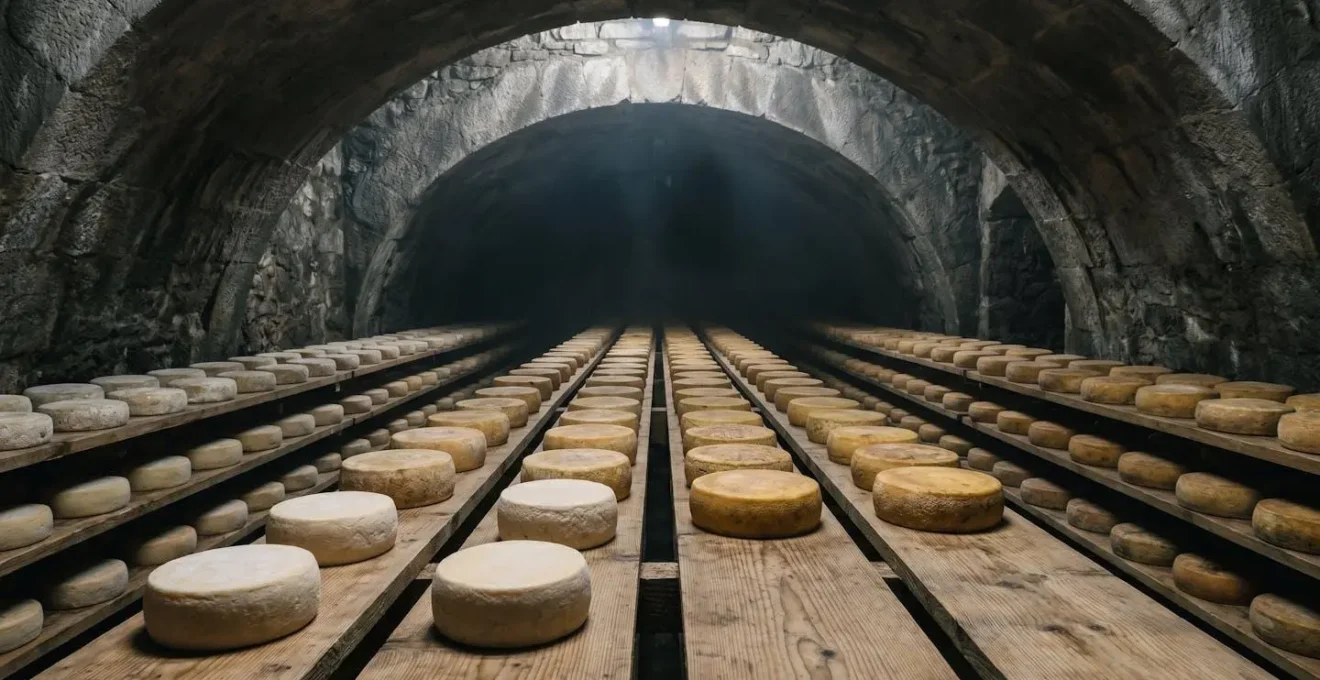
This patient maturation, often taking place in atmospheric cellars as shown above, is where the magic happens. A young, 5-month-old Comté from the supermarket, regardless of season, will taste primarily lactic and buttery. It hasn’t had the time to develop the complex aromatic compounds and tyrosine crystals that define a great, mature wheel. Therefore, a spring-made Comté (a summer cheese) will be at its absolute peak not the following autumn, but the autumn or winter one to two years later.
This aging calendar, based on official Comté flavour guides, highlights the ideal timelines.
| Production Season | Milk Characteristics | Cheese Color | Optimal Aging Time | Peak Flavor Profile |
|---|---|---|---|---|
| Summer Comté (April-Sept) | Rich in beta-carotene from fresh grass and wildflowers | Yellower, golden hue | 18-24 months | Fruity, floral aromas; roasted notes; tropical fruit hints |
| Winter Comté (Oct-March) | Made from hay-fed milk with lower carotene | Paler, ivory tone | 12-15 months | Nutty, brothy notes; celery leaves; more subdued complexity |
| Young (8-12 months) | Any season | Varies by season | Immediate consumption | Lactic, buttery, fresh cream, mild |
| Mature (18-24 months) | Any season | Darker with age | Peak complexity | Roasted almonds, caramel, fruity notes |
| Extra-Aged (30+ months) | Any season | Deep golden-amber | Maximum intensity | Prominent tyrosine crystals (crunch), spicy, coffee, leather |
Why Does AOP Certification Matter More Than Producer Marketing Claims?
In a world of slick marketing, the AOP certification stands apart as a legally binding and publicly audited standard. While a brand can claim its product is “authentic,” “traditional,” or “artisanal” without any verifiable proof, an AOP certification is non-negotiable. It is governed by a strict rulebook, the cahier des charges, which dictates every critical aspect of production. This includes the precise geographical zone, the specific breeds of animals, their diet (e.g., forbidding fermented silage for Comté cows), and the detailed methods of production and aging.
This rulebook isn’t a marketing document; it’s a legal contract. As described by the Institut National de l’Origine et de la Qualité (INAO), the governing body for French AOPs, this framework is a pact between producers and consumers. This is reinforced by a powerful statement from their guidelines.
The cahier des charges is a public contract between producers and consumers that enforces strict, non-negotiable rules on geography, production methods, and animal breeds.
– Institut National de l’Origine et de la Qualité (INAO), AOP Certification Specifications Framework
This makes the AOP logo a far more powerful guarantee than any self-proclaimed virtue on a package. It represents a collective commitment to preserving a specific gastronomic heritage, and it’s backed by rigorous, independent checks. This system protects consumers from fraud and ensures that a cheese carrying the AOP name is a genuine article, tied to a specific place and a time-honoured method. The economic weight of this trust is immense, underpinning what has become a significant sector of the French agricultural economy.
Why Do Some Grand Cru Wines Cost 10 Times More Than Equally Rated Neighbours?
The world of fine wine provides a perfect parallel for understanding price variations in AOP cheese. In Burgundy, two adjacent vineyards can both hold the prestigious “Grand Cru” classification, yet the wine from one may cost ten times more than its neighbour. The difference isn’t the classification, but the producer’s reputation, historical performance, and the micro-terroir of their specific plot. The same economic principles of brand equity and scarcity apply directly to high-end AOP cheese, particularly Comté.
The AOP label is the equivalent of the regional appellation, but the name of the *affineur* is the equivalent of the esteemed domaine or château. These master ripeners are the secret stars of the cheese world. They don’t just age cheese; they curate it. They select the most promising young wheels from the best *fruitières* (village dairies) and mature them in unique environments to develop maximum complexity. The consumer pays a premium not just for the cheese, but for the affineur’s expertise and the guarantee of their selection.
Case Study: The Marcel Petite Method
Marcel Petite, a legendary affineur, ages Comté in a repurposed 19th-century military fort. This unique environment provides a stable, cool, and humid microclimate ideal for slow aging. Their master affineurs taste and grade each wheel individually, using a proprietary bell system to mark the most exceptional ones. While they handle thousands of tons of Comté, their top-tier, long-aged wheels are scarce. A Comté aged by Marcel Petite for 24 months commands a high price because of this rigorous selection process and the brand’s century-old reputation for excellence. As with a Grand Cru wine, you are paying for the curation, the aging expertise, and the scarcity created by an uncompromising standard that operates far above the AOP baseline.
Just as a wine lover seeks out a specific producer, a knowledgeable cheese buyer learns to seek out a specific affineur. Their name on a cheese is a secondary, more powerful signal of quality than the AOP logo alone. It transforms a commodity into a curated, luxury product where the price reflects a guarantee of an exceptional experience, not just authentic provenance.
Key Takeaways
- The AOP label guarantees authenticity and origin, not peak flavour; it is a baseline standard.
- True quality and value are often determined by the affineur (ripener), whose expertise and selection create a premium product within the AOP framework.
- Look for secondary signals like the affineur’s name, the age of the cheese, and whether it’s ‘fermier’ (farmhouse) to find exceptional quality.
Why Does Your Comté From the Supermarket Taste Like Plastic Compared to What You Had in Jura?
That feeling of disappointment is real and entirely justified. The glorious, nutty, and complex Comté you tasted in a French mountain village seems a world away from the bland, slightly rubbery wedge you bought at your local supermarket, despite both being AOP. This dramatic drop-off in quality is not an illusion; it’s the result of three specific culprits in the mass-market supply chain: packaging, selection, and the supply chain itself.
First, plastic wrap is a cheese killer. Cheese is a living product that needs to breathe. When shrink-wrapped, it suffocates. Moisture and ammonia are trapped, creating off-flavours and a sweaty texture, while the plastic itself can impart a synthetic taste. In contrast, a proper fromagerie uses special two-ply paper that allows the cheese to breathe while maintaining optimal humidity. Second, supermarket selection is driven by price and uniformity, not flavour. The Comté you find is typically young (5-8 months) and chosen from large, consistent batches. With a massive output of over 60,000 tonnes annually, Comté is the most-produced AOP cheese in France, making this mass-market tier possible. This is a far cry from the 18-24 month-old, hand-selected wheels found at a specialist.
Finally, the supply chain prioritises shelf life over quality. Cheese cut from a large wheel begins to oxidise and lose its delicate aromatic compounds immediately. A pre-cut, factory-wrapped piece has been losing flavour for days or weeks. Furthermore, supermarket refrigeration is often too cold (2-4°C), which dulls flavour development, whereas optimal storage is closer to 8-12°C. These three factors combine to strip an otherwise authentic AOP cheese of its soul, leaving a product that meets the legal definition but fails the taste test.
- Culprit #1: The Packaging. Plastic wrap suffocates cheese and imparts off-flavours. Proper cheese paper allows it to breathe.
- Culprit #2: The Selection. Supermarkets choose young, mass-selected wheels for price uniformity, while specialists source older, hand-selected wheels for flavour complexity.
- Culprit #3: The Supply Chain. Pre-cut, factory-wrapped cheese suffers from oxidation and flavour loss compared to cheese freshly cut from the wheel.
Armed with this knowledge, your next visit to the cheese counter is no longer a game of chance. You now have the analytical tools to see beyond the primary AOP logo and identify the true markers of quality. Start your journey to becoming a discerning cheese buyer by seeking out a knowledgeable cheesemonger, asking the right questions, and investing in cheese that has been properly selected, aged, and handled.