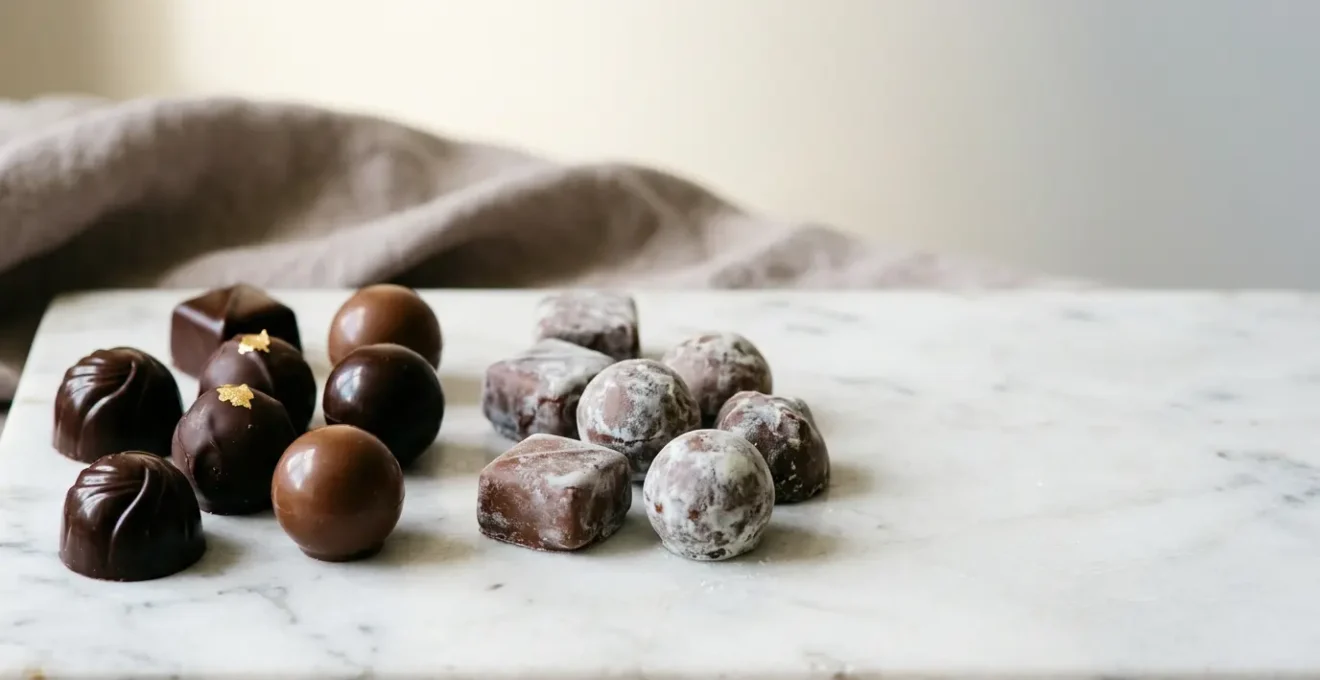
You might believe the difference between a sublime, silky praline and a waxy, disappointing one is merely about ‘better ingredients’ or a higher price tag. The reality is far more precise. The coveted texture is a feat of fragile science, depending entirely on the perfect crystal structure of cocoa butter and the delicate stability of its ganache emulsion. This guide reveals how that fleeting perfection is achieved and, more importantly, how easily it is shattered on the journey from the chocolatier’s workshop to your home.
It’s a vivid memory for any chocolate lover: stepping into a small *chocolaterie* in a French city, the air thick with the scent of pure cocoa. You select a praline. The thin, glossy shell cracks with a sharp, satisfying snap, giving way to a ganache so impossibly smooth it melts on your tongue in a wave of pure flavour. You buy a beautiful box to bring that memory home, only to open it in the UK a week later and find… disappointment. The snap is gone, replaced by a dull thud. The ganache feels heavy, greasy, almost waxy. The magic is lost.
The common assumption is that the ingredients must be different, or that you simply chose the wrong brand. While ingredient quality is a factor, it doesn’t explain the dramatic textural shift from silky to waxy. The problem isn’t what’s in the chocolate; it’s what has happened to it. The heartbreaking difference between that Parisian memory and the waxy box on your coffee table is not a question of recipe, but of physics. It’s a story of unstable emulsions, misaligned crystals, and the unforgiving laws of thermodynamics.
But what if the secret to preserving that perfect texture wasn’t a secret at all, but a science you could understand? Instead of focusing on cocoa percentage or origin, the true connoisseur learns to read the signs of textural integrity. This article will deconstruct that science. We will explore why one praline feels silky and another grainy, how temperature fatally wounds chocolate’s structure, and how to become an informed buyer who can finally bring the true French chocolate experience home.
To fully grasp the difference between an authentic artisanal creation and a mass-market confection, this guide will walk you through the key principles of chocolate texture. The following sections break down the science, the regional variations, and the practical steps you can take to ensure every bite is as perfect as the chocolatier intended.
Summary: The Praline Paradox: A Guide to Chocolate Texture and Freshness
- Why Does One Praline Feel Silky While Another With Similar Ingredients Feels Grainy?
- How to Tell if Pralines Are Fresh Enough to Taste as the Chocolatier Intended?
- Parisian Ganache or Lyon Cushion: Which French Praline Style Suits Your Palate?
- The Temperature Mistake That Turns Silky French Pralines Into Waxy Disappointments
- When Should You Order Seasonal Pralines to Get Maximum Freshness at Holiday Time?
- Why Can Cassoulet Never Taste Exactly Right When Made Outside Its Home Region?
- Why Does the Affineur Matter More Than the Farmer for How Your Cheese Tastes?
- Why Does £50 French Chocolate Taste Different but Not Necessarily Better Than £10 Options?
Why Does One Praline Feel Silky While Another With Similar Ingredients Feels Grainy?
The answer lies in the microscopic world of emulsions and water. A classic French ganache is a delicate emulsion—a suspension of tiny fat globules (from cream and cocoa butter) within a water-based medium (from the cream). When perfectly crafted, this structure feels divinely smooth and silky on the palate. However, this perfection is inherently unstable. The graininess you perceive is often the first sign that this emulsion is beginning to break, or that it was formulated for stability over texture from the outset.
A key scientific concept that governs this is water activity (aw). This measures the ‘free’ water available in a product for microbial growth and chemical reactions. The silkiest, most melt-in-your-mouth ganaches often have a high water activity, making them incredibly fresh but also highly perishable. A 2024 study on chocolate ganache confirms that formulations with water activity (aw) above 0.90 have a shelf life of less than 14 days. In contrast, those designed for a longer shelf life (like many boxed chocolates for export) have a lower water activity, achieved by adjusting sugar and fat content.
This creates a fundamental trade-off. To achieve a longer shelf life, the chocolatier must bind the water, which can subtly but surely alter the texture, making it denser and less “alive” on the tongue. Graininess can also result from sugar recrystallisation in an aging or poorly stored ganache. Therefore, the silky praline is a fleeting pleasure, a sign of high water activity and recent creation, while the grainy one is often a product of time, travel, and the scientific compromises required for stability.
How to Tell if Pralines Are Fresh Enough to Taste as the Chocolatier Intended?
Beyond a “best by” date, a truly fresh praline telegraphs its quality through sensory clues. As a discerning enthusiast, you can train your palate and eyes to spot the hallmarks of perfection, separating a vibrant, recently made confection from one that has begun its inevitable decline. The intended experience is a multi-sensory one, and freshness is its most critical component.
Before you even taste, use your eyes. A perfectly tempered chocolate shell should have a beautiful, satin gloss with no dull spots, streaks, or a chalky white film. This sheen is the visual evidence of a stable cocoa butter crystal structure, which is the foundation of a good texture. A dull appearance can be a warning sign of temperature damage and the beginning of fat bloom.
Next, listen. Pick up the praline and snap it in half (if it’s a solid piece or has a firm shell). A well-tempered chocolate should break with a clean, sharp “snap”. A dull, soft break suggests the cocoa butter has fallen out of temper, a sure-fire recipe for a waxy mouthfeel. Then, bring it to your nose. A fresh praline will have a vibrant, complex aroma of cocoa, and perhaps notes of roasted nuts, fruit, or cream. A stale one will smell flat, faintly waxy, or even slightly plasticky from its packaging.
Finally, the ultimate test: the taste. A fresh, well-made praline will begin to melt almost instantly in your mouth, releasing its flavours smoothly and cleanly. There should be no lingering, greasy, or waxy coating left on your palate. This immediate, clean meltaway is the signature of a chocolate whose melting point is correctly calibrated just below human body temperature—a hallmark of freshness and masterful technique.
Parisian Ganache or Lyon Cushion: Which French Praline Style Suits Your Palate?
Not all French “pralines” are created equal, and regional traditions play a huge role in the textural experience. Your preference might depend on whether you crave the ephemeral silkiness of a Parisian-style ganache or the satisfying, robust chew of a confection from Lyon. Understanding these differences is key to choosing a chocolate that truly delights your palate.
The Parisian style, famous worldwide, typically centres on the ganache: that delicate emulsion of chocolate and cream. Its defining characteristic is its smoothness and its role as a carrier for a huge variety of flavours, from classic dark cocoa to exotic fruit or spice infusions. This style is all about subtlety, a melt-in-the-mouth texture, and a relatively short shelf life due to the high water content of the cream. It represents the pinnacle of delicate, fresh confectionery.
In contrast, the city of Lyon has its own iconic tradition, rooted in a different definition of “praline” altogether. Here, the star is the almond, often enrobed in a crunchy, boiled sugar coating.
Case Study: The Resilient Crunch of Lyonnaise Pralines Roses
The iconic *pralines roses* of Lyon are a perfect example of a regional specialty built for a different kind of pleasure. These are not soft ganaches, but pink-tinted, sugar-candied almonds. This tradition became a hallmark of the Auvergne-Rhône-Alpes region in the 19th century. Their structure, based on nuts and cooked sugar rather than a cream emulsion, gives them a much denser, crunchier texture. This formulation makes them far more stable than their Parisian counterparts, ideal for baking into regional specialties like *tarte aux pralines* and for gifting or shipping over long distances without significant textural degradation.
This textural difference is stark and intentional, as the illustration below highlights. One is an experience of yielding silkiness, the other of satisfying resistance and nutty flavour.
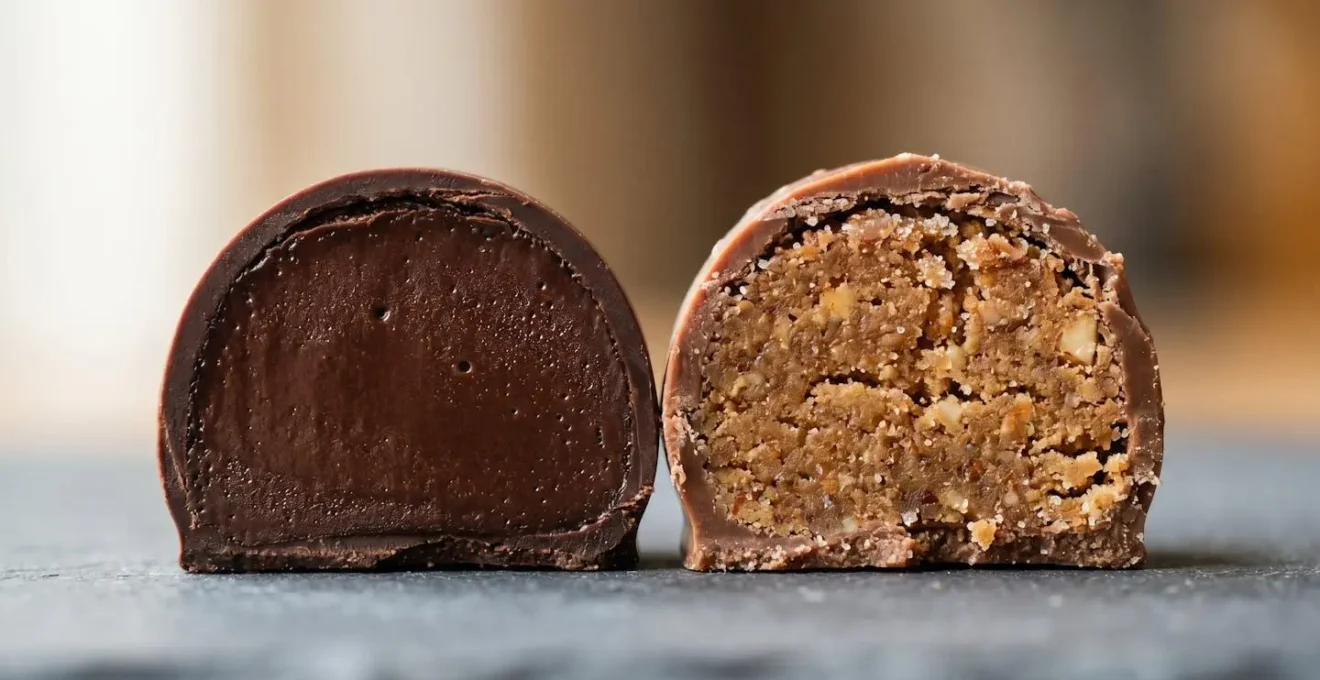
As you can see, the choice is not about which is “better,” but what kind of sensory experience you are seeking. Do you want the delicate, fleeting luxury of a fresh Parisian ganache, or the hearty, long-lasting crunch of a Lyonnaise candied almond? Your answer will guide you to the perfect French confection.
The Temperature Mistake That Turns Silky French Pralines Into Waxy Disappointments
The single greatest enemy of a perfect praline is improper temperature. That waxy, greasy coating you find on disappointing chocolates is almost always a phenomenon called fat bloom. This occurs when the meticulously organized crystal structure of the cocoa butter is disrupted, typically by temperature fluctuations. The experience is ruined not because the ingredients have gone bad, but because their physical structure has been broken.
A chocolatier’s most important skill is tempering, a precise process of heating and cooling chocolate to encourage the cocoa butter to crystallize into its most stable and desirable form, known as Form V. This specific crystal structure is what gives high-quality chocolate its glossy sheen, its satisfying “snap,” and, most importantly, its magical melting point. Research into chocolate science shows that well-tempered dark chocolate melts at 31-32°C, just below human body temperature (37°C). This is the secret to the clean, luxurious “meltaway” feel. It doesn’t coat your mouth; it simply vanishes into flavour.
Fat bloom is the visible and textural sign that the chocolate has lost this perfect temper. When chocolate gets too warm, the Form V crystals melt. As it cools down too slowly or improperly, the cocoa butter recrystallizes into a different, larger, and more stable form (Form VI). These larger crystals migrate to the surface, creating a dusty, greyish-white film. This new crystal structure has a higher melting point, which means it no longer melts cleanly in your mouth. It feels waxy, cloying, and greasy because your body heat is no longer sufficient to melt it quickly. The chocolate’s flavour is muted, trapped within a stubborn, fatty matrix.
This is often the tragic fate of finely crafted pralines during shipping and storage. As experts from a renowned chocolatier explain, the cause is almost always environmental.
Fat bloom occurs when the cocoa butter separates from the other ingredients and rises to the surface. It often happens due to changes in temperature, like when chocolate is stored in a warm room or moves in and out of refrigeration.
– Cluizel Chocolate experts, What Is Chocolate Bloom—And Should You Be Worried?
When Should You Order Seasonal Pralines to Get Maximum Freshness at Holiday Time?
Ordering fresh, artisanal pralines for a special occasion like Christmas or Easter presents a logistical challenge. You want them to be as fresh as possible for the event, but you also need to order in advance to secure them from a small-batch chocolatier. Timing is everything. Ordering too early means you might receive a product that is already past its peak texture, while ordering too late risks the chocolatier being sold out or shipping delays.
The key is to think like a logistics expert. You need to coordinate your order with the chocolatier’s production schedule, not just your personal calendar. The freshest pralines, especially those with delicate ganaches, are made in the final days and hours leading up to a major holiday shipping cutoff. Your goal is to get your hands on a box from that last production run.
This requires proactive communication and strategic planning. You must bridge the gap between placing your order and the moment the chocolates are actually dispatched. The following checklist provides a clear plan to ensure the pralines that arrive at your door are as vibrant and texturally perfect as the day they were made.
Your Action Plan: Strategic Timing for Ordering Fresh Holiday Pralines
- Order Early, Ship Late: Place your order well in advance to reserve your pralines, but in the order notes or a follow-up email, request the latest possible shipping date that still guarantees delivery for your occasion.
- Ask About Production Runs: Directly ask the chocolatier: “When is your final production run for fresh ganaches before the holiday?” Time your requested shipping date for the day after that run is complete.
- Follow Ingredient Seasonality: Align your choices with nature. Winter is the perfect time for pralines featuring seasonal citrus, while autumn is the peak season for confections using fresh nuts like hazelnuts and walnuts, which have the best flavour right after harvest.
- Understand the Science: Remember that fresh, high water activity ganaches have a very limited shelf life. Acknowledge this when ordering and plan to consume them quickly upon arrival.
- Factor in Shipping Conditions: Ask about temperature-controlled shipping options, especially if you live in a climate with extreme temperatures. The best-made praline can be ruined by a hot delivery van.
Why Can Cassoulet Never Taste Exactly Right When Made Outside Its Home Region?
To understand why a praline can lose its soul when it travels, it helps to make a surprising detour into the heart of French regional cuisine. Consider Cassoulet, the legendary slow-cooked bean stew from the Southwest of France. A chef can follow the most authentic recipe in a London kitchen, using the finest imported ingredients, yet it will never taste exactly like it does in Toulouse or Carcassonne. Why?
The reason is *terroir*. This French concept, most often applied to wine, describes the unique environmental factors that shape a product’s character. For Cassoulet, this includes the local water with its specific mineral content used to cook the beans, the regional variety of Tarbais beans themselves, and the locally cured *confit de canard* and *saucisse de Toulouse* made according to generations of tradition. It’s an entire ecosystem of flavour that cannot be perfectly replicated elsewhere. The dish is more than a list of ingredients; it’s the embodiment of a place.
A chocolatier’s workshop is its own form of micro-terroir. The “local water” is the specific cream from a nearby dairy, with its unique fat content and flavour profile. The “local tradition” is the chocolatier’s proprietary technique for tempering, their specific room temperature and humidity, and their “feel” for when an emulsion is just right. A praline made in a small Parisian shop is a product of that specific, controlled environment. When you take it out of that environment, you are, in a sense, taking the Cassoulet out of Toulouse. It’s still good, but a crucial part of its identity is lost.
Why Does the Affineur Matter More Than the Farmer for How Your Cheese Tastes?
An even more precise analogy for the role of the chocolatier comes from the world of French cheese. A farmer can produce the most exquisite milk from a prize-winning herd of cows, but this raw material is only the starting point. The final flavour and, crucially, the texture of a great Comté or Roquefort cheese are not determined by the farmer, but by the *affineur*—the master of aging.
The *affineur* takes the young cheese and guides it to maturity in a *cave* (cellar) with painstakingly controlled temperature and humidity. Over weeks, months, or even years, they turn, brush, and care for the cheese, orchestrating the complex enzymatic and microbial processes that transform a bland curd into a flavour masterpiece. They are masters of time and environment. A slight change in humidity can ruin the rind; a few degrees of temperature difference can alter the texture from creamy to chalky.
The chocolatier is the *affineur* of the praline. The cocoa plantation is the farm, producing the raw material (the cocoa beans). But it is the chocolatier who acts as the master of transformation. Through the precise alchemy of tempering, they control the crystallization of cocoa butter. Through the art of emulsification, they craft the ganache’s texture. They are managing a dynamic physical process, not just mixing ingredients. The difference between a silky ganache and a grainy one is the same as the difference between a perfectly creamy Brie and a chalky, under-ripe one—it’s all in the master’s control of the process.
Key Takeaways
- The “waxy” texture in disappointing pralines is caused by fat bloom, a change in the cocoa butter’s crystal structure due to temperature fluctuations, which raises its melting point.
- A “silky” ganache is a fragile, often high water activity emulsion. Its sublime texture is a sign of extreme freshness and a short shelf life.
- The high price of luxury French chocolate often covers the immense cost of process control and temperature-controlled logistics—the price of preserving its perfect, fragile texture from the workshop to your home.
Why Does £50 French Chocolate Taste Different but Not Necessarily Better Than £10 Options?
After understanding the science of texture, we can finally decode the price tag. Why does a £50 box of pralines from a top Parisian chocolatier taste so different from a £10 box from a supermarket, even if both claim to use high-quality ingredients? The price difference is often not just about rarer cocoa beans; it’s the cost of fighting a war against textural decay.
The £10 box is designed for robustness and shelf life. Its ganaches are likely formulated with a lower water activity to be stable for months. Its shell may contain traces of other vegetable fats to inhibit bloom. It is built to survive the long, uncontrolled journey in a shipping container, on a lorry, and on a store shelf. The trade-off is a muted flavour and a texture that will never achieve that sublime, silky meltaway.
The £50 box, conversely, is priced to cover the cost of preserving perfection. This price includes: small-batch production that ensures freshness; the use of delicate, high water-activity ganaches that have a shelf life measured in days, not months; and most critically, the enormous expense of a rapid, temperature-controlled supply chain. That praline is kept within its ideal temperature range from the moment it leaves the chocolatier until it reaches a specialty retailer, or is shipped directly to you in an insulated package. The £40 difference is the price of maintaining that perfect Form V crystal structure and stable emulsion all the way to your palate.

This is why a £50 box that has suffered temperature abuse during its journey can taste worse than a fresh £10 bar. The value is not in the price itself, but in the unbroken chain of custody that protects its fragile texture. You are paying for the chocolatier’s mastery and the logistical bubble that keeps it intact.
Now armed with the science of texture, you can transform from a hopeful buyer into a confident connoisseur. Instead of being swayed by fancy packaging or a high price alone, you can start to look for the true signs of quality: the glossy sheen, the sharp snap, and the story the chocolatier tells about their process and shipping. The next time you invest in fine French pralines, you are not just buying chocolate; you are investing in the preservation of a perfect, and fragile, moment of sensory pleasure.