The taste of a French cheese is sculpted more by the final handler (the affineur) than by its origin, turning your purchase from a lottery into a choice.
- An AOP label guarantees authenticity and method, not the peak of flavour; it is the legal starting line, not the finish.
- The journey of the cheese, from transport to the shop’s counter, is a critical stage where quality is either preserved or destroyed.
Recommendation: Judge the shop and its handler as much as you judge the cheese label itself. Seek out specialists who understand and control the maturation process.
You have experienced the frustration. One week, you bring home a wheel of Camembert de Normandie from a high-end delicatessen; it is perfectly yielding, with a complex, mushroomy aroma and a creamy, unctuous paste. The next, you buy the exact same AOP-certified cheese from a different supermarket, and it is a world apart: chalky, rigid, and tasting faintly of ammonia. You paid for a promise of French excellence, but the result feels like a gamble. This inconsistency is the single greatest challenge for any UK-based lover of authentic French cheese.
The common advice is to simply “look for the AOP label” or understand “terroir.” While important, these concepts are only part of the story. They explain where the cheese began its life, but not the critical journey it took to reach your cheeseboard. The truth is that cheese is not a static, finished product like a bottle of wine. It is a living, breathing product, constantly evolving. Its final character is not set in stone at the farm; it is actively shaped, day by day, by the environment and the expert hands that guide it to its peak.
The secret you are missing lies not with the farmer, but with the often-invisible artisan who finishes the work: the affineur, or cheese maturer. This guide will shift your perspective from simply buying a product to assessing a craft. We will explore why the skill of the affineur and the integrity of the supply chain are the true determinants of quality. Forget the marketing claims and the vague notions of terroir; we are going to give you the assessment tools of a professional to ensure every pound you spend on French cheese is an investment in exceptional flavour.
In this guide, we will break down the crucial factors that create this variance in taste and quality. From understanding the pivotal role of the cheese maturer to learning how to assess ripeness yourself, you will gain a deeper appreciation for the craft and become a more confident buyer.
Contents: The Affineur’s Impact on French Cheese Quality
- Why Does the Affineur Matter More Than the Farmer for How Your Cheese Tastes?
- How to Judge if a French Cheese Is at Perfect Ripeness Before You Buy It?
- Soft Ripened or Hard Alpine: Which French Cheese Category Works Best for Dinner Parties?
- The Supermarket Display That Kills Your £30 French Cheese Before You Get It Home
- When Should You Buy Mont d’Or to Catch It at Peak Season Rather Than Storage?
- Why Does the Same Cheese Taste Better When the Maker Handed It to You Personally?
- Why Does AOP Certification Matter More Than Producer Marketing Claims?
- Why Do Some Shops Charge Triple for AOP Cheese That Tastes No Better Than Standard?
Why Does the Affineur Matter More Than the Farmer for How Your Cheese Tastes?
The farmer’s role is undeniably fundamental; they produce the high-quality milk that forms the foundation of any great cheese. However, once the initial cheesemaking is done, the raw potential of the cheese is handed over. This is where the affineur (the cheese maturer or ager) takes over, becoming the true sculptor of the final product’s flavour, texture, and aroma. Think of the farmer as the one who grows the perfect block of marble, and the affineur as the Michelangelo who reveals the masterpiece within.
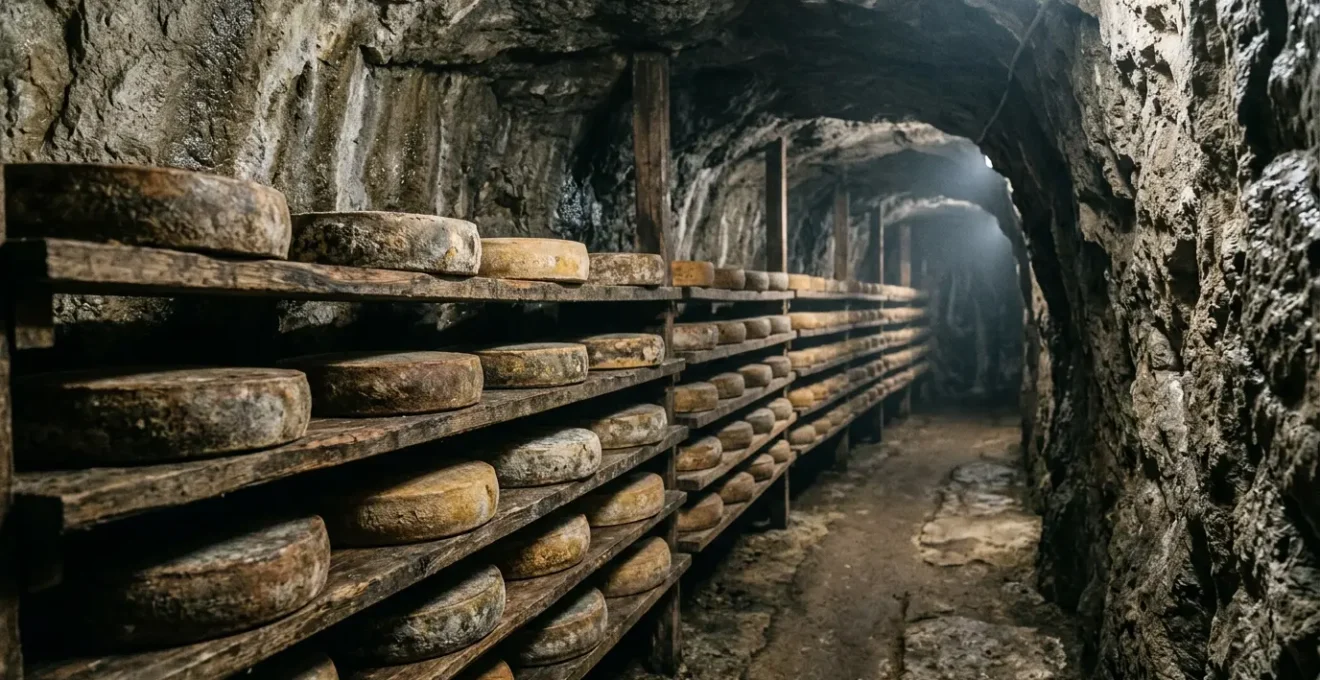
Affinage is the art and science of aging cheese. It involves controlling a delicate ecosystem of temperature, humidity, and airflow to guide the cheese’s development. A skilled affineur does not just store the cheese; they actively cultivate its character. They will wash the rinds, brush away unwanted moulds, and turn the wheels regularly to ensure even maturation. This process happens in a cave d’affinage, or cheese cave, an environment as unique as a fingerprint. As one expert from Murray’s Cheese Caves explains, the specific microflora in the air contributes to the final taste. This is why a cheese finished in one cave will taste different from the exact same cheese finished in another.
Every cheese cave is completely its own; completely unique.
– Jenkelunas, Murray’s Cheese Caves expert, The Process of Aging Cheese – Cheese Connoisseur
These are not passive cellars. Affinage experts work to maintain precise conditions of above 90% humidity and 10°C to encourage the right enzymatic and microbial activity. A supermarket, focused on shelf life, cannot replicate this. They receive a young, ‘green’ cheese and essentially halt its development with cold temperatures and plastic wrap. A specialist fromagerie, however, invests in the time and expertise to bring that same cheese to its absolute peak potential. The difference you taste is not just the origin; it is the artistry of maturation.
How to Judge if a French Cheese Is at Perfect Ripeness Before You Buy It?
Once you understand that cheese is a living product guided to a peak by an affineur, the next step is learning to identify that peak yourself. You do not need to be an expert to make an informed judgement at the cheese counter. Your own senses—sight, touch, and smell—are your most powerful tools for assessing a cheese’s condition before you commit to buying it. Trusting these senses will help you avoid the disappointment of an underripe, ‘chalky’ heart or an overripe, ammoniated paste.
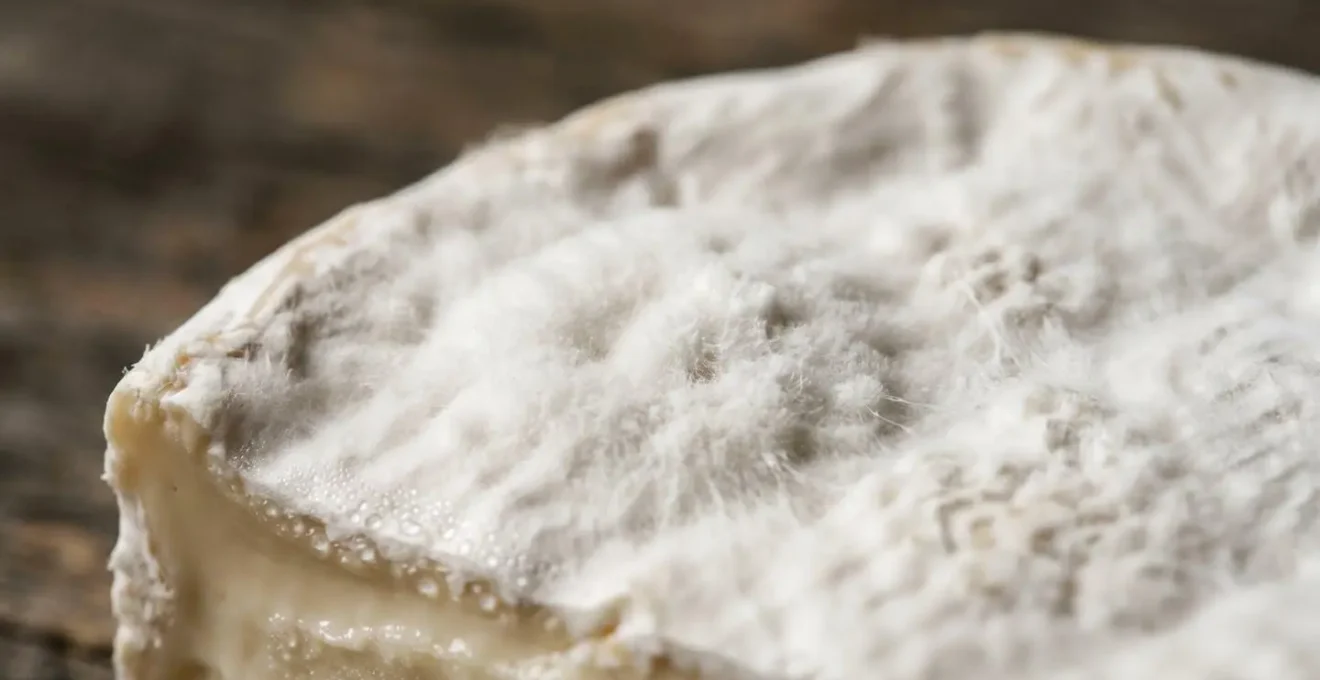
For soft, bloomy-rind cheeses like Brie or Camembert, the touch test is paramount. A perfectly ripe cheese should feel uniformly yielding across its entire surface, like a well-toned muscle. If you press gently and feel a hard, resistant disc in the centre, the cheese is underripe. Visually, the rind should be a fluffy, almost downy white, not slimy, cracked, or discoloured. But the most definitive sign of a soft cheese past its prime is its smell. A strong, pungent whiff of ammonia is an unmistakable red flag; it signals that the proteins are breaking down too far, and the cheese is dying.
Hard cheeses, like a good Comté, offer different clues. Look for tiny droplets of moisture, known as ‘beading’, on the cut surface. This is a sign of a well-aged cheese where fats are breaking down properly. The texture should have a slight give and not be rock-hard or brittle. The following checklist provides a practical guide to assessing different cheese types before you make your selection.
Your Sensory Checklist for Judging Cheese Ripeness
- Soft Bloomy Rinds (Brie, Camembert): Press gently near the centre. The entire wheel should give evenly. A chalky, firm resistance means it needs more time to ripen at room temperature.
- Visuals for Bloomy Rinds: Look for a fluffy, uniform white mould. Avoid any cheese with a slimy, wet, or cracked rind, which indicates poor handling or age.
- The Smell Test (Soft Cheeses): A strong, sharp smell of ammonia is the ultimate red flag for an overripe, dying soft cheese. It should smell of mushrooms, earth, and rich cream.
- Hard Cheeses (Comté, Beaufort): Look for ‘beading’ (pinpricks of moisture) on the cut surface as a sign of proper aging. The paste should have a slight flexibility, not be rock-hard.
- Washed Rinds (Epoisses, Livarot): The rind should be a healthy reddish-orange and feel slightly sticky or tacky. A dry, dull, or cracked rind signals neglect and dehydration.
Soft Ripened or Hard Alpine: Which French Cheese Category Works Best for Dinner Parties?
Choosing the right cheese for a dinner party goes beyond personal preference; it involves logistics and understanding how a cheese will perform over several hours at room temperature. Both soft-ripened cheeses like Brie and hard Alpine cheeses like Comté can be showstoppers, but they serve very different roles and require different levels of management from the host. Your choice should align with the style of your event and how much attention you want to pay to the cheeseboard once it’s served.
A perfectly ripe, runny Brie de Meaux can be a dramatic and delicious centrepiece. However, it is a high-maintenance guest. Its flavour and texture evolve rapidly at room temperature, moving from perfect to overly pungent in a short window. It demands to be served at its peak ripeness and can be challenging for guests to serve without mess. Furthermore, its strong character can be divisive and requires a more specific wine pairing to shine. It is a choice for the host who wants the cheese to be a memorable, interactive part of the meal.
In contrast, a hard Alpine cheese like a 24-month-old Comté or a Beaufort is the low-stress, high-reward option. Its flavour profile is remarkably stable at room temperature, remaining consistently nutty, savoury, and complex for hours. It is easy for guests to cut and handle, and its approachable flavour is almost universally loved. Its versatility with wine is a major advantage, pairing beautifully with everything from crisp white wines to medium-bodied reds. This makes it a forgiving and reliable choice for a busy host who wants to set out a fantastic cheeseboard and then focus on their guests.
This is a common dilemma for hosts, and a recent comparative analysis helps clarify the choice by breaking down the characteristics of each category for entertaining.
| Characteristic | Soft-Ripened (Brie, Camembert) | Hard Alpine (Comté, Beaufort) |
|---|---|---|
| Temperature Stability | Evolves dramatically at room temp; requires timing | Stable for hours; low-stress option |
| Flavour Trajectory | Living centerpiece; aggressive evolution | Consistent nutty profile throughout event |
| Guest Accessibility | Requires management; can be divisive | Universally approachable; easy to cut |
| Wine Pairing Range | Narrow pairing window; specific requirements | Wide pairing footprint; crisp whites to medium reds |
| Serving Complexity | Must be served at precise ripeness | Forgiving; can be sliced in advance |
The Supermarket Display That Kills Your £30 French Cheese Before You Get It Home
You have selected a promising-looking cheese, perhaps even an expensive one. But the journey from the shop to your home is fraught with peril, and the single biggest culprit in sabotaging fine cheese is a ubiquitous, seemingly harmless material: plastic wrap. Supermarkets rely on it for hygiene and visibility, but for a living, breathing cheese, it is a suffocation chamber. This is arguably the most common way that the potential of a great cheese is destroyed before it even reaches your kitchen.
Cheese needs to breathe. As it ripens, it releases various compounds, including moisture and ammonia. When tightly wrapped in impermeable plastic, these gases have nowhere to go. The moisture gets trapped against the rind, creating a slimy, damp surface that is a breeding ground for undesirable bacteria. Worse, the trapped ammonia gas gets reabsorbed into the cheese paste, imparting a harsh, chemical flavour that completely masks the delicate, complex notes the affineur worked so hard to develop. Your cheese doesn’t just taste ‘off’; it tastes of its own waste products. It is the equivalent of storing a fine steak in a sealed plastic bag for a week.
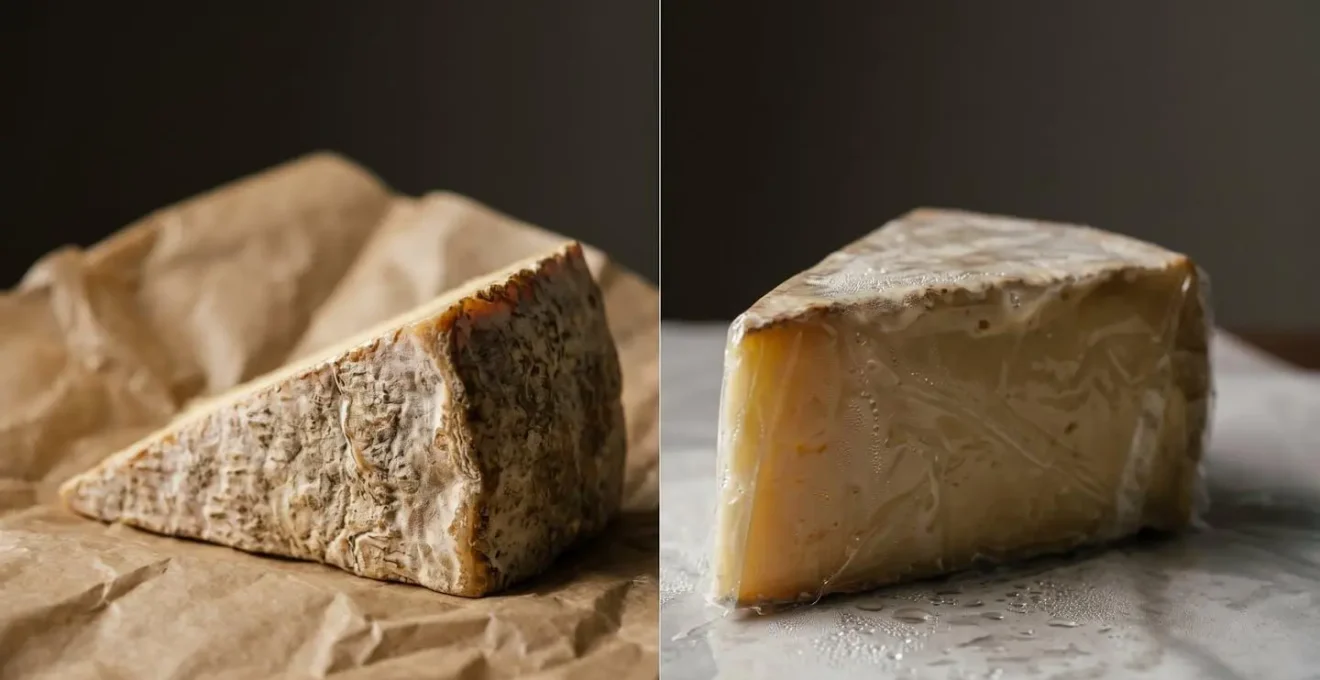
A specialist fromagerie will never wrap your cheese in plastic. They use specially designed cheese paper, which has a porous inner layer that wicks away excess moisture while allowing the cheese to breathe, and a waxy outer layer to prevent it from drying out. The difference this makes is not subtle, as documented in a real-world case study on cheese suffocation.
Case Study: The Plastic Wrap Suffocation Effect
A real-world experiment documented how an expensive wedge of Stilton, suffocated in two layers of plastic wrap, quickly became slimy and developed a harsh, unpleasant flavour, making it inferior even to a standard supermarket blue cheese. After being unwrapped and re-wrapped in proper waxed paper for just a few days, the cheese was able to breathe. It dried out, its texture improved, and it transformed into a delicately flavoured, complex product. The cheese went from being barely usable in a salad dressing to being the star of the dish, demonstrating the profound and rapid damage caused by plastic.
When Should You Buy Mont d’Or to Catch It at Peak Season Rather Than Storage?
Some of France’s most treasured cheeses are not available year-round, and Mont d’Or is the quintessential example of a seasonal delicacy. Understanding its specific season is crucial for experiencing it at its absolute peak. Buying it at the right time means you are tasting a fresh product made from the richest milk, rather than one that has been held in storage for months, its character slowly fading. For a cheese like Mont d’Or, timing is everything.
Mont d’Or, also known as Vacherin du Haut-Doubs, is a soft, unctuous cheese made in the Jura mountains on the French-Swiss border. Its production is intrinsically linked to the transhumance of the local cattle. Historically, when the first snows fell, the cows would be brought down from their high summer pastures. Their milk production would drop, making it insufficient for the giant wheels of Comté produced in the summer. Cheesemakers therefore created this smaller, richer cheese to be made during the autumn and winter months. This tradition is now enshrined in its AOP regulations.
The official rules are strict: production is only permitted from August 15th to March 15th. Consequently, it is only available for sale between September 10 and May 10. While you might see it in a shop in May, a cheese purchased in October or November is almost certainly going to be a fresher, more vibrant example. The best time to buy is from late autumn through the winter. This is when you will find the cheese as the maker intended: luxuriously gooey, with notes of woodland, cured meat, and rich, decadent cream, all held within its signature spruce bark girdle.
Purchasing outside this core window, especially towards the very end of the season, increases the risk of getting a product that is either overripe or has been kept in cold storage for an extended period, which can dull its complex aromatics. Seeking it out during its peak season is a pilgrimage every cheese lover should make.
Why Does the Same Cheese Taste Better When the Maker Handed It to You Personally?
There is a perceptible magic to tasting a cheese directly at the fromagerie or farm where it was made. While part of this is undoubtedly psychological—the romance of the location and the connection to the producer—there is a very real, technical reason for this enhanced flavour: you are experiencing the product with zero supply chain damage. It is the cheese in its most pristine, intended state, untouched by the stresses of transportation and improper storage.
The journey from the affineur’s cave to a UK shop counter can be a brutal one for a delicate, living product. As affinage experts explain, this “zero-mile” advantage is significant. The cheese avoids the vibrations from trucks, the fluctuations in temperature in transit, and the almost inevitable period spent in a generic, non-specialised distribution warehouse. Each of these factors introduces stress that can disrupt the delicate balance of enzymes and microflora, subtly (or not so subtly) altering the final taste and texture.
Furthermore, when you buy directly from the source, you are tasting a cheese that has just been plucked from its perfect aging environment. The unique terroir of the aging cave, which is a complex ecosystem of airborne microbes that have developed over years, is still fully expressed in the cheese. It has not had its character flattened by cold chain logistics or compromised by being placed next to other products in a refrigerated lorry. You are tasting the full, unadulterated complexity of its flavour profile, exactly as the affineur intended you to.
The Zero-Mile Cheese Advantage
Affinage experts explain that cheese caves develop unique terroir over time as airborne molecules reflect the flora of microbes that have thrived in that specific facility. When you purchase directly from an affineur or farmer, the cheese has not had to endure the stresses of transportation. It has avoided vibrations from trucks, damaging temperature fluctuations, and the risk of improper storage in a generic distribution hub. You experience the product in its most pristine state, with the full complexity of its intended flavour profile perfectly intact, a feat that becomes progressively harder to achieve the further the cheese travels from its home.
Why Does AOP Certification Matter More Than Producer Marketing Claims?
In a market filled with evocative but unregulated marketing terms like “artisanal,” “farmhouse,” or “traditional,” the Appellation d’Origine Protégée (AOP) label stands apart. It is not a marketing slogan; it is a legally binding guarantee of authenticity, method, and origin. Understanding what AOP certifies—and what it does not—is fundamental to navigating the world of French cheese and separating genuine tradition from empty branding.
The AOP system, which protects products from a specific geographical area, is a powerful tool against industrial imitation. To earn the coveted red and yellow seal, a producer must adhere to a strict set of rules known as the cahier des charges. This rulebook is a legal contract that dictates every step of the production process. While there are currently 45 French cheeses with AOP designation, each has its own unique and detailed cahier des charges. This ensures that a “Camembert de Normandie AOP” is made in Normandy using traditional methods, not in a factory in another country using industrial shortcuts.
This legal framework provides a crucial baseline of quality and authenticity that marketing claims simply cannot match. The requirements of an AOP go far beyond a simple recipe. They typically include:
- Geographical Control: The milk must come from, and the cheese must be made and matured within, a strictly defined geographical zone.
- Animal Breed & Feed: The rules often specify the breed of cow, goat, or sheep (e.g., Montbéliarde cows for Comté) and what they are allowed to eat, linking the cheese directly to its local environment.
- Traditional Production Methods: The cahier des charges forbids industrial shortcuts like using powdered milk, pasteurising the milk when raw milk is required, or adding enzymes to artificially speed up the aging process.
- Mandatory Audits and Taste Testing: Producers are regularly audited to ensure they are following the rules, and the final cheeses must often pass a blind taste test by an expert panel to be granted the AOP status.
This rigorous, legally enforced system is why the AOP label is a far more reliable indicator of authenticity than any marketing term a producer might invent. It guarantees the cheese is a genuine expression of its terroir and heritage.
Key Takeaways
- The affineur’s skill in maturing cheese is often more impactful on final flavour than the cheese’s origin or AOP status.
- Your senses are the best tools: learn to look, touch, and smell to judge a cheese’s ripeness and quality at the counter.
- Plastic wrap is the enemy of fine cheese. It suffocates the product and creates off-flavours; always opt for cheese paper.
Why Do Some Shops Charge Triple for AOP Cheese That Tastes No Better Than Standard?
This is the final, and perhaps most frustrating, piece of the puzzle. You’ve done your research, you’ve chosen a cheese with the prestigious AOP label, yet the expensive version from a specialist shop sometimes tastes no better—or even worse—than a cheaper one. This happens when the chain of quality is broken. The AOP is a guarantee of a traditional production method, but it is not a guarantee of excellent affinage or perfect storage.
The high price at a top-tier fromagerie is not for the AOP label itself. You are paying for the expertise, labour, and cost associated with perfect maturation and selection. As the Academy of Cheese explains, these specialist shops often buy the same young AOP cheeses that supermarkets do. The difference is what happens next. The fromagerie invests weeks, or even months, of expert care, aging the cheese in their own purpose-built caves to unlock its full potential. The triple price reflects the cost of that extra time, the dedicated labour of the affineur, the energy costs of the controlled environment, and, most importantly, the expertise to know exactly which producers within an AOP are the best and exactly when each individual cheese has reached its peak.
Conversely, if that same expensive AOP cheese is handled poorly anywhere along the supply chain—if it’s stored in a warehouse that’s too cold, transported improperly, or left to languish on a shelf wrapped in plastic—its potential will be destroyed. In this scenario, you are paying a premium price for a pedigree that is no longer reflected in the taste. The cheaper, non-AOP cheese that was handled correctly might well provide a better eating experience. The price tag and the AOP label become meaningless if the supply chain integrity has been compromised.
Ultimately, the price reflects the care invested. AOP guarantees the starting point, but the journey to your plate determines the final quality. The high price is justified only when it represents the cost of an unbroken chain of excellence, from the farm to the affineur’s cave to the knowledgeable cheesemonger who hands it to you.
Now that you can distinguish between a cheese’s origin and its final quality, the next step is to confidently apply this knowledge. Start by seeking out a dedicated cheesemonger and asking them not just about the cheese, but about how they care for it. This is how you begin your journey to consistently enjoying exceptional French cheese.