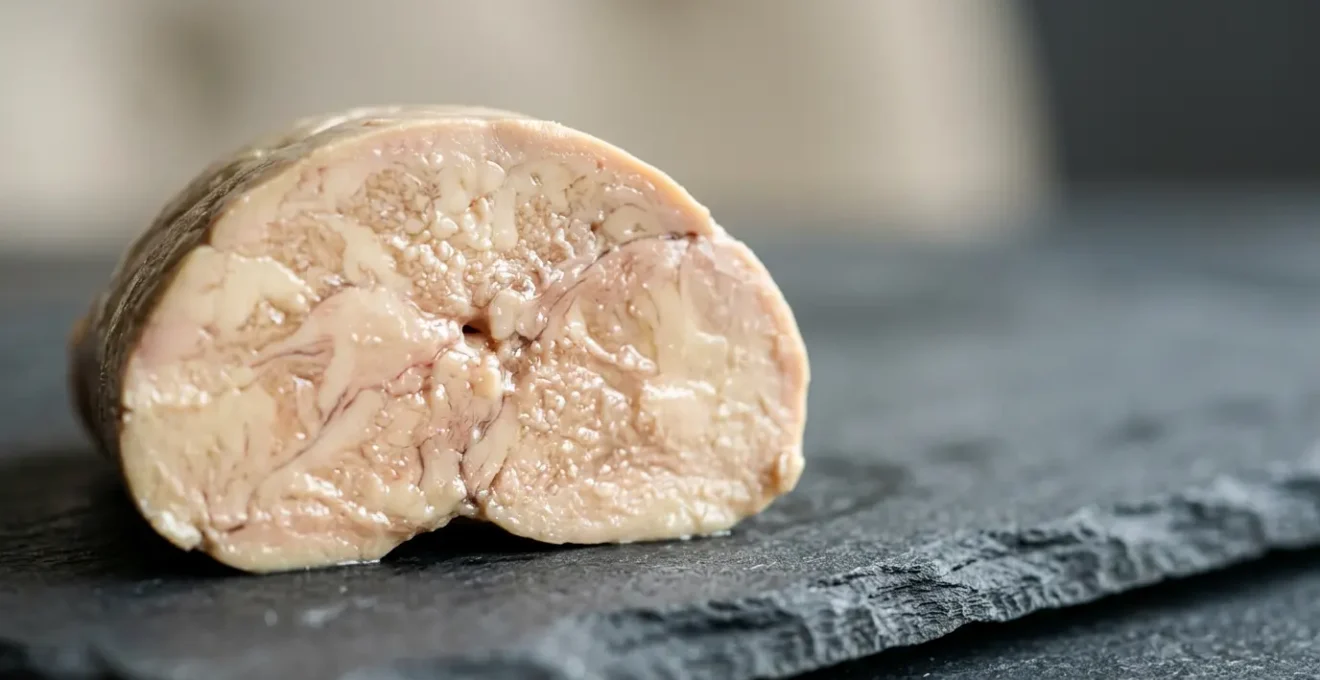
The sublime texture of exceptional foie gras is not an accident of luxury, but the direct result of verifiable production choices that separate authentic craft from industrial compromise.
- Farm scale and ethical practices directly impact the liver’s final quality, creating a silky texture versus a strong, mineral taste.
- Understanding legal grades and labels like ‘Entier’ vs. ‘Bloc’ and AOP vs. ‘Artisanal’ is the key to avoiding overpriced, inferior products.
Recommendation: Focus less on the price tag and more on production integrity and temperature discipline to guarantee a perfect tasting experience every time.
For any gastronome, the experience of truly exceptional foie gras is unforgettable: a delicate, buttery richness that melts on the tongue, leaving a clean, complex, and utterly luxurious finish. Yet, a common and deeply disappointing experience is spending a significant sum on what is billed as a delicacy, only to be met with a strong, metallic, or distinctly “liver-y” taste that feels more coarse than silken. This inconsistency has led many to question the product itself, often viewing it through the single lens of the ethical debate surrounding its production, without understanding the vast quality spectrum that exists within it.
The common advice is often to simply “buy expensive” or choose a specific region, but this oversimplifies a complex reality. The truth is that the jarring, unpleasant flavour is a tell-tale sign of industrial shortcuts, poor production integrity, or improper handling. The sublime, silky texture you seek is not a matter of chance or marketing. It is the direct and measurable outcome of specific agricultural practices, strict product grading, and precise culinary technique that separates authentic artisans from mass-market producers.
But if the secret isn’t just the price, the region, or the type of bird, what is it? The key lies in understanding the ‘why’ behind the quality. It’s about a holistic view that I call production integrity—a combination of farm scale, animal welfare, feed quality, and processing methods. This is the knowledge that allows chefs and discerning consumers to navigate the market with confidence.
This guide will demystify the world of foie gras. We will move beyond the superficial and delve into the tangible factors that define quality. We’ll explore why small-farm products differ so starkly from industrial ones, how to decode labels to get what you pay for, and the simple technical mistakes that can ruin a perfect product. By the end, you will be equipped not just to buy better foie gras, but to understand and appreciate the craft behind the world’s finest examples.
To navigate this complex delicacy, we will explore the critical distinctions that separate the exceptional from the merely expensive. The following sections provide a clear roadmap for the discerning connoisseur.
Summary: A Connoisseur’s Path to Perfect Foie Gras
- Why Does Duck Foie Gras From Small Farms Taste Different From Industrial Production?
- How to Choose Between Entier, Bloc and Mi-Cuit for Your Christmas Starter?
- Périgord or Alsace Foie Gras: Which Region Offers Better Quality and Production Standards?
- The Temperature Mistake That Ruins £80 Worth of Foie Gras at Your Dinner Party
- When Should You Order Christmas Foie Gras to Get Fresh Production Rather Than Stored?
- Why Does AOP Certification Matter More Than Producer Marketing Claims?
- How to Choose Your Menu at a Multi-Course Starred Restaurant for Maximum Satisfaction?
- Why Does Your Pan-Seared Foie Gras Disappear Into Fat While Restaurant Portions Stay Intact?
Why Does Duck Foie Gras From Small Farms Taste Different From Industrial Production?
The most significant factor influencing the final taste and texture of foie gras is the environment in which the bird was raised. The difference between a small, family-owned farm and a large-scale industrial operation is not merely philosophical; it is chemically and structurally tangible in the final product. On small farms, ducks are often raised in the open air, allowed to forage naturally for a significant portion of their lives. This varied diet and active lifestyle develop leaner muscle and a different fat composition, which is crucial for a refined flavour profile. The final, brief gavage phase is conducted with high-quality, whole-kernel corn, often grown on the same farm.
Industrial production, by contrast, prioritizes yield and efficiency over all else. The birds are often kept in more crowded conditions with less mobility. This shift towards intensification is not new; research tracking the industrialization of foie gras production reveals that the average fattening flock size more than tripled in just a decade. This focus on scale can lead to higher stress levels in the birds, which releases hormones that can impart a stronger, more “gamey” or metallic taste to the liver. The feed may be a standardized, less expensive pellet-based formula rather than whole corn, further altering the delicate fat balance.
This difference in production integrity is why small-farm foie gras is often described as cleaner, sweeter, and more buttery. The liver itself is less likely to be fibrous or contain an excess of blood, resulting in that sought-after silky texture. While the industry rightly notes that many producers are family-owned, the scale of operation is the defining variable. A “family-owned” farm with thousands of birds in an industrial setup will produce a fundamentally different product than one with a few hundred raised with more traditional, low-stress methods.
Ultimately, choosing a product from a smaller, transparent producer is the first and most important step towards avoiding that undesirable liver-y taste and ensuring a truly sublime experience.
How to Choose Between Entier, Bloc and Mi-Cuit for Your Christmas Starter?
Navigating the terminology on a foie gras label is the first challenge for any aspiring connoisseur. The terms ‘Entier’, ‘Bloc’, and ‘Mi-Cuit’ are not marketing fluff; they are legal definitions that dictate the product’s composition, texture, and ideal use. Understanding them is essential to ensure you are getting the quality you pay for, especially for a centrepiece like a Christmas starter.
Foie Gras Entier (‘Whole Foie Gras’) is the highest grade. It consists of one or two whole liver lobes, simply seasoned with salt, pepper, and perhaps a dash of Armagnac or Sauternes. Its texture is natural and non-uniform, with visible marbling. This is the purist’s choice, best served sliced on its own to appreciate its unadulterated quality. ‘Bloc de Foie Gras’, on the other hand, is a reconstituted preparation made from emulsified foie gras. While it can be of good quality, it will always have a smoother, more homogenous texture. For better quality, look for ‘Bloc avec morceaux’ (with pieces), which must contain at least 30% whole lobe pieces, offering a textural compromise.
The cooking method adds another layer of complexity. Mi-Cuit (‘half-cooked’) is pasteurized at a low temperature (around 70-85°C). This gentle cooking preserves the liver’s delicate fats, resulting in an incredibly silky, custard-like texture and a fresh, rich flavour. It has a short shelf-life and must be refrigerated. In contrast, ‘Conserve’ or ‘fully cooked’ foie gras is sterilized at a high temperature (over 100°C), making it shelf-stable for years. This process gives it a firmer, denser texture and allows it to develop more complex, mature flavours over time, much like a fine wine.
This following table, based on information from French culinary guides, breaks down the key differences to help you make an informed choice for your festive table.
| Type | Composition | Texture | Best Use | Price Point |
|---|---|---|---|---|
| Foie Gras Entier | One or more whole lobes, simply seasoned | Natural, non-homogeneous with visible marbling | Slicing for plated starters, pure experience | Highest (premium quality) |
| Bloc (with morceaux) | Emulsified foie gras, minimum 30% lobe pieces | Smooth, uniform, easily sliceable | Canapés, toast spreads, mousses | Medium (good compromise) |
| Mi-Cuit (semi-cooked) | Low-temperature pasteurized (70-85°C) | Incredibly silky, custard-like, delicate | Connoisseur tasting, minimal accompaniment | High (short shelf-life) |
| Conserve (sterilized) | High-temperature sterilized (100°C+) | Firmer, more compact, ages well | Long-term storage, gifts | Medium-High (long shelf-life) |
Your Label Decoding Checklist: Avoiding Luxury Traps
- Check the legal name: Ensure it says ‘Foie Gras Entier’ for whole lobes. ‘Bloc’ is always a reconstituted product.
- Inspect Bloc composition: If choosing a Bloc, look for the ‘avec 100% morceaux’ or a minimum of 30% lobe pieces to guarantee a higher quality.
- Verify the cooking method: ‘Mi-Cuit’ will be found in the refrigerated section with a short expiry date, while ‘Conserve’ is shelf-stable for years.
- Ignore vague marketing claims: Terms like ‘Artisanal’, ‘Luxury’, or ‘Traditional’ have no legal weight without a formal certification (like IGP or Label Rouge) to back them up.
- Inquire about the grade: Although rarely labelled for consumers, ask your purveyor about the source grade (‘Extra’ or ‘Grade A’ is best) for searing or pure tasting.
For a Christmas starter where quality is paramount, a ‘Foie Gras Entier Mi-Cuit’ offers the best of both worlds: the integrity of a whole lobe and the sublime, fresh texture that defines a luxury experience.
Périgord or Alsace Foie Gras: Which Region Offers Better Quality and Production Standards?
The debate between foie gras from Périgord (in the Southwest) and Alsace is a classic one, rooted in centuries of distinct culinary traditions. While both regions produce exceptional products, they differ in their typical bird of choice, preparation styles, and production scale. Understanding these nuances helps a connoisseur choose based on preference rather than a misguided notion of one region’s inherent superiority.
The Southwest of France, including Périgord, is the undisputed heartland of foie gras production. It is overwhelmingly dominated by duck (Moulard breed), which accounts for approximately 95% of all French foie gras production. The style here is often rustic and product-focused, with simple seasonings of salt and pepper to let the rich, powerful flavour of the duck liver shine. The vast scale of production means the Southwest offers a wide spectrum of quality, from industrial-scale operations to a thriving network of small, high-integrity farms protected by certifications like IGP Périgord.
Alsace, by contrast, has a long and storied tradition centred on goose foie gras. As the Foie Gras Regional Association notes, “Alsace has a long tradition of goose fattening… Alsatian culinary tradition has made a significant contribution to the international renown of French foie gras.” Goose liver is generally considered more delicate, refined, and subtle in flavour than duck, with a slightly higher price point due to the more demanding and lengthy raising process. Alsatian preparations are often more elaborate, sometimes featuring spices like nutmeg or a wrapping in pork fat. Production in Alsace is much smaller and more secretive, often sold through local networks and high-end restaurants.
Alsace has a long tradition of goose fattening. Foie gras production in Alsace is a little more secretive, but Alsatian culinary tradition has made a significant contribution to the international renown of French foie gras.
– Foie Gras Regional Association, The Production Regions of Foie Gras
So, which is better? It is a matter of taste and purpose. For a powerful, rich flavour and for pan-searing (duck liver holds its shape better), the best of the Southwest is unparalleled. For a more subtle, elegant, and refined experience, Alsatian goose foie gras is the connoisseur’s choice. The key is not the region itself, but finding a producer with high production integrity within that region’s tradition.
Ultimately, a top-tier small-farm duck foie gras from Périgord will always be superior to a mediocre goose foie gras from Alsace, and vice versa. Quality of production trumps regional stereotypes every time.
The Temperature Mistake That Ruins £80 Worth of Foie Gras at Your Dinner Party
You have invested in a beautiful ‘foie gras entier mi-cuit’. You have the perfect fig chutney and toasted brioche. Yet, when you slice it, the terrine crumbles, smears, and looks messy on the plate. Or worse, it’s served so cold that its texture is waxy and the flavour is muted. This common disaster has nothing to do with the quality of the foie gras itself and everything to do with a lack of thermal discipline—the single most common mistake made by home entertainers.
Foie gras is an emulsion of fat and liver, and its texture is exquisitely sensitive to temperature. Served too cold, straight from the fridge, the fats are solid and dense, masking the delicate flavours and creating a waxy, unpleasant mouthfeel. Served too warm, the fats begin to melt and separate (‘render’), causing the terrine to become greasy, lose its structure, and taste heavy. The perfect serving temperature is a narrow window, typically between 10-15°C, where the fats are softened just enough to release their full aroma and create that signature melting texture without collapsing.
The second critical error involves slicing. Using a cold, dry knife will cause the foie gras to stick and tear. The blade drags through the delicate fat, smearing the edges and ruining the presentation. A clean, perfect slice is not just for aesthetics; it preserves the integrity of the terrine’s structure, ensuring a consistent texture in every bite. The professional technique is simple but non-negotiable: use a hot, clean blade for every single cut.
To avoid disappointment, follow this precise method used by French chefs. It ensures your investment is showcased perfectly, delivering the sublime experience you paid for.
- Remove the foie gras terrine from the refrigerator exactly 15-20 minutes before you plan to serve it. This is the golden rule to let it soften slightly.
- Prepare a tall glass or jug of very hot water and a clean, dry cloth.
- Dip the blade of a thin, non-serrated knife into the hot water for a few seconds.
- Wipe the blade completely dry with the cloth. A wet blade will leave watermarks.
- Make a single, clean, deliberate cut through the terrine. Do not saw back and forth. Let the warm blade glide through the fat.
- Repeat the dip-and-wipe process for every single slice. Serve immediately to capture the perfect temperature window.
This simple ritual separates a passable presentation from a truly professional and respectful one, ensuring your expensive delicacy tastes every bit as good as it should.
When Should You Order Christmas Foie Gras to Get Fresh Production Rather Than Stored?
For the ultimate Christmas indulgence, a ‘mi-cuit’ foie gras is often the top choice due to its fresh flavour and silky texture. However, unlike its shelf-stable ‘conserve’ counterpart, the quality of mi-cuit is directly tied to its production date. Ordering at the right time is critical to ensure you receive a product from the peak seasonal batch, rather than one that has been sitting in refrigerated storage for months.
The key lies in understanding the production cycle. The traditional gavage period for ducks and geese aligns with their natural pre-migration fattening instinct, which occurs in the autumn. Consequently, the peak production season for fresh and mi-cuit foie gras is from late November to early December. This is when artisans are processing the highest quality livers of the year. A mi-cuit product made during this window will have the most vibrant flavour and optimal texture.
Since mi-cuit has a refrigerated shelf-life of only a few weeks to a couple of months, timing your order is paramount. Ordering in late November or the first week of December for delivery in mid-to-late December is the ideal strategy. This ensures you are receiving a product from the current season’s peak production run. Ordering too early (e.g., in October) might mean you receive an end-of-season product from the previous year, or one that will have been stored for a longer period, potentially diminishing its delicate qualities.
Case Study: The Mi-Cuit Freshness Window
Mi-cuit foie gras undergoes low-temperature pasteurization (70-85°C), which preserves its delicate flavour but limits its refrigerated shelf-life to between 3 and 6 weeks. This makes its production timing fundamentally different from sterilized conserve (cooked at 90-110°C), which is stable for years. The peak production window for mi-cuit aligns with the end of the autumn gavage cycles, occurring in late November and early December. A consumer ordering for Christmas in this timeframe is guaranteed to receive a product at its absolute peak. An order placed months earlier for the same product is buying time in storage, not freshness.
To ensure transparency and guarantee you are getting a fresh product, don’t be afraid to engage with your supplier. A quality producer will be proud of their production schedule and happy to provide details. Here are the key questions to ask:
- “When was this specific batch of mi-cuit produced?” (They should be able to provide a precise date or week).
- “What is the production window for your current season?” (This helps verify their claims).
- “Do you source from a single farm or multiple farms?” (Single-farm sourcing often indicates tighter quality control).
- “Can you provide traceability documentation for this product?” (This is a legal requirement for certified products like IGP).
By strategically timing your order and asking the right questions, you can ensure your Christmas foie gras is a true reflection of peak-season quality, not a relic of months past.
Why Does AOP Certification Matter More Than Producer Marketing Claims?
In the world of luxury goods, marketing language is often designed to evoke a sense of quality that may not exist. Terms like ‘Artisanal’, ‘Traditional Recipe’, ‘Gourmet’, or ‘Luxury’ are legally meaningless when it comes to foie gras. They are unregulated, unenforceable, and offer zero guarantee of the product’s origin, production method, or quality. In contrast, official certifications like AOP, IGP, and Label Rouge are legally binding designations protected by French and EU law, enforced by rigorous, independent audits.
These certifications provide a baseline of production integrity that marketing fluff cannot. An ‘Indication Géographique Protégée’ (IGP), such as IGP Périgord or IGP Sud-Ouest, guarantees that at least one stage of production (typically the raising and fattening of the birds) occurred in that specific geographical region. It enforces traceability and adherence to a set of standards (‘cahier des charges’) regarding feed, animal welfare, and processing. ‘Label Rouge’ is another French state certification focused on superior quality. For foie gras, it sets standards for bird breeds, outdoor access, and feed quality that are stricter than standard production.
The pinnacle of certification is the ‘Appellation d’Origine Protégée’ (AOP). This is the most stringent designation, guaranteeing that every single stage of production, from the birth of the bird to the final processing of the liver, has occurred within a specific terroir using recognized, traditional know-how. This provides an unparalleled link between the product and its origin. Discerning consumers understand this distinction and are willing to invest in it; an IFOP 2022 survey found that 78% of French consumers are willing to pay more for foie gras with an official quality certification.
The following table, created from information on a producer’s website, clarifies the crucial difference between a legally-backed guarantee and an empty marketing promise. By learning to prioritize the former, you protect yourself from paying a premium for a standard product in a fancy package.
| Certification Type | Legal Weight | What It Guarantees | Control Mechanism |
|---|---|---|---|
| AOP (Appellation d’Origine Protégée) | EU-protected legal designation | All production stages in specific terroir, traditional methods, specific breeds | INAO audits, independent certification bodies |
| IGP (Indication Géographique Protégée) | EU-protected legal designation | At least one production stage in designated region, origin verification | Annual audits, traceability documentation |
| Label Rouge | French state certification | Superior quality vs. standard products, strict welfare/feed standards | Independent organism controls, unannounced inspections |
| ‘Artisanal’ (marketing term) | No legal definition | Nothing enforceable – purely marketing language | None |
| ‘Traditional Recipe’ (marketing term) | No legal definition | No guarantees on production method or ingredients | None |
| ‘Luxury’ (marketing term) | No legal definition | No quality baseline – only price positioning | None |
When faced with a choice, always trust the legally enforced certification over the poetic marketing description. The stamp of an AOP or IGP is a far more reliable indicator of quality than the word ‘Gourmet’.
How to Choose Your Menu at a Multi-Course Starred Restaurant for Maximum Satisfaction?
Ordering in a multi-Michelin-starred restaurant is not just about picking dishes you like; it’s about curating an experience. When foie gras is on the menu, its placement and context are critical to avoid overwhelming your palate and diminishing the enjoyment of the entire meal. A strategic approach to your menu selection ensures this rich delicacy enhances, rather than dominates, the culinary journey.
Firstly, use the foie gras dish as a litmus test of the kitchen’s skill. A simple, perfectly pan-seared slice of Grade A foie gras with a complementary acidic or sweet element demonstrates immense technical mastery. The chef has nowhere to hide; the quality of the product and the precision of the cooking are laid bare. Conversely, an overly complex preparation with multiple strong flavours may sometimes be used to mask a less-than-perfect liver. Trust the restaurants that show confidence in simplicity.
Secondly, consider the dish’s position in the tasting menu. Foie gras is intensely rich. Consuming it too early can lead to palate fatigue, making subsequent, more delicate dishes taste bland. The ideal placement is typically just before the main meat course. It serves as a decadent bridge from lighter fish or vegetable starters to the richer finale, preparing the palate for what’s to come without exhausting it. If you’re ordering à la carte, avoid preceding your foie gras with another rich dish like a cream-based soup or sweetbreads.
Finally, engage the sommelier with purpose. Don’t just ask “what” wine pairs with the foie gras, ask “why” their chosen pairing works. A great sommelier will move beyond the classic (and sometimes cloying) Sauternes pairing. They might suggest a dry but aromatic white like a Vouvray or a Savennières from the Loire Valley, whose acidity can cut through the fat beautifully, or even a vintage Champagne. Their explanation will reveal the depth of their understanding and lead you to a more interesting and balanced pairing.
- Use foie gras as a kitchen litmus test: Simple preparations showcase skill; complex ones can hide flaws.
- Position it strategically: Order it just before the main meat course to avoid palate fatigue.
- Avoid richness overload: Don’t pair it with other creamy or butter-heavy dishes in the same meal.
- Question the sommelier’s ‘why’: Understand the philosophy behind the wine pairing, don’t just accept the ‘what’.
- Evaluate pairing philosophy: A great pairing balances the fat with acidity, rather than just adding more sweetness.
This thoughtful approach ensures the foie gras becomes a harmonious highlight of your meal, not a delicious but overpowering roadblock.
Key takeaways
- The silky texture of great foie gras is a direct result of low-stress, small-scale farming, not just price.
- Legal certifications like AOP and IGP are the only reliable guarantees of quality; ignore vague marketing terms like ‘Artisanal’.
- Perfect serving and searing results depend on strict temperature control—’thermal discipline’ is non-negotiable for both terrines and fresh slices.
Why Does Your Pan-Seared Foie Gras Disappear Into Fat While Restaurant Portions Stay Intact?
This is perhaps the most frustrating experience for a home cook: you purchase a beautiful, expensive lobe of fresh foie gras, place it in a hot pan, and watch in horror as it rapidly melts away, leaving you with a tiny, shrunken piece swimming in a pool of rendered fat. The reason this happens is twofold, involving a factor you cannot control—the product’s grade—and a factor you can—your technique.
The invisible factor is the Grade A imperative. In the professional supply chain, fresh foie gras is graded (A, B, or C) based on its size, texture, colour, and integrity. As gourmet specialists from Marky’s point out, “Grade A foie gras represents the pinnacle of quality… The absence of blemishes, blood spots, or irregularities makes Grade A foie gras the preferred choice for chefs who intend to serve the liver in its most pristine form — such as searing.” These livers have an optimal fat-to-protein ratio, which allows them to hold their structure under high heat. Lower grades, like B or C, have a higher fat content and are intended for making terrines, mousses, or pâtés. When you sear a Grade B liver, its less stable structure causes it to render excessively—it literally ‘disappears’ into fat. Unfortunately, this grade is rarely specified on retail packaging, so buying from a trusted, high-end butcher who can vouch for the liver’s grade is essential.
The second factor is technique, specifically the non-negotiable “cold liver, hot pan” rule. Any warmth in the liver before it hits the pan will cause it to start melting on contact, rather than forming a protective crust. The foie gras must be refrigerator-cold and the pan searingly hot. This creates an instantaneous Maillard reaction, forming a golden-brown, crispy crust that locks in the fat and protects the interior, allowing it to gently cook to a warm, melting consistency without disintegrating.
Grade A foie gras represents the pinnacle of quality. Livers in this category are usually larger, with a smooth, firm texture and a uniform, pale color — indicators of a high-quality, healthy liver… Grade A foie gras the preferred choice for chefs who intend to serve the liver in its most pristine form — such as searing.
– Markys Gourmet Specialists, Elevating Your Culinary Creations: Foie Gras Pairings
To achieve restaurant-quality results, you must combine a high-quality product with flawless technique. Follow these steps exactly:
- Ensure you have purchased a Grade A (or ‘Extra’) liver from a reputable supplier.
- Keep the foie gras refrigerator-cold (2-4°C) until the very last second.
- Slice it into thick (approx. 1-inch) medallions while still cold. A warm knife helps make clean cuts.
- Preheat a dry, heavy-bottomed pan (cast iron is ideal) over medium-high heat until it is extremely hot but not smoking. Do not add any oil.
- Season the slices with salt and pepper just before placing them in the pan.
- Sear for 30-45 seconds per side, just until a deep golden crust forms. Do not move them while they sear.
- Remove immediately and serve. The rendered fat left in the pan is liquid gold—use it to roast potatoes or wilt spinach.
Now that you are equipped with the knowledge to select, prepare, and serve this delicacy with confidence, the next step is to apply these principles in your own kitchen or when dining out, transforming your appreciation from simple enjoyment to true connoisseurship.