The reason your French classics fall short isn’t your cooking skill; it’s because you’re trying to replicate an entire, non-transferable ecosystem of water, soil, and microbes.
- Authentic flavour is born from a region’s unique water chemistry, which alters how ingredients cook, and its specific “microbial terroir” from local yeasts and bacteria.
- Official certifications like AOP exist to protect this entire, complex system, not just a list of ingredients.
Recommendation: Stop chasing impossible imitation. Instead, learn to “translate” the principles of a French classic using the best of your own local British terroir to create something honest and delicious.
There is a specific, haunting frustration known to any dedicated home cook. It’s the memory of a perfect dish, eaten somewhere far away—a deeply savoury coq au vin in a Burgundy farmhouse, a cassoulet in the Languedoc so profound it felt like a spiritual experience. You secure the recipe, buy the best ingredients you can find, follow the steps with military precision, and the result is… fine. It might even be good. But it is not that. The soul is missing. The depth is absent. That specific magic, rooted in a place, remains stubbornly elusive.
The common advice feels hollow. “Use better ingredients,” they say. “Cook it longer.” You’ve done that. You’ve sourced heritage-breed chicken and used a whole bottle of expensive Pinot Noir. The internet is filled with tips and tricks, promising that the secret lies in a specific herb, a certain brand of lardons, or the type of pot you use. While these elements matter, they are merely notes in a much larger, more complex symphony. They are the visible tips of a vast, invisible iceberg of flavour that lies beneath the surface of the recipe.
The truth is far more scientific and liberating. If your authentic French dishes consistently fall short, the problem is not your ability. The problem is that you are attempting the impossible: to replicate an entire ecosystem in a foreign kitchen. The real recipe for these foundational dishes is written in the land itself. This isn’t about vague romantic notions; it’s about chemistry, biology, and geology. It’s about a concept the French have a word for, but which the English language struggles to contain: terroir.
This article will deconstruct that magic. We will not offer you another “perfect” recipe that will lead to the same disappointment. Instead, we will explore the scientific reasons—the water signature, the microbial life, the genetic heritage of plants and animals—why these dishes are so tied to their place of origin. We’ll then provide a new, more honest framework: not replication, but translation. You will learn not only why your cassoulet can’t be perfect, but how to make a brilliant, honest British stew inspired by its principles.
Table of Contents: Unpacking the Science of Terroir Cooking
- Why Can Cassoulet Never Taste Exactly Right When Made Outside Its Home Region?
- How to Make an Honest British Version of a French Terroir Classic Without Faking It?
- Bouillabaisse or Boeuf Bourguignon: Which Classic Is Easier to Approximate in a UK Kitchen?
- The Substitution That Changes Your Gratin Dauphinois From Classic to Completely Different Dish
- When Can You Find UK Ingredients That Best Approximate What’s in Season in French Regions?
- Why Does the Same Recipe Taste Completely Different Depending on Its Region of Origin?
- Why Does AOP Certification Matter More Than Producer Marketing Claims?
- Why Do “Regional Specialities” Sold in Paris Bear Little Resemblance to the Real Thing?
Why Can Cassoulet Never Taste Exactly Right When Made Outside Its Home Region?
Cassoulet, the legendary bean and meat stew from the Languedoc region of southern France, is a prime example of a dish intrinsically linked to its environment. While the combination of white beans, sausage, and confit duck or pork seems straightforward, its authentic character is shaped by invisible forces, starting with the very water used to cook the beans. The specific mineral content of the local water—its unique water signature—profoundly affects how the star ingredient, the Tarbais bean, cooks.
Hard water, rich in calcium and magnesium, can prevent beans from ever becoming truly soft and creamy. Conversely, the water in the Castelnaudary region, considered a spiritual home of cassoulet, possesses a specific profile that allows the beans to break down to a perfect, melting texture. This isn’t folklore; it’s chemistry. Scientific research on bean cooking chemistry shows that essential elements like calcium, potassium, and magnesium leach from the beans into the cooking liquid, a process that is heavily influenced by the starting mineral content of the water itself. Your filtered tap water in London or soft water in the Lake District creates a completely different chemical reaction in the pot.
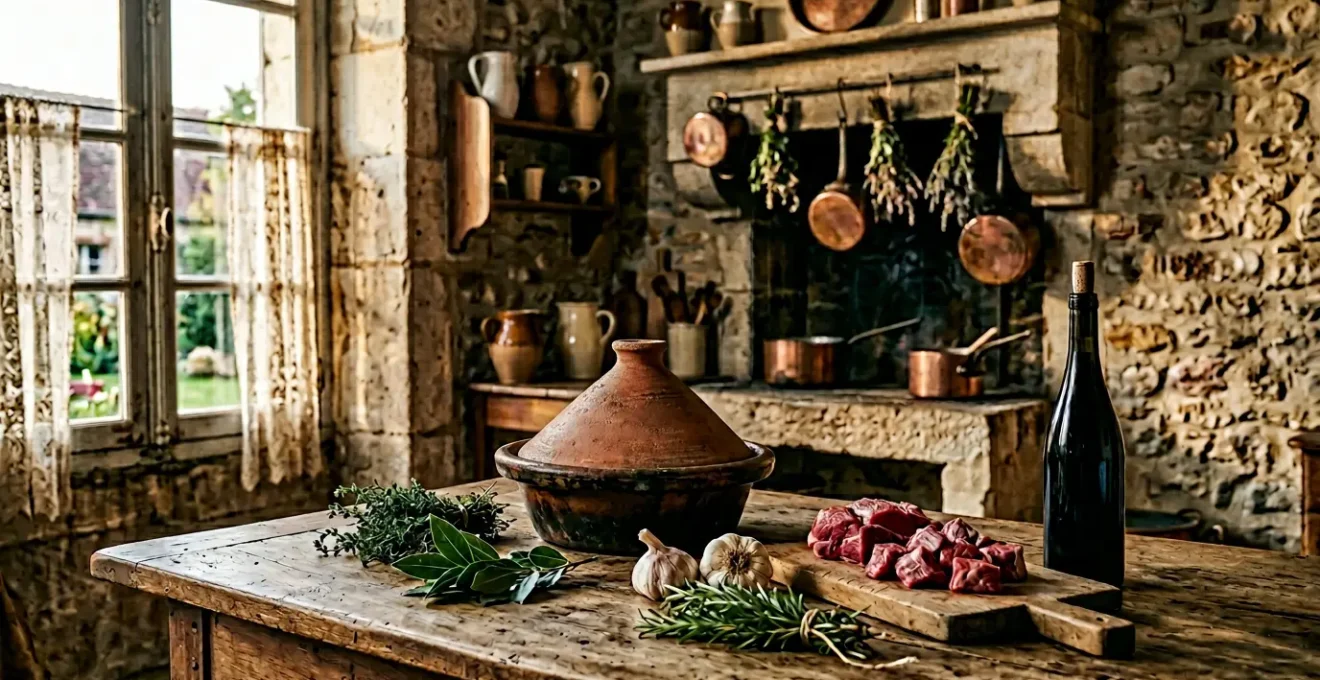
This sense of place extends to the tools. As the D’Artagnan blog notes, “The name cassoulet comes from the word cassole, referring to the traditional, conical clay pot in which it is cooked.” This specific earthenware vessel, perfected by potters in the village of Issel, provides a unique, gentle, and even heat that a modern Dutch oven, however high-quality, cannot perfectly replicate. The clay itself, porous and earthy, contributes its own subtle character. When you make cassoulet outside its home, you are fighting against a different water chemistry and a different set of cooking physics from the very beginning.
This doesn’t mean you can’t make a delicious bean and sausage stew. But accepting that you cannot replicate the exact texture and flavour of a Castelnaudary cassoulet is the first, liberating step towards cooking honestly.
How to Make an Honest British Version of a French Terroir Classic Without Faking It?
The goal, then, is not replication but terroir translation. This is a conscious and creative process. It involves deconstructing a French classic to its core principles—its essential flavour profile, texture, and purpose—and then rebuilding it using the best ingredients your own local terroir has to offer. Instead of a pale imitation, you create a new dish that is a respectful cousin, honest to its own time and place. Think of it as translating poetry: you don’t translate word-for-word; you capture the spirit and rhythm in a new language.
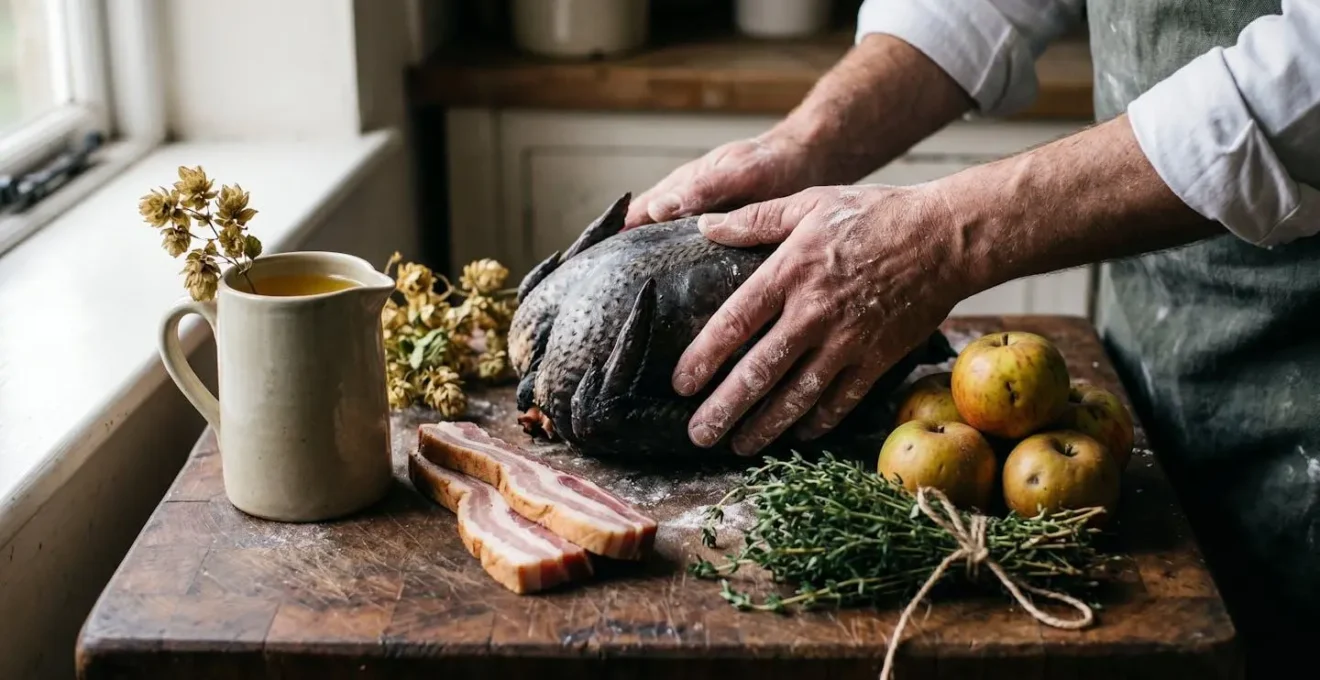
Let’s take Coq au Vin. Its essence is chicken, slowly braised in red wine with bacon, mushrooms, and onions, creating a deep, savoury, and comforting dish. The Burgundian original uses a local cockerel, Burgundy wine, and Charolais pork lardons. A direct translation to a UK kitchen might involve a heritage Sussex cockerel, a rich Herefordshire cider instead of wine, thick-cut Wiltshire bacon, and earthy field mushrooms from the New Forest. The result is not Coq au Vin, but it is a magnificent, deeply British dish built on the same foundational principles.
This approach celebrates what you *do* have, rather than lamenting what you don’t. It connects you to your own landscape, your own farmers, and your own seasons. It moves the act of cooking from one of imitation to one of creation, grounded in respect for both the original dish and your own local environment. This is the path to truly satisfying cooking.
Your Action Plan: A 5-Step Audit for Terroir Translation
- Identify the Core Function: Break down the French classic. Is the key element a slow-braised tough cut of meat, a creamy potato-starch emulsion, or the fresh acidity of a wine reduction? Isolate the fundamental purpose of each component.
- Find the Local Analogue: Search for the British ingredient that performs the same function. Instead of Pinot Noir for acidity and depth, could a perry or a damson-infused gin work? Instead of Comté cheese, could a Lincolnshire Poacher or a Keen’s Cheddar provide the right nutty, savoury notes?
- Respect the Process: The cooking method is often as crucial as the ingredients. If the original calls for a long, slow braise to break down collagen, honour that technique. The *how* of cooking is a universal language.
- Name It Honestly: This is not “British Boeuf Bourguignon.” Call it “Slow-Braised Hereford Beef in Porter with Smoked Bacon.” Giving it an honest name frees it from the burden of comparison and allows it to be judged on its own delicious merits.
- Celebrate the Result: Take pride in a dish that speaks of your place. You haven’t made a failed French classic; you’ve created a successful British original.
By embracing this mindset, you are no longer a failed imitator but a creative, place-conscious cook. You are participating in the true spirit of terroir.
Bouillabaisse or Boeuf Bourguignon: Which Classic Is Easier to Approximate in a UK Kitchen?
When choosing which French classics to tackle, it’s crucial to understand that not all terroir is created equal in its resistance to replication. Some dishes are more forgiving than others. The answer often lies in whether the core challenge is biological specificity or chemical process.
A classic Marseille bouillabaisse is a perfect example of a dish bound by biological specificity. Its defining character comes from a legally protected list of local Mediterranean rockfish, such as rascasse (scorpionfish), galinette (gurnard), and congre (conger eel). These specific fish, with their unique flavour profiles and collagen structures, are simply not available fresh in a UK market. Substituting cod, haddock, and salmon results in a perfectly pleasant fish soup, but it is categorically not bouillabaisse. The terroir here is the living fauna of a specific sea. It is nearly impossible to approximate.
Boeuf Bourguignon, on the other hand, is a dish of chemical process. Its core is a tough cut of beef braised in red wine. While a Charolais cow and a Burgundy Pinot Noir are the ideal, the fundamental process—using acid (wine) and slow heat to transform collagen in beef into gelatine—is a universal chemical reaction. You can achieve a very good approximation using a quality cut of Hereford or Angus beef and a decent, full-bodied red wine. However, the ghost of terroir remains. As with beans, the mineral content of your water will affect the final texture of the meat and vegetables. Further studies on legume cooking water composition reveal that high levels of minerals and other compounds leach into the broth, creating a unique flavour base that is impossible to replicate exactly. So while Bourguignon is easier to *approximate*, it will still taste different based on your local water’s geological fingerprint.
Therefore, for the home cook, a beef stew is a more achievable and satisfying project than a Mediterranean fish stew. You are working with a chemical process that can be successfully translated, rather than a list of irreplaceable biological ingredients.
The Substitution That Changes Your Gratin Dauphinois From Classic to Completely Different Dish
Few dishes seem simpler than Gratin Dauphinois: potatoes, cream, garlic, salt, pepper. Yet, it is a masterclass in food chemistry, and one small, common substitution completely derails the entire process. That substitution is using the wrong kind of potato. Many modern recipes, in an attempt to create a “richer” dish, might even suggest adding cheese. This is a heresy that fundamentally misunderstands the science at play.
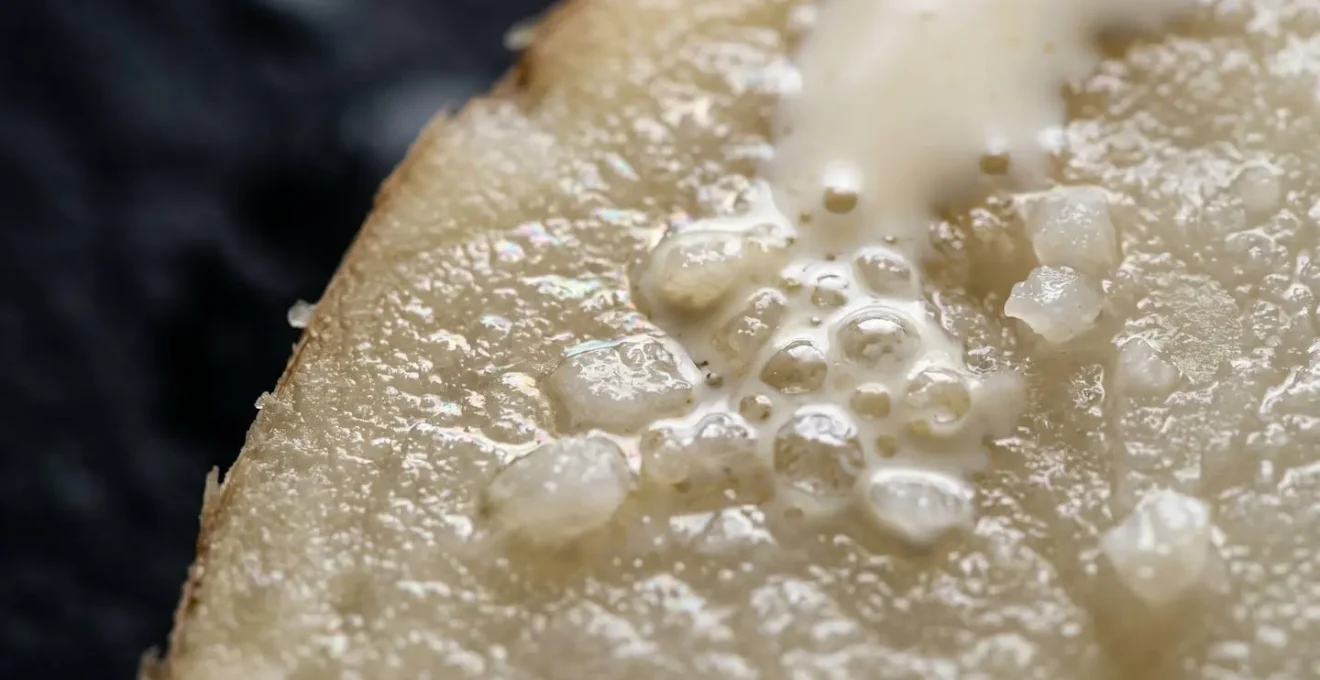
The magic of a true Gratin Dauphinois lies not in cheese, but in starch. The classic recipe calls for a floury, high-starch potato variety, like a Maris Piper or King Edward in the UK. When these potatoes are thinly sliced (and crucially, not rinsed), their surfaces are covered in released starch granules. As the gratin bakes, these starch molecules swell and burst, emulsifying with the fat from the cream. This natural process creates a sauce that is thick, creamy, and clings to the potatoes, all without a single gram of flour or cheese. It is a self-saucing dish, a miracle of culinary science.
What happens when you use a waxy potato, like a Charlotte or a Jersey Royal? These varieties have a lower starch content and hold their shape when cooked. They do not release enough starch to emulsify the cream. The result is a dish of cooked potato slices swimming in a pool of greasy, separated cream. The same failure occurs if you rinse the sliced potatoes—you wash away the very starch that is the key to the sauce. Adding cheese is a clumsy attempt to fix a problem that shouldn’t exist, creating a different, heavier dish: a Gratin Savoyard, perhaps, but not a Dauphinois. The choice of potato is not an “ingredient”; it is the entire chemical engine of the dish.
This highlights a core tenet of terroir cooking: the specific genetic heritage of a plant variety is paramount. It’s not just “a potato”; it’s a specific type of potato, chosen for its precise chemical properties honed over generations in a particular region.
When Can You Find UK Ingredients That Best Approximate What’s in Season in French Regions?
The concept of “eating seasonally” is a cornerstone of good cooking, but it becomes more complex when trying to approximate a French classic. A UK-grown tomato in August is not necessarily equivalent to a Provençal tomato in August. This is due to what botanists call phenological lag—the difference in timing of natural events like budding, flowering, and fruiting, driven by latitude, climate, and daylight hours.
Southern France has a significant head start on the UK. Their spring arrives earlier, their summer is longer and hotter, and their soil has a different composition. This means that a French spring lamb, fed on early spring grasses, will have a different flavour profile from a British spring lamb. French *gariguette* strawberries, available in April, have a unique perfumed flavour that can’t be matched by the first UK strawberries in May or June, which have grown in different conditions. The “in season” label is not a guarantee of equivalence.
The challenge is not just about the type of ingredient, but the specific varietal and its growing conditions. This has a tangible impact on cooking. For example, dramatic research on common bean consumer traits demonstrates that cooking time variations can range from 19 to 271 minutes across different bean genotypes. This staggering difference isn’t just about freshness; it’s about the bean’s genetic makeup and the soil it grew in. A bean that cooks to perfection in 45 minutes in France might be a variety that remains tough after three hours in your UK kitchen, or vice versa.
A savvy cook aiming for terroir translation will think in terms of “seasonal equivalents.” Instead of seeking the first tender broad beans for a lamb dish in April (mimicking a French recipe), they might wait until May for UK broad beans or use the UK’s superb early-season asparagus as a local expression of spring’s arrival. It’s about matching the *spirit* of the season in your own climate, not the letter of the calendar in another.
This shift in perspective moves you from being a recipe-follower to a true seasonal cook, attuned to the rhythms of your own terroir.
Why Does the Same Recipe Taste Completely Different Depending on Its Region of Origin?
Beyond water, soil, and genetics, there is an even more invisible and powerful force at play: microbial terroir. Every region, every vineyard, every farm, and every cellar has a unique population of indigenous yeasts and bacteria. These microscopic organisms are the unsung heroes of flavour, responsible for the complex processes of fermentation that define many of the world’s greatest foods and wines.
Wine is the most well-studied example. The flavour of a Burgundy wine is not just from the Pinot Noir grape; it’s from the specific wild yeasts that live on the grape skins in that particular vineyard and in the air of that specific cellar. These yeasts conduct the fermentation, producing a unique cocktail of flavour and aroma compounds. Use the same grapes in a different location with different native yeasts, and you get a completely different wine. This is not a matter of opinion, but of scientific fact.
As a groundbreaking study from UC Davis on the subject explains, there is a clear link between the local microbial population and the final product:
Regional microbiota signatures correlate with wine chemical composition, with bacterial and fungal consortia of wine fermentations composed from vineyard and winery sources.
– Nicholas A. Bokulich et al., Associations among wine grape microbiome, metabolome, and fermentation behavior (UC Davis study)
This principle extends far beyond wine. The unique tang of a sourdough bread from San Francisco, the specific earthy funk of a raw-milk Camembert from Normandy, the complex flavour of a traditionally cured salami from Tuscany—all are the work of unique, localised microbial communities. When you use a generic, commercially produced yeast from a packet, you are bypassing this entire universe of flavour. When you use pasteurised milk, you have erased the microbial signature of the farm. This is why a raw-milk cheese tastes “more alive” and complex; it literally is.
The flavour you are chasing is not just an ingredient; it is the taste of a living, breathing microbial ecosystem that exists only in one place on Earth.
Why Does AOP Certification Matter More Than Producer Marketing Claims?
In a world of confusing marketing labels—”farm-fresh,” “artisanal,” “traditional recipe”—how can a consumer find a genuine product of terroir? The French answer is a legally binding system of geographical indication: the Appellation d’Origine Protégée (AOP), which evolved from the older Appellation d’Origine Contrôlée (AOC).
An AOP label is not a marketing gimmick; it is a legal guarantee. It certifies that a product owes its character to its geographical origin and has been produced according to a strict, legally defined set of rules (the *cahier des charges*). This goes far beyond just the location. As the French AOC regulatory framework states, the mission is to ensure products “are to be produced in a consistent and traditional manner with ingredients from specifically classified producers in designated geographical areas.” This means the AOP for Roquefort cheese dictates not just the location, but also the use of a specific breed of sheep (Lacaune), their diet (they must graze on specific local pastures), the use of raw milk, and even the source of the mould (*Penicillium roqueforti*), which must be cultured on bread in the same caves where the cheese is aged.
The AOP is a holistic protection of an entire terroir ecosystem: the geography, the genetic heritage of the plants or animals, the local know-how, and the microbial environment. It is an anti-industrial promise. The scale of this system is immense; according to official French agricultural data, France has 489 products under AOC/AOP certification, with the majority being wines. When you buy a product with an AOP label, you are buying a guarantee of authenticity and a direct connection to a specific place.
In contrast, a label that simply says “French Brie” or “Camembert-style cheese” offers no such guarantee. It is likely an industrial product made anywhere in France (or the world), using standardised ingredients and methods, and will bear little resemblance to the complex, living flavour of its AOP-protected counterpart.
Key Takeaways
- Terroir is science, not romance: Authentic flavour is determined by measurable factors like water chemistry, soil mineralogy, and regional microbial life.
- AOP is your guarantee: Appellation d’Origine Protégée (AOP) certification is a legal promise that a product’s entire ecosystem—from genetics to geography—is authentic.
- Translate, don’t imitate: The path to success is not chasing a perfect copy but translating the principles of a French classic using the best of your own local terroir.
Why Do “Regional Specialities” Sold in Paris Bear Little Resemblance to the Real Thing?
Even within France, the power of terroir can be diluted or erased entirely. A visitor might be tempted to buy a can of cassoulet from a Parisian supermarket or a vacuum-packed “Saucisson de Lyon” from a tourist shop, assuming it represents an authentic taste of its region. More often than not, this leads to the same disappointment you experience in your home kitchen. The reason is simple: industrialisation and scale are the natural enemies of terroir.
True terroir products are often made by small producers on a limited scale, using specific, sometimes difficult ingredients and time-consuming methods. To create a “regional speciality” that can be produced in the thousands, shipped across the country, and sold at a competitive price in a Parisian hypermarket, compromises are essential. The specific Tarbais beans for cassoulet are replaced by a generic, high-yield white bean. The raw milk for cheese is pasteurised for stability and longer shelf life, killing its microbial character. The slow-cured sausage is rushed with chemical additives.
The product is standardised to ensure every can or package is identical, which is the exact opposite of terroir, where slight variations from season to season are a mark of authenticity. The name on the label—”Cassoulet,” “Boeuf Bourguignon”—becomes a generic descriptor for a flavour profile, not a connection to a specific place. It is a recipe de-racinated, stripped of its soul for commercial convenience. The Parisian tourist shop version and your own homemade version often fail for the same reason: they both lack a genuine connection to the source ecosystem. The only difference is that yours is made with care.
The next time you cook, forget the pressure of creating a perfect replica. Instead, focus on making a delicious, honest dish that speaks of its ingredients and the care you put into it. By understanding the science of terroir, you are free to stop imitating and start truly cooking.