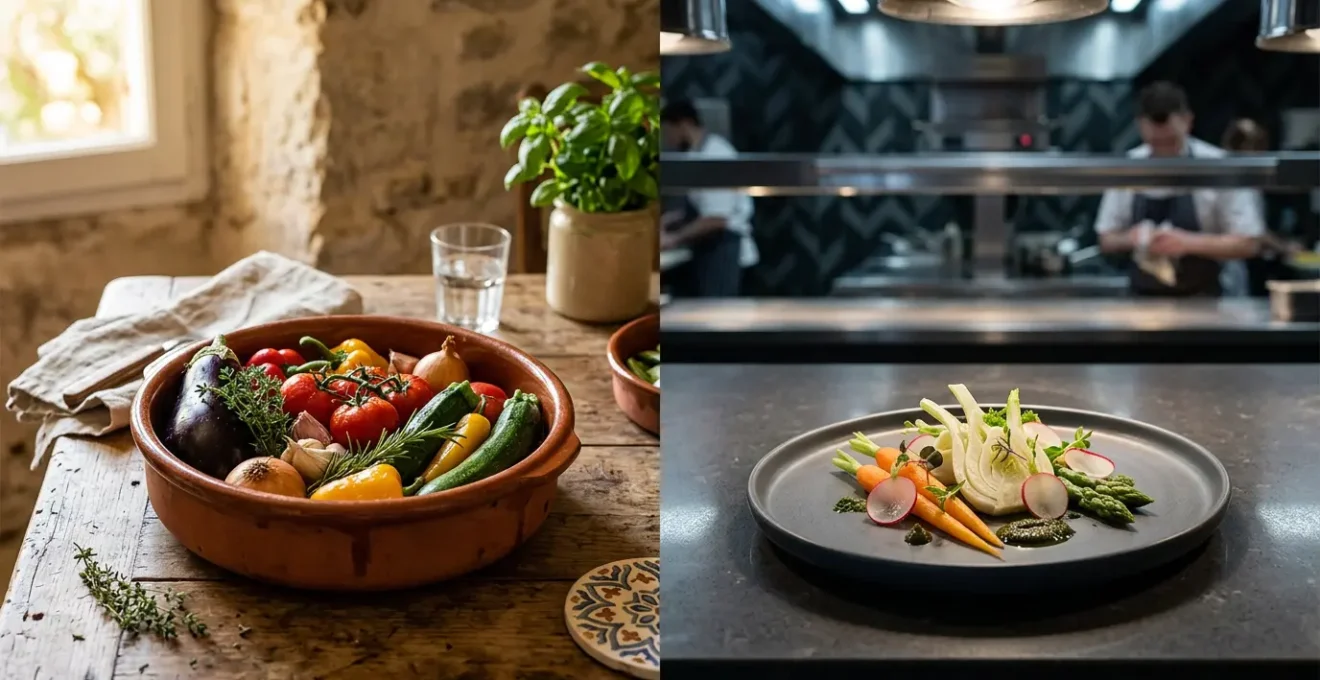
You followed the recipe perfectly, yet your homemade French dish lacks that authentic soul you remember from your holiday. Contrary to popular belief, the secret isn’t just in the recipe or the quality of ingredients. The profound difference in taste comes from three invisible forces: the unique microbial life on the vegetables, the chemical makeup of your local water, and treating time itself as a non-negotiable ingredient. Mastering these elements is the true path to recreating genuine French regional cuisine.
There’s a specific, almost universal disappointment known to British food lovers: the homemade ratatouille that, despite your best efforts, tastes nothing like the one you enjoyed in that small, sun-drenched bistro in Aix-en-Provence. You sourced the freshest vegetables, used a good olive oil, and followed a recipe from a celebrated French chef to the letter. Yet, the result is flat, a pale imitation of the vibrant, complex dish etched in your memory. You are not alone in this culinary frustration.
Many guides will tell you the key is “better ingredients” or a vague notion of “terroir”. They might suggest a different brand of tinned tomatoes or a more expensive olive oil. While well-intentioned, this advice barely scratches the surface. The real heart of French regional cooking lies far deeper, in a realm that recipes rarely mention. It’s an understanding of how place, science, and patience intertwine to create flavour.
But what if the true key to unlocking authentic flavour wasn’t in adding something, but in understanding what’s already there? What if the difference between a passable dish and a sublime one was hidden in the very water from your tap, the invisible life on your aubergine’s skin, and your willingness to let time do its sacred work? This is where the Parisian cliché ends and the journey into the soul of French regional cuisine begins.
This guide will deconstruct these invisible pillars of French cooking. We will explore the science of taste, the practicalities of sourcing, and the philosophy behind time-honoured techniques, giving you the knowledge not just to follow a recipe, but to truly understand it.
To navigate this culinary journey, we will explore the fundamental principles that separate authentic regional dishes from their international imitations. The following sections break down the essential concepts, from the science of terroir to the art of patience.
Summary: Unlocking the Secrets of French Regional Cooking
- Why Does the Same Recipe Taste Completely Different Depending on Its Region of Origin?
- How to Find Genuine French Ingredients in the UK Without Paying Triple the Price?
- Cassoulet from Toulouse or Castelnaudary: Which Version Should You Master First?
- The Ingredient Substitution That Ruins 80% of British Attempts at French Cuisine
- When Should You Start a Daube to Have It Ready for Saturday Dinner?
- Why Does AOP Certification Matter More Than Producer Marketing Claims?
- Why Do French Locals Pair Wines You’ve Never Heard of With Their Regional Dishes?
- Why Do “Regional Specialities” Sold in Paris Bear Little Resemblance to the Real Thing?
Why Does the Same Recipe Taste Completely Different Depending on Its Region of Origin?
The answer lies in a word often used but rarely understood: terroir. For most, terroir refers to soil and climate. But this is a dramatic oversimplification. The true, deeper meaning of terroir extends to an invisible world of microorganisms. A sun-ripened tomato from Provence carries a unique fingerprint of local yeasts and bacteria on its skin. These microbial communities are not contaminants; they are essential flavour-building agents that begin to work the moment the vegetable is picked.
This isn’t folklore; it’s science. Groundbreaking research demonstrates that regionally distinct microbial populations directly and differentially affect the final phenotype of wine. What holds true for the grape holds true for the courgette, the pepper, and the aubergine. An identical vegetable grown in a polytunnel in the UK simply does not possess the same complex microbiological starting point as its French counterpart grown in open soil, exposed to the Provençal air and its unique microbial signature.
This microscopic world is the first, and perhaps most crucial, layer of authentic flavour. The image below captures the essence of this idea: a landscape of texture and life on the surface of a vegetable, representing the invisible terroir that recipes can’t specify.
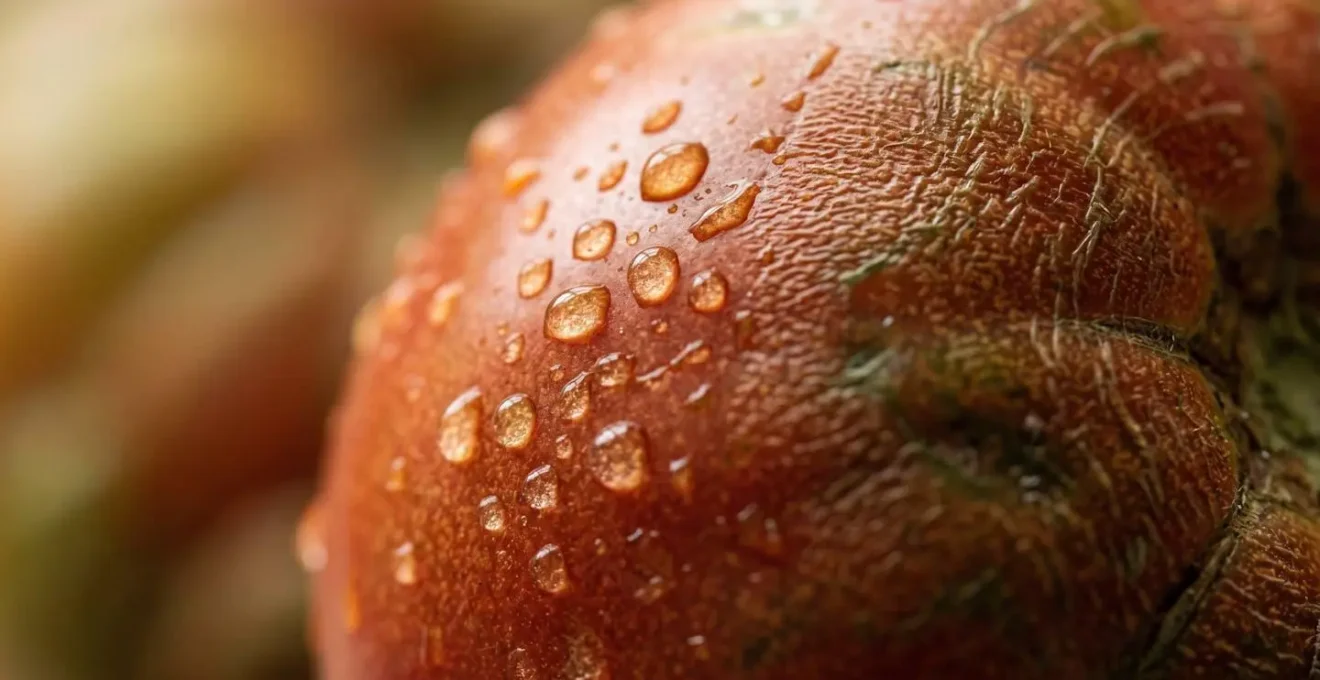
As you can see, the surface is not sterile or uniform. It’s a living ecosystem. When you cook, you are not just applying heat to inert matter; you are orchestrating a reaction between all these native yeasts and microbes. This is why a simple tomato sauce made in Provence with local tomatoes can have a depth and complexity that seems impossible to replicate elsewhere. You are not just tasting the tomato; you are tasting the place itself, right down to its microscopic inhabitants.
How to Find Genuine French Ingredients in the UK Without Paying Triple the Price?
Convinced of the importance of authentic ingredients, the UK-based food lover faces a daunting challenge: sourcing. Supermarket shelves offer “French” products at inflated prices, often with questionable provenance. The key is not to pay more, but to shop smarter by understanding the supply chain and making strategic choices. Forget the fancy French-branded items in generic stores and look for the importers who supply the professionals.
Companies like Natoora have built their business on this very principle. They established a direct network of over 250 independent growers across Europe to supply top London restaurants. Now, through partnerships with retailers like Ocado and Waitrose, they offer home cooks access to the same high-quality, seasonal produce that chefs use. This model proves it’s possible to get genuinely superior French produce in the UK by focusing on sourcing specialists rather than mainstream retailers.
Beyond fresh produce, intelligent substitution and selection are crucial. High-quality frozen French herbs, for example, often retain more flavour than “fresh” bunches that have spent days in transit. Similarly, when a specific French olive oil is prohibitively expensive, a top-tier Spanish oil from a similar climate can be a more authentic choice than a mediocre, mass-produced French alternative. The goal is to match the quality and character, not just the label. Prioritise seasonality; buying French ingredients when they are naturally in season ensures better quality and lower import costs.
Cassoulet from Toulouse or Castelnaudary: Which Version Should You Master First?
To delve deeper into regional identity, there is no better example than cassoulet. Asking for “the” authentic recipe is like asking for “the” authentic British roast—it invites a passionate, almost theological, debate. The dish is a cornerstone of Occitan cuisine, so revered that the famed chef Prosper Montagné described its variations with religious reverence.
Le cassoulet est le Dieu de la cuisine occitane. Un Dieu en trois personnes : Dieu le Père qui est le cassoulet de Castelnaudary, Dieu le fils qui est celui de Carcassonne et le Saint-Esprit, celui de Toulouse.
– Prosper Montagné, Le Festin Occitan (1929)
This “trinity” highlights the fierce local pride attached to the dish. The two most famous versions, from Castelnaudary and Toulouse, are not merely different recipes; they represent distinct culinary philosophies. Castelnaudary’s version is considered the rustic, pure “Father,” while Toulouse’s is the more opulent “Holy Spirit,” enriched by the city’s wealth. For the home cook, choosing which to master first depends on your preference for rustic purity or decadent complexity. Understanding their differences is the first step.
The following table, drawing from centuries of tradition, breaks down the key distinctions between these two iconic versions. It’s a guide to help you choose your path in the sacred world of cassoulet.
| Element | Castelnaudary (The Father) | Toulouse (The Holy Spirit) |
|---|---|---|
| Bean Type | Lingot beans from Lauragais (firmer texture) | Tarbais beans (softer, more delicate) |
| Meat Philosophy | Rustic purity: pork (loin, ham, leg, sausage, rind) + duck/goose confit | Urban opulence: adds mutton/lamb + Toulouse sausage |
| Cooking Method | One-pot approach: meat pre-cooked in duck fat then combined | Layered assembly: separate preparation stages |
| Official Recognition | Recipe formalized in 1909; protected by Grande Confrérie du Cassoulet | Part of Occitan culinary trinity since 1929 |
| Typical Presentation | Baked in traditional cassole with 7-times-broken crust | Often topped with breadcrumbs for gratinating |
For a beginner, the Castelnaudary version is arguably the better starting point. Its focus on fewer, perfectly cooked elements teaches the fundamental techniques of confit and slow-baking. Mastering this “Father” recipe provides the foundation upon which the complexities of the Toulouse version can be built. It teaches respect for the core ingredients before adding layers of opulence.
The Ingredient Substitution That Ruins 80% of British Attempts at French Cuisine
We’ve discussed sourcing quality ingredients, but there’s one ubiquitous, invisible ingredient that most UK home cooks overlook: the water. The vast majority of the UK, particularly the South East, has very hard water. In contrast, many regions of France famed for their stews and vegetable dishes have significantly softer water. This isn’t a minor detail; it’s a chemical reality that fundamentally alters the way food cooks.
Hard water is rich in minerals like calcium and magnesium. These minerals strengthen the pectin in the cell walls of vegetables and legumes. The result? Beans that refuse to soften, carrots that remain stubbornly firm, and onions that never quite melt into a sauce. According to comprehensive food quality analysis, hard water not only increases cooking times for beans but can also impart a faint mineral taste to vegetables. If you’ve ever wondered why your *soupe au pistou* lacks the creamy texture of the one you had in Nice, or why the beans in your cassoulet are chalky, your tap water is the likely culprit.
This is the substitution no one talks about. You are inadvertently swapping the soft, gentle water of a French *terroir* for the hard, mineral-rich water of the British Isles. The solution is surprisingly simple: for dishes where the texture of vegetables or legumes is paramount, use filtered or bottled still water. It may feel extravagant, but it is the single most effective change you can make to bridge the gap between your kitchen and a French one.
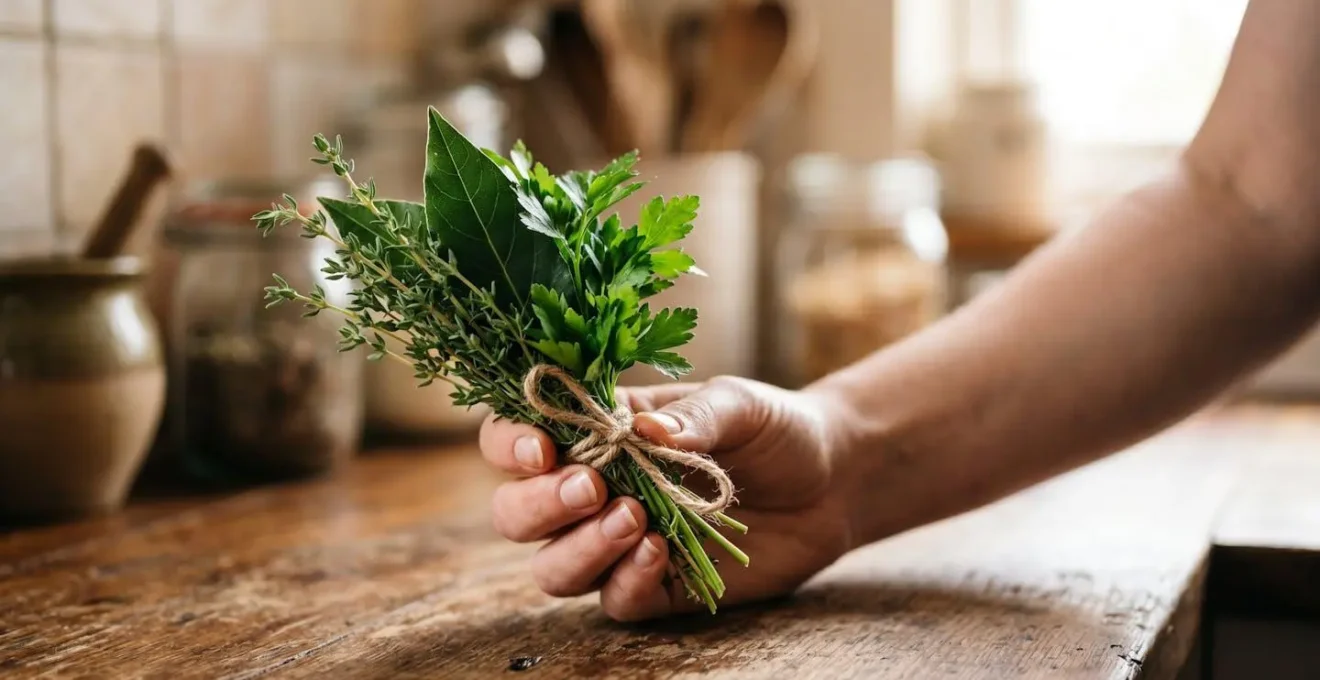
The same principle of non-compromise applies to aromatics. Using dried herbs instead of a fresh bouquet garni, as shown above, is another common pitfall. The vibrant, volatile oils in fresh thyme, bay leaf, and parsley are essential. They infuse the dish with a clean, bright flavour that dried herbs simply cannot replicate. The combination of using the wrong water and compromising on aromatics is a death knell for authentic flavour.
When Should You Start a Daube to Have It Ready for Saturday Dinner?
The third pillar of authentic French regional cooking, alongside terroir and ingredients, is time. In modern cooking, time is seen as an enemy to be conquered with pressure cookers and quick-braising techniques. In traditional French cuisine, particularly for stews like a Daube Provençale, time is an active ingredient. It is the magical element that transforms tough cuts of meat into meltingly tender morsels and melds disparate flavours into a harmonious whole. To make a truly great daube for Saturday dinner, you must start on Thursday.
This is not an exaggeration; it is a necessity. The process relies on long, slow chemical reactions that cannot be rushed. First, a 24- to 36-hour marination in red wine allows the acid to begin breaking down the tough collagen in the beef. This is followed by a long, slow initial cooking cycle. But the most crucial, and often skipped, step is the *repos*—the sacred rest. Allowing the daube to cool completely and rest overnight is when the real magic happens. Flavours deepen, textures relax, and the fat solidifies on top, making it easy to remove for a cleaner, richer sauce.
A second, gentle reheating completes the process, further tenderising the meat and concentrating the sauce. Rushing this three-day journey into a single afternoon is why so many homemade daubes are disappointing, with tough meat swimming in a thin, acidic sauce. To help you embrace this philosophy, here is a practical timeline.
Your Action Plan: Daube Retro-Planning for Saturday Dinner
- Thursday Evening (6 PM): Begin marination. Cut beef into chunks and submerge in red wine with aromatics. The acid begins the crucial process of breaking down tough connective tissue (collagen).
- Friday Evening (6 PM): First cook cycle. Remove beef, sear it, then braise slowly in the marinade for 3-4 hours at a low temperature (150°C/300°F). This long, slow heat melts collagen into gelatin, creating a silky mouthfeel.
- Friday Night to Saturday Morning: The sacred rest. Cool the daube completely and refrigerate overnight. Flavours meld and deepen, proteins relax, and the fat solidifies for easy removal. This step is non-negotiable.
- Saturday Midday (12 PM): Second cook cycle. Skim the solidified fat and gently reheat the daube for another 2-3 hours. This final braise further tenderises the meat and reduces the sauce to its perfect consistency.
- Saturday Evening (6 PM): Final rest. Let the finished daube rest for 30 minutes off the heat before serving. This allows the meat to reabsorb juices and the serving temperature to stabilise.
Why Does AOP Certification Matter More Than Producer Marketing Claims?
Navigating the world of French ingredients can be confusing, with packaging often filled with vague claims like “traditional,” “artisanal,” or “French recipe.” There is, however, one label that cuts through the noise: AOP (Appellation d’Origine Protégée). This is not a marketing slogan; it is a legally binding European Union certification, the successor to the French AOC system, that guarantees a product’s origin and production method.
The AOP system is the ultimate expression of terroir, a legal framework designed to protect the unique character of a region’s products. As the International Organisation of Vine and Wine notes, the very concept of French appellations “presumes that the land from which the grapes are grown imparts a unique quality that is specific to that growing site.” The AOP extends this principle from wine to cheeses, oils, and even peppers.
Case Study: The Protective Power of Piment d’Espelette AOP
The AOP system acts as a “cahier des charges” (a book of specifications) that shields traditional producers from industrial imitation. For Piment d’Espelette, the prized mild chilli from the Basque Country, the AOP designation is a fortress of authenticity. It mandates the specific pepper variety (“Gorria”), the exact 10 villages where it can be grown, traditional harvesting by hand, and a precise, multi-week drying process. This isn’t a suggestion; it’s the law. This government-backed guarantee ensures that when you buy Piment d’Espelette AOP, you are getting the genuine article, supporting small-scale farmers, and preserving ancestral know-how.
When you see an AOP label on a block of Roquefort cheese, a bottle of Nyons olive oil, or a jar of Piment d’Espelette, you can be certain that the product was made in a specific place, using specific ingredients and time-honoured methods, all verified by French and EU authorities. It is a producer’s pledge of authenticity, co-signed by the government. In a world of marketing fluff, the AOP is a rare and powerful mark of trust.
Why Do French Locals Pair Wines You’ve Never Heard of With Their Regional Dishes?
A common experience for visitors to regional France is encountering wine pairings that defy conventional wisdom. You might be served a crisp white you’ve never heard of with a rich pork dish, or a light, earthy red with fish. This isn’t random; it’s the ultimate expression of terroir. The guiding principle is simple and profound: “what grows together, goes together.”
For centuries, before the advent of global wine markets and international sommeliers, regional food and wine co-evolved. The wines of a specific place were made to complement the food of that same place, using grapes that thrived in the local soil and climate. These pairings are not intellectual constructs; they are the result of generations of agricultural and culinary harmony. A daube in Provence is traditionally paired with a local, robust red like a Bandol or a Palette, not because a wine critic decreed it, but because those grapes grow on the same hillsides as the herbs used in the stew and where the cattle once grazed.
As wine historians have noted, the French crystallized the concept of terroir by observing these subtle differences from one vineyard to another. They understood that the wine was a liquid expression of the place, just as the local cheese or stew was a solid expression of it. Therefore, when you are in a French region, the most authentic pairing is almost always a wine from the nearest vineyard. It shares the same soil, the same water, the same climate—the same soul—as the food on your plate. It’s a holistic approach that prioritises local harmony over generic international pairing rules.
Key Takeaways
- True authentic flavour comes from “invisible” factors: microbial terroir, water chemistry, and using time as an ingredient.
- Sourcing genuine ingredients in the UK is about finding specialist importers and making smart substitutions, like using filtered water to counteract hard water.
- Authenticity is hyper-regional and codified, as shown by the distinct, protected versions of cassoulet.
Why Do “Regional Specialities” Sold in Paris Bear Little Resemblance to the Real Thing?
After exploring the pillars of terroir, ingredients, water, and time, the answer becomes clear. The “regional specialities” sold in Parisian tourist traps and even some high-end grocers are often products of compromise. They are designed for mass production, long shelf life, and a generalised palate. They are, by necessity, disconnected from the very things that give a regional dish its soul.
A vacuum-packed cassoulet made in an industrial facility cannot replicate the seven-times-broken crust of a version slow-baked in a traditional cassole. Its beans were likely cooked in standardised water, its meats sourced for cost-efficiency rather than local character. A “Provençal” tapenade made in a factory on the outskirts of Paris uses olives from a mix of origins and is pasteurised to an extent that kills any subtle, terroir-specific flavours. These products are not lies, but they are translations—and much is lost in translation.
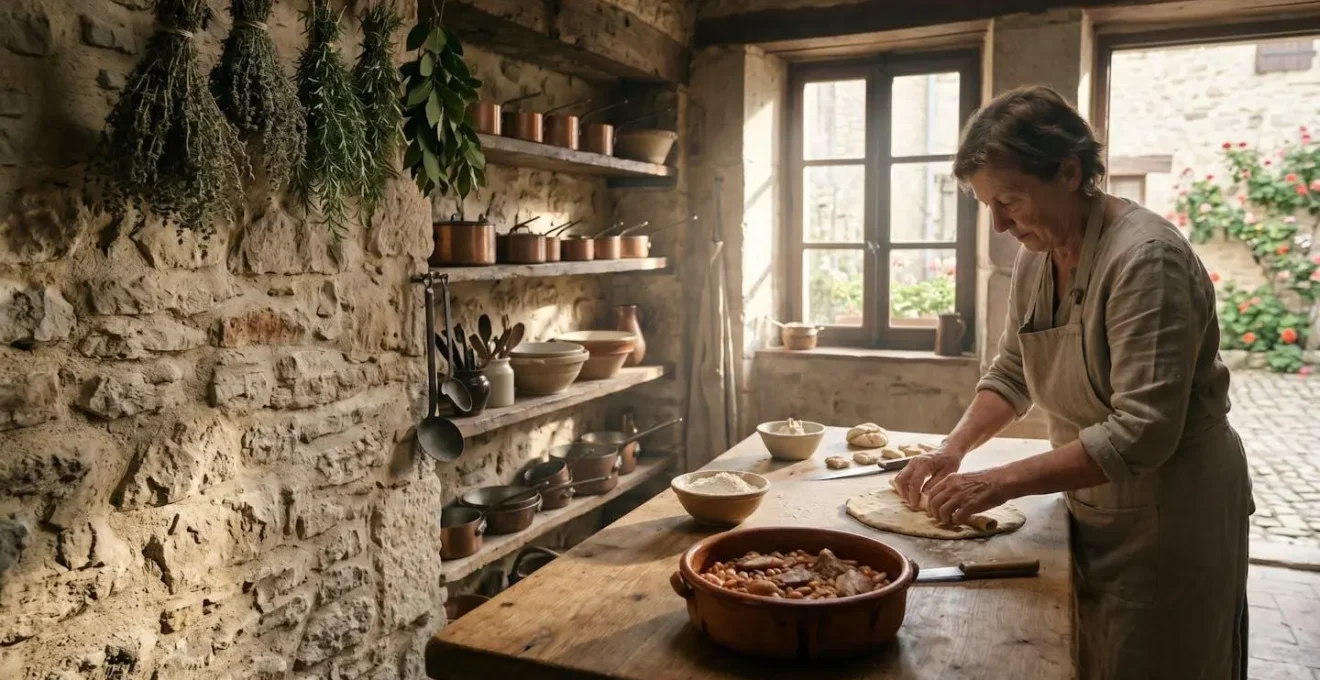
The real thing, as evoked in the image above, is a product of its environment, made by hand, with patience. It is inherently small-scale and often, not economically viable to transport and sell hundreds of miles away. The real Canistrelli biscuit from Corsica is crumbly and fragrant precisely because of the local flour, wine, and air; the version in a Parisian supermarket is a different product entirely.
This is not to say that good food cannot be found in Paris. It can. But for true regional specialities, the product is inseparable from its place. It is a lesson in culinary humility: to taste the real Provence, you must go to Provence. To taste it in your own kitchen, you must do your best to replicate not just the recipe, but the invisible elements of its home.
Now that you understand the principles, the next step is to put them into practice. Start by choosing one regional dish, commit to sourcing the best possible ingredients, test your water, and, most importantly, give the dish the time it deserves. This is how you transform a simple meal into a genuine culinary experience.