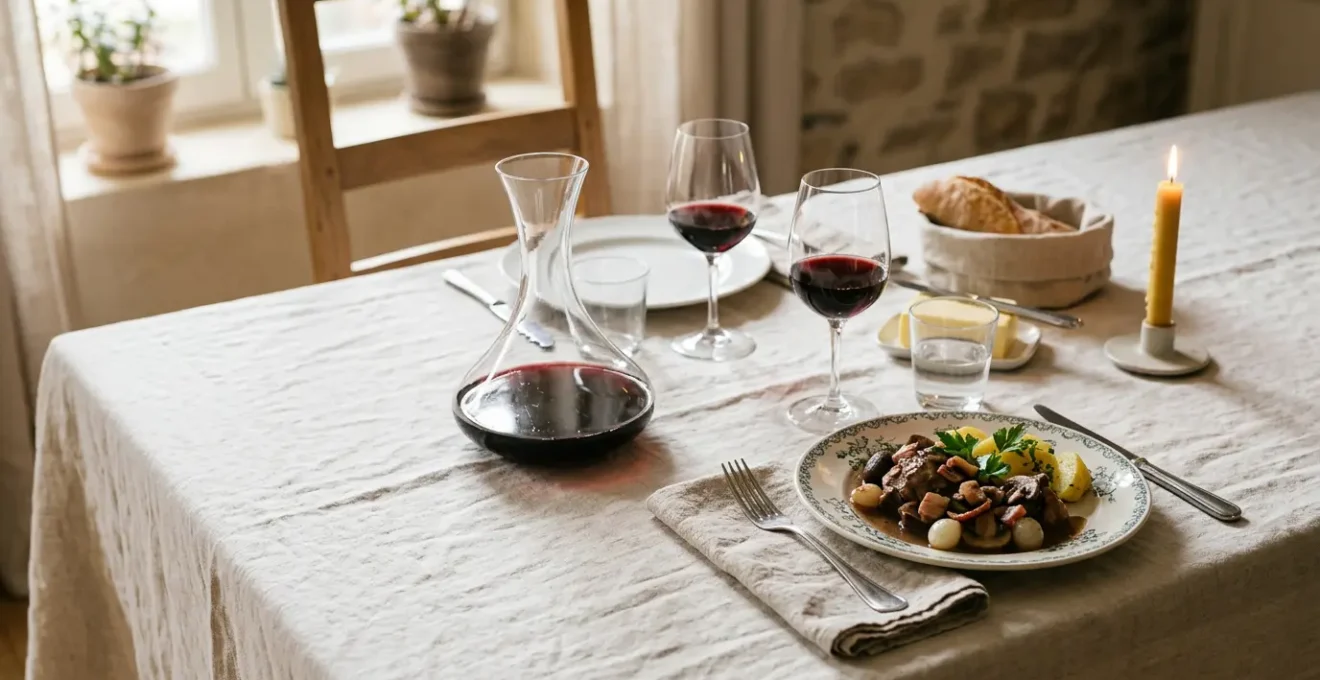
Contrary to popular belief, successful wine pairing isn’t about following rules like “red with meat”—it’s about mastering food chemistry.
- The sauce, not the protein, is the ‘chemical pivot’ that dictates the wine choice due to its concentration of fat, acid, and sugar.
- A wine’s structural elements (acidity, tannin, alcohol) must be used to scientifically counterbalance a dish’s components for a harmonious result.
Recommendation: Stop matching generic ingredients and start pairing the specific chemical properties of your dish with the core structure of your wine.
You’ve done everything right. You sourced the perfect cut of beef for your Boeuf Bourguignon, followed the recipe to the letter, and even bought a well-regarded Burgundy to serve alongside it. Yet, as you take the first sip after a bite, something is off. The seamless, almost magical harmony you experienced at that bistro in Lyon is absent, replaced by a clumsy, disjointed clash of flavours. This frustrating gap between the restaurant experience and the home table is a common story for many UK food and wine enthusiasts. You follow the conventional wisdom—”red with red,” “pair from the region”—but the result consistently falls short.
The internet and pairing apps offer a deluge of these rules, treating food and wine like a simple colour-by-numbers exercise. They suggest pairings based on the main protein, ignoring the dozen other variables at play. But what if the secret isn’t in the rules at all? What if the sommelier’s art is less about a library of memorised pairings and more about being a practical chemist? The truth is, a dish’s soul, its dominant chemical profile, often lies not in the protein, but in the sauce, the garnish, and the cooking method.
This guide will deconstruct the science behind truly great pairings. We will move beyond the platitudes and explore the chemical interplay of fat, acid, tannin, and texture. You will learn to think like a sommelier, focusing on the structural elements of both the food and the wine. We will analyse why a dish’s sauce is its true chemical pivot, how to build a multi-course wine journey without overwhelming your senses, and why your cooking technique can make or break a pairing. By understanding these core principles, you can finally close the gap and start creating pairings at home that are not just correct, but genuinely sublime.
To navigate this exploration of flavour chemistry, this article breaks down the core concepts that separate amateur pairings from professional harmony. The following sections will equip you with the knowledge to analyse dishes and wines on a structural level, transforming your approach to creating the perfect match.
Summary: Deconstructing the Science of Flawless Wine Pairing
- Why Should You Pair Wine With Your Sauce, Not Your Meat?
- How to Create a Wine Journey That Builds Through 5 Courses Without Palate Fatigue?
- French Wine or New World Alternative: Which Creates Better Harmony With Classic French Dishes?
- The Pairing “Rule” That Prevents You Enjoying What You Actually Like
- When Should You Buy Wines for Next Year’s Special Dinner to Ensure Optimal Pairing?
- How to Train Your Palate to Feel Why Sancerre and Goat Cheese Work Together?
- Why Does Your Puff Pastry Go Soggy Despite Perfect Oven Temperature?
- Why Does Your Wine Pairing Advice From Apps Never Match What French Restaurants Serve?
Why Should You Pair Wine With Your Sauce, Not Your Meat?
The most common mistake in home wine pairing is focusing on the protein. A piece of chicken can be poached, grilled, or smothered in a creamy mushroom sauce; each preparation is a fundamentally different dish from a chemical standpoint. The protein provides texture and a base flavour, but the sauce is where the dominant chemical agents—fat, acid, sugar, and umami—are concentrated. A sommelier intuitively understands that these elements, not the meat itself, will be the most reactive with the wine.
As Master Sommelier Matthieu Longuere explains, the sauce often has a greater impact on the dish’s overall taste profile. He notes that while it’s common to focus on the meat or fish, “the sauce or cooking method have more influence on the actual taste” of the final dish. This is the first principle of moving beyond generic rules. You must learn to identify the “chemical pivot” of your plate. Is it a tart, acidic vinaigrette? A rich, fat-laden cream sauce? Or a sweet and sour glaze? That component is your true pairing partner.
Case Study: The Tomato Sauce Principle
Tomato-based sauces like a classic marinara are a perfect example of this principle. The defining characteristic of a tomato is its high acidity. To create harmony, the wine must match this acidic profile. A high-acid Italian red like Chianti Classico works beautifully because its own acidity mirrors that of the tomatoes, creating a complementary and refreshing pairing. However, if you were to pair that same tomato sauce with a high-tannin, lower-acid Cabernet Sauvignon, the tannins would react with the acid to create an unpleasant, metallic taste in your mouth. This proves that the sauce’s chemical structure, not the meatball underneath it, is the deciding factor for the wine pairing.
Therefore, the first step in elevating your pairings is to deconstruct your dish. Taste the sauce or dominant condiment on its own. Is it sharp and acidic? Rich and creamy? Sweet? This simple analysis will guide you to a wine with a corresponding or contrasting structure far more effectively than simply noting whether you’re serving fish or beef.
How to Create a Wine Journey That Builds Through 5 Courses Without Palate Fatigue?
A multi-course meal is a narrative, and the wines should act as a supporting storyline, not a series of disconnected statements. The goal is to build intensity gradually without overwhelming the senses, a phenomenon known as palate fatigue. This occurs when your taste receptors become saturated with strong flavours (like high alcohol, intense tannins, or overpowering oak), diminishing your ability to perceive nuance in subsequent courses. It’s a physiological reality; preventing it requires strategic chemical management.
The progression should generally follow an arc: from light to heavy, from dry to sweet, from simple to complex. You begin with wines that are high in acidity and low in alcohol, like a sparkling wine or a crisp Sauvignon Blanc. These act as a “palate reset,” using acidity to cleanse the mouth and prepare it for what’s to come. As the food becomes richer and more complex, so should the wine, moving through light-bodied whites, to fuller whites or light reds, and peaking with a full-bodied red for the main course. It’s crucial that this peak is not surpassed until the dessert course, as returning to a lighter wine after a powerhouse red will make it taste thin and lifeless.
This isn’t just about flavour; it’s about managing your palate’s endurance. Intermissions are key. A sip of sparkling water or a bite of plain bread between courses helps to neutralise lingering flavours and reset your taste buds. This is especially important since some palates need up to 6 minutes to fully recover from particularly strong flavours. A well-planned journey respects this recovery time, ensuring the last bite is as enjoyable as the first.
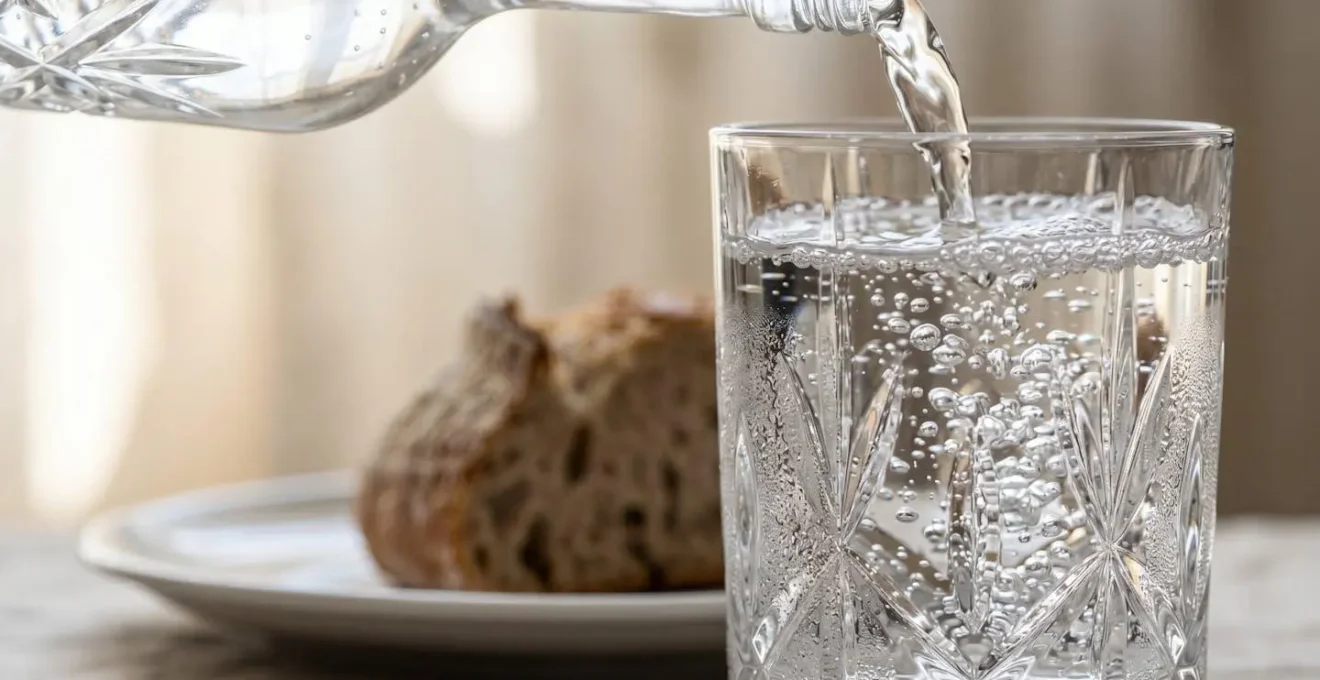
As the image illustrates, the simplest tools are often the most effective for palate management. The clean, effervescent quality of sparkling water provides a physical and chemical reset, scrubbing the palate of residual fats and tannins, allowing you to approach the next wine and food pairing with renewed sensory acuity. This conscious act of cleansing is a hallmark of a professionally curated dining experience.
French Wine or New World Alternative: Which Creates Better Harmony With Classic French Dishes?
The classic adage “what grows together, goes together” holds significant weight in French cuisine. For centuries, French wines have evolved alongside the local food, creating a natural, time-tested synergy. This is not a coincidence; it’s a result of shared terroir and compatible chemical structures. French wines are typically characterised by higher acidity, lower alcohol, and more subtle, earthy or mineral-driven flavours. These structural elements are perfectly suited to French cooking, which often relies on rich sauces, butter, and cream.
The higher acidity in a classic French wine, like a white Burgundy with a sole meunière, acts as a solvent, cutting through the richness of the butter sauce and cleansing the palate. In contrast, many New World wines (from places like California, Australia, or South America) are celebrated for their bold, fruit-forward profiles, higher alcohol content, and often more pronounced oak influence. While delicious on their own, these powerful characteristics can easily overwhelm the delicate nuances of a classic French dish. The high alcohol can make a dish taste “hot,” and the powerful fruit can clash with savoury, herbal notes.
This doesn’t mean New World wines can never work. The key is to seek out New World wines that are made in a more “Old World” style—those from cooler climates that prioritise balance and acidity over raw power. A cool-climate Oregon Pinot Noir, for instance, can be a beautiful match for Coq au Vin, as it shares the earthy notes and elegant structure of its Burgundian cousin. However, a jammy, high-alcohol Zinfandel would likely overpower the dish. The choice isn’t about geography as much as it is about chemical compatibility.
The following table breaks down the key structural differences and their impact on pairing with classic French cuisine, as highlighted in a comparative analysis of wine styles.
| Characteristic | French Wine Style | New World Wine Style | Pairing Impact |
|---|---|---|---|
| Alcohol Content | Lower (12-13%) | Higher (13.5-15%+) | High alcohol can overwhelm delicate French dishes |
| Flavor Profile | Earthy, mineral, terroir-driven | Fruit-forward, bold, powerful | Earthy notes complement subtle French cuisine |
| Tannin Structure | Elegant, integrated | Bold, pronounced | Softer tannins better match with refined sauces |
| Acidity | Higher, food-friendly | Moderate to low | Higher acidity cuts through rich French dishes |
| Oak Influence | Subtle, restrained | Often prominent | Heavy oak can clash with delicate flavors |
| Best Pairing Approach | Regional matching (Burgundy with Boeuf Bourguignon) | Style translation (cool-climate Oregon Pinot Noir) | French wines evolved with local cuisine |
The Pairing “Rule” That Prevents You Enjoying What You Actually Like
Of all the pairing platitudes, “white wine with fish, red wine with meat” is the most famous—and often, the most restrictive. Many people genuinely prefer red wine but dutifully switch to white when fish is served, fearing a disastrous clash. While this rule exists for a reason, understanding the science behind it is what empowers you to break it intelligently. The problem isn’t the colour of the wine; it’s a specific chemical component: tannins.
Tannins are phenolic compounds found in grape skins, seeds, and stems (and oak barrels) that create a sensation of astringency or dryness in your mouth. Red wines, which are fermented with their skins, are much higher in tannins than white wines. A 2009 study identified the specific cause of the classic red-wine-and-fish clash: the iron content in red wine reacts with fish oils, creating a distinct and unpleasant fishy, metallic aftertaste. So, the rule isn’t really about red versus white; it’s about high-tannin versus low-tannin.
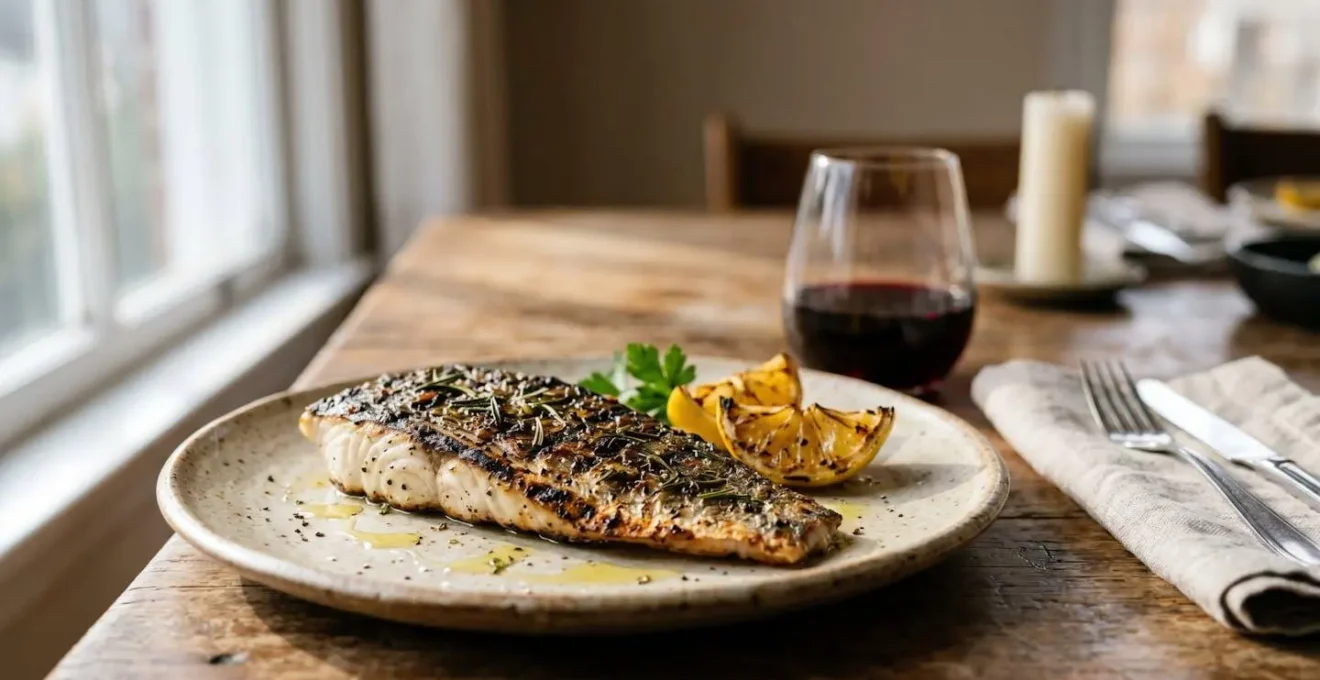
Once you know the enemy is tannin, not colour, a world of possibilities opens up. You can absolutely enjoy red wine with fish, provided you choose a variety that is naturally low in tannins. This is where the joy of discovery begins, moving from rigid rules to informed choices, as the pairing above suggests is possible.
Case Study: When Red Wine Works With Fish
As Master Sommelier Alpana Singh demonstrates, the key is matching wine body to the fish’s texture and cooking method. Low-tannin reds like Gamay (from Beaujolais), Pinot Noir, and Valpolicella are excellent candidates. Their lighter structure and bright acidity won’t create the dreaded metallic reaction. These wines work particularly well with meatier, oilier fish like tuna or salmon, especially when they are grilled or pan-seared. The char from grilling provides a smoky, slightly bitter counterpoint that the light red wine can stand up to, while a delicate poached cod would still be better served by a crisp white. It’s about understanding the chemistry, not obeying a colour code.
When Should You Buy Wines for Next Year’s Special Dinner to Ensure Optimal Pairing?
You’ve planned the menu months in advance, but the wine is often a last-minute purchase. This is a critical error that can sabotage an otherwise perfect pairing. Wine is a living chemical solution, and it is surprisingly sensitive to its environment, especially travel. The vibration and agitation from transport can cause a temporary and undesirable condition known as “bottle shock” or “travel sickness.” During this phase, the wine’s aromas can seem muted, its flavours disjointed, and its structure out of balance. Opening a wine in this state is like asking an athlete to perform immediately after a turbulent flight—it simply won’t be at its best.
To ensure your wine is showing its true character and is ready to harmonise with your food, it needs time to rest and reintegrate. This allows the phenolic compounds, esters, and acids to settle back into a stable equilibrium. The amount of resting time required depends on the wine’s structure. Lighter, more delicate wines recover more quickly, while more robust and complex wines need a longer period of calm. Storing them in a cool, dark, and stable environment (ideally between 12-18°C) is essential. For wines with corks, storing them horizontally prevents the cork from drying out, which can lead to oxidation and spoil the wine.
Planning your wine purchases well in advance is not just about organisation; it’s a crucial part of chemical preparation. Giving a wine the time it needs to recover from its journey ensures that what you pour into the glass is the balanced, expressive beverage the winemaker intended, ready to perform its role in the pairing.
Wine Resting Timeline for Optimal Pairing
- Delicate whites and rosés: Purchase at least 1 week ahead to allow recovery from bottle shock caused by transportation.
- Medium-bodied whites and light reds: Allow 2-3 weeks of rest in a stable, cool environment.
- Robust reds and age-worthy wines: Buy 3-4 weeks ahead to let them settle completely and integrate.
- Sparkling wines: Purchase 5-7 days ahead; they are more sensitive to agitation due to the dissolved CO2.
- Storage conditions: Keep all wines in a dark, cool place lying horizontally to maintain cork integrity and chemical stability.
How to Train Your Palate to Feel Why Sancerre and Goat Cheese Work Together?
Some pairings are so classic they become legendary, like Sancerre and Loire Valley goat cheese. But simply knowing they work isn’t enough; to truly master pairing, you must train your palate to understand *why* they work on a physical and chemical level. It’s an interaction of complementary textures and contrasting structures. Sancerre, a Sauvignon Blanc from the Loire Valley, is defined by its searing acidity and distinct mineral notes of flint or wet stone, a direct expression of the region’s Kimmeridgian limestone soils. Young goat cheese (chèvre) is characterised by its creamy, fatty texture and a pronounced lactic tang.
The magic happens when they meet on your palate. The wine’s high acidity acts as a powerful solvent, cutting straight through the rich, palate-coating fat of the cheese. This creates a cleansing, refreshing sensation that prevents the pairing from feeling heavy or cloying. After the acid has done its job, what’s left is a beautiful echo between the chalky texture of the cheese and the flinty minerality of the wine—a “terroir echo” where the soil speaks through both the grape and the grass the goat ate. This is not just a flavour match; it’s a structural and textural dance.
The Science of Acid Cutting Fat
The Sancerre and goat cheese pairing is a textbook example of a fundamental pairing principle: acid counterbalances fat. Chemically, the wine’s acidity (typically with a pH between 3.0 and 3.3) provides a sharp contrast to the rich, creamy mouthfeel of the cheese. This contrast is what makes the pairing so dynamic and refreshing. The acid effectively “cleans” the palate after each bite of cheese, removing the fatty film and leaving your mouth ready for the next taste. This cleansing action is precisely why many rich French dishes, from foie gras to cream-based sauces, demand a wine with bright, high acidity to prevent flavour fatigue and maintain balance.
To internalise this lesson, you must experience it actively. The following deconstructive tasting exercise is a practical way to train your palate to move beyond simply tasting “good” and start identifying the specific interactions that create harmony.
Your Action Plan: How to Audit the Sancerre & Goat Cheese Pairing
- Isolate the Wine: Taste the Sancerre on its own. Focus on the feeling on the sides of your tongue—that’s the piercing acidity. Note the citrus and flinty mineral notes.
- Isolate the Cheese: Now, taste the goat cheese by itself. Pay attention to the creamy, fatty texture that coats your mouth, and the distinct chalky quality and lactic tang.
- Combine and Observe: Take a bite of cheese, chew, and then take a sip of the Sancerre. The key moment is feeling how the wine’s acidity instantly cuts through and washes away the cheese’s fat, leaving a clean, refreshing, mineral finish.
- Create a Bad Pairing: For contrast, try the same goat cheese with a rich, buttery, oaky Chardonnay. You will physically experience how the lack of high acidity fails to cleanse the palate, making the combination feel heavy, cloying, and unbalanced.
- Identify the Terroir Echo: Revisit the successful Sancerre pairing. Actively look for the connection between the wine’s stony minerality and the cheese’s chalky quality. This is the shared signature of the Loire Valley’s limestone soil.
Why Does Your Puff Pastry Go Soggy Despite Perfect Oven Temperature?
At first glance, a question about pastry technique seems out of place in a discussion of wine. Yet, it strikes at the very heart of why home pairings can fail. The success of a pairing depends on the final state of the dish served, and a technical flaw in the kitchen can create a chemical problem on the plate that no wine can solve. A perfect *vol-au-vent* should have a crisp, flaky, buttery puff pastry case. A soggy bottom is a sign of a cooking error, often caused by a wet filling releasing moisture into the pastry during baking. This isn’t just a textural failure; it’s a chemical transformation.
A crisp pastry provides a clean, neutral, and structurally sound base. Its buttery flavour is distinct but not overwhelming. A soggy pastry, however, becomes a dense, greasy mass. The fat and moisture combine into a palate-coating film that dulls other flavours and presents a significant challenge for any wine. A wine that would have perfectly complemented the crisp version will struggle against the soggy one, as its acidity and structure are now tasked with cutting through a much heavier, greasier layer. The pairing is compromised before the cork is even pulled.
This illustrates a crucial point: the sommelier’s job in a restaurant is made possible by the chef’s precision. The chef delivers a dish with a consistent and intended texture and flavour profile. At home, we are both chef and sommelier, and a lapse in one role dooms the other to failure.
How Cooking Technique Directly Impacts Wine Pairing Needs
Professional chefs employ specific techniques to prevent a soggy bottom, such as blind-baking the pastry shell before adding the filling or using a moisture barrier like a layer of breadcrumbs or melted chocolate (for sweet tarts). Furthermore, the quality of ingredients matters immensely. An all-butter puff pastry offers a clean, rich flavour that integrates well with wine. In contrast, pastry made with lower-quality vegetable fats can leave a greasy, waxy film on the palate that actively clashes with a wine’s delicate structure. This demonstrates that pairing success is a chain of events starting with ingredient choice and cooking precision, which together create the final chemical and textural profile the wine must harmonise with.
Your role as a home enthusiast is to ensure the dish you create is the one you intend to pair. Master the cooking technique first, because no wine, however perfect, can rescue a dish that is fundamentally flawed in its execution.
Key Takeaways
- Pairing success hinges on chemical interactions (acid, fat, tannin), not generic rules like matching colours or main ingredients.
- The sauce or dominant seasoning is the dish’s “chemical pivot” and should be the primary focus for pairing.
- Understanding a wine’s structural elements (acidity, body, tannin) allows you to break traditional rules intelligently and create more personal, enjoyable pairings.
Why Does Your Wine Pairing Advice From Apps Never Match What French Restaurants Serve?
In the quest for restaurant-quality pairings at home, many turn to technology. Wine pairing apps promise to put a sommelier in your pocket, offering instant recommendations. You type in “Chicken,” and it suggests a Chardonnay. Yet, this is often the very same advice that leads to disappointment. The reason for this disconnect is that current app technology operates on a level of generality that is the complete antithesis of a sommelier’s approach. An app works with broad categories; a sommelier works with hyper-specific context.
A sommelier doesn’t just see “chicken.” They see “pan-roasted Poulet de Bresse with a morel mushroom cream sauce and spring asparagus.” They consider the cooking technique (pan-roasting adds Maillard reaction flavours), the sauce’s chemistry (rich, fatty, umami), the garnish’s character (earthy asparagus), and even the serving temperature. They are also conducting a dynamic dialogue, considering your personal preferences, the other courses in the meal, the occasion, and the specific vintages they have in their cellar, which are often at a perfect drinking window.
An app, by contrast, is a static database. It cannot know the nuances of your specific preparation or your personal taste. It recommends commercially available products based on algorithmic rules, which are essentially the same platitudes we aim to move beyond. It provides a one-way, context-free suggestion for a single dish in isolation. The sommelier provides a bespoke, holistic service that curates an entire experience. This fundamental difference in specificity and context is why an app’s suggestion feels generic, while a sommelier’s pairing feels transcendent.
The table below, based on the approach described by professionals in the restaurant industry, clarifies the vast gap between these two approaches.
| Factor | Wine Pairing App | Restaurant Sommelier |
|---|---|---|
| Specificity Level | Generic categories (Chicken, Salmon) | Hyper-specific (Pan-seared salmon with dill-beurre blanc sauce) |
| Preparation Awareness | Ignores cooking method, sauce, side dishes | Considers every element: technique, sauce, garnishes, temperature |
| Wine Selection | Currently available commercial products | Specific vintages at optimal drinking windows from curated cellar |
| Personalization | Static, one-way recommendation | Dynamic dialogue considering diner preferences and entire meal progression |
| Context Consideration | Single dish in isolation | Multi-course flow, occasion, guest preferences, seasonal ingredients |
| Expertise Applied | Algorithm based on general rules | Years of training, tasting experience, intimate cellar knowledge |
| Service Type | Database query | Bespoke, conversational service |
By embracing the principles of chemistry and context, you can begin to bridge this gap. Stop looking for a simple answer in an app and start engaging with your food and wine on a deeper, more analytical level. Analyse the sauce, respect the wine’s structure, and control your cooking technique. This is the path to recreating that restaurant magic at your own table. Start tonight by deconstructing your meal and choosing a wine based on its chemical role, not its colour.